Higher pay, fewer jobs: The real cost of a $15 minimum wage in the Twin Cities
Published in Business News
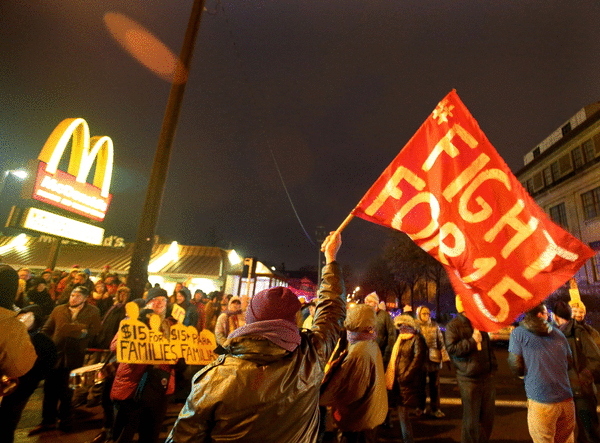
When the Minneapolis City Council approved a controversial $15 minimum wage in 2017, no one knew what would happen next.
Workers and business owners made dueling predictions of boom or bust that would result from the citywide wage hike. Cities with similar policies were still phasing in the $15 minimum, so it was impossible to say who was right.
Nearly a decade later, businesses in Minneapolis and St. Paul — which passed its own similar law in 2018 — say they’re stretched thinner than ever, and both cities have lost thousands of jobs.
Pressure on the hospitality industry is particularly acute. Restaurants and other leisure-related businesses say shrinking margins have left them less able to weather economic shocks, such as the federal immigration crackdown that forced many to temporarily close this winter.
The Federal Reserve Bank of Minneapolis, which has studied the effects of the $15 minimum wage in Minneapolis since 2018, recently reported minimum wage policies have resulted in higher hourly pay but fewer available hours and positions. That has meant lower earnings: Between 2017 and 2021, the average decline in wage earnings across all industries was 1% in Minneapolis and about 2% in St. Paul. The research controlled for the effects of the COVID-19 pandemic and unrest after George Floyd’s murder in 2020.
“There are these huge trade-offs,” said Anusha Nath, senior research economist with the Minneapolis Fed. “There are some workers who are benefiting, but there are a large amount of workers who are losing jobs and are not able to find new jobs. So the question is, what do you do?”
In Chicago and Washington, D.C., city leaders have put in place a lower minimum wage for tipped workers. In Seattle, where the minimum now tops $20 an hour, the city has left the pay scale as-is — and businesses have reduced labor costs in other ways, including by cutting jobs, said Jacob Vigdor, a University of Washington professor who’s studied that city’s minimum wage law.
In Minneapolis, the minimum wage rose from $9.50 an hour to $10 six months after the law passed and then ticked up in stages. It reached $15 for all employers in 2024.
The Minneapolis Fed research found rising labor costs have hit restaurants especially hard. The number of jobs at full-service restaurants in Minneapolis fell nearly 36% between 2018 and 2023 and nearly 20% in St. Paul.
According to the Fed researchers, Minneapolis lost 5,425 jobs and St. Paul lost 3,797 between 2017 and 2021 due to the minimum wage increase.
St. Paul started seeing the impact before its policy took effect, which researchers attributed to business owners gearing up for the change. Employers with six or more employees now pay at least $15 an hour in St. Paul, while those with fewer employees pay $13.25, about 16% higher than the state minimum of $11.41.
In its latest annual report, Hospitality Minnesota zeroed in on the minimum wage and other local and state policies, saying they’re pushing the industry to the brink of collapse.
“Cities with higher regulations are losing jobs and businesses at a faster rate,” said Angie Whitcomb, Hospitality Minnesota’s president and CEO. “So if you look at Minneapolis and St. Paul ... and the number of jobs that they’ve lost since increasing their minimum wage higher than that of the state, I would say it was not an effective tactic for economic development.”
Minneapolis-based First Avenue Productions, parent of the celebrated downtown club and other Twin Cities venues, was able for a time to manage rising costs as the minimum wage rose.
“It was really tough,” said General Manager Nate Kranz, “but for a while, it was navigable.
“But the reality is, it was really built on a really fragile foundation. And the moment that anything in this economy changed and it stopped going up ... bam. "
Like many businesses, First Avenue’s challenges have compounded over the years since the minimum wage began to rise.
Some challenges, like the pandemic, were widespread — and drew a government lifeline. Others, like declining alcohol sales, are industry-specific. Still others, like the heavier tax burden for downtown businesses, are location-specific.
“Our national friends are not having the issues that we’re having being located in these cities here and now,” CEO Dayna Frank said.
Workers are struggling, too
Minimum-wage workers are also grappling with challenges facing their industries, in addition to the rising cost of living. In Minneapolis, the median annual household income is more than $80,000; a full-time worker earning the city’s $16.37 minimum wage makes less than half that amount, about $34,000
Governments pay more for programs such as unemployment insurance and food stamps when times are bad, and implement policies like minimum wage increases when times are good, said Kathryn Edwards, an independent economic policy consultant.
“The point of the minimum wage is not to keep a recession from never happening in Minnesota,” she said. “As the economy is slowing down, like it is right now, it’s really hard to maintain a sense of why did we do these things in the first place?
“Hopefully, it won’t take additional economic destruction and pain to remind people why you had these policies at all.”
Sheli Stein advocated for the $15 minimum wage in Minneapolis and St. Paul and is now director of the Restaurant Opportunities Center of Minnesota. She said blaming business woes on policies that benefit workers is “a tired trope.”
Many employees earning the higher minimum wage still struggle, she said, and others are fighting to get their employers to simply follow the law.
“Every time, in my entire life, workers have asked for what they deserve or fought for improvements for workers … the industry has responded by saying, ‘This is going to ruin us, and this will be catastrophic,’ ” Stein said.
Vigdor, the University of Washington professor, said Seattle hasn’t seen widespread business closures. As in the Twin Cities, he said, some businesses are paying more than minimum wage to compete for workers.
Josh Monson, a full-time employee at Next Chapter Booksellers in St. Paul, started about six months ago at $19 an hour and soon got a raise. In his previous job at Barnes and Noble in Woodbury, Minnesota — where the state minimum wage law applies — his hourly pay rose from about $11 in 2018 to $18 in 2025.
Monson, 30, now makes $21.50 an hour without benefits, which he said is likely the most he can expect in the bookselling business.
“I’m not rich; I’m still not making a lot of money here,” he said. “But that was certainly like, oh, I don’t have to worry as much about going out to dinner with friends occasionally, about where money’s going to come from for car repairs or living in a reasonable apartment with my partner; that all is much more manageable.”
Striking a balance
Minneapolis and St. Paul each have one City Council member still in office who voted for the $15 minimum wage.
Minneapolis City Council Member Linea Palmisano and St. Paul City Council President Rebecca Noecker take a similar view that the cities can support both workers and businesses.
Last year, St. Paul implemented a wage theft ordinance that gives the city power to penalize employers that withhold pay, Noecker noted, and city leaders are also working to eliminate red tape for businesses.
“We can create an environment that is friendly to small businesses while also ensuring that employees, minimum-wage workers, are protected,” Palmisano said. “But that requires balancing what sometimes feels like competing interests.”
Many small-business owners say they don’t object to policies that benefit workers, but they say mounting costs mean they may not be able to stay open to employ anyone.
Cristian de Leon, who co-owns the El Sazon restaurants in Minneapolis, Eagan and Stillwater with his wife, Karen, said they understand the higher minimum wage. A dishwasher, for example, “cannot make less than 16, 17 bucks, otherwise that’s impossible for him to live,” de Leon said.
At the same time, he said, payroll is “a huge chunk of the revenue.” And with fewer customers, rising costs and the lingering effects of Operation Metro Surge, “I don’t think we can survive, to be honest,” de Leon said.
First Avenue isn’t about to go dark — an 8,000-capacity amphitheater the company will manage with the Minnesota Orchestra broke ground May 4. But Frank said the number of shows it puts on has been cut by 15% to 18%.
“We always wanted to be open every single weekend,” she said. “But we can’t afford to just keep our doors open because it’s the right thing to do.”
©2026 The Minnesota Star Tribune. Visit at startribune.com. Distributed by Tribune Content Agency, LLC.








Comments