Federal judge Tom Ludington sentenced in 'super drunk' driving case
Published in News & Features
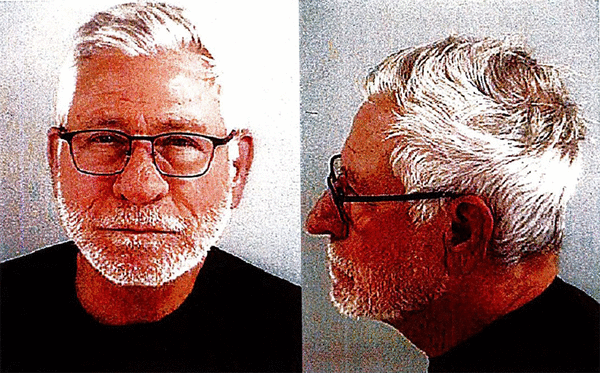
DETROIT — U.S. District Judge Thomas Ludington was sentenced to six months' probation Wednesday for drunk driving, capping a rare criminal case against a federal judge whose intoxicated, belligerent and slurring behavior during an October arrest has sparked an investigation into his conduct.
He was sentenced by 90th District Judge Angela Lasher seven months after police say a witness called 911 saying they watched the judge crash into two signs along a curved road in Springvale Township, east of Petoskey, on Oct. 3.
He was considered legally "super drunk" because he registered a 0.27% blood-alcohol level ― more than three times the 0.08% legal limit — and Ludington continued hearing cases for four months until after The Detroit News revealed the judge's arrest.
Ludington pleaded no contest to one misdemeanor count of operating while intoxicated in exchange for the dismissal of a more serious super drunk charge. Ludington is not expected to return to the federal bench in Bay City immediately amid an investigation by the 6th U.S. Circuit Court of Appeals prompted by a misconduct complaint against him filed by a judicial watchdog group.
“I would like to say I am disappointed in myself for having to be in front of you this morning,” Ludington told the judge. “I am particularly thankful that there were no injuries. I apologize to you but I also apologize to all the other drivers I shared the road with. This will not happen again.”
Ludington also was ordered to undergo twice-weekly alcohol testing and pay fines and court costs.
“This court also believes judges should be held to a higher standard,” Lasher told Ludington. “We have an obligation…to abide by the law and to act in a way that…does not endanger others and endanger the public.
“I am very disturbed by the information I have received in court about what happened here,” she added.
Ludington, 72, took voluntary paid leave from his $249,900-a-year lifetime appointment in February and approximately 70 cases assigned to the judge have been transferred to colleagues.
A nonpartisan nonprofit group, Fix the Court, is calling for an investigation into Ludington's conduct. The organization, which advocates for more openness and accountability within the federal court system, filed a misconduct complaint against Ludington in February. An investigation by the 6th U.S. Circuit Court of Appeals is underway and Ludington has hired Lake Orion lawyer Kenneth Mogill, who specializes in professional ethics matters, to address potential disciplinary matters. Mogill declined comment Wednesday.
"Of course there should be an investigation into whether the Oct. 3 incident was a one-time event or if Judge Ludington has a drinking habit that interferes with his work," said Fix the Court Executive Director Gabe Roth.
"One could argue that a one-time event does not constitute grounds for impeachment, provided that Ludington receives proper counseling and regularly checks in with the chief judge of the district about his health," he added. "If we learn that the Oct. 3 incident was part of a pattern, I don't see how Ludington could remain on the bench."
Ludington faced up to 93 days in jail after pleading no contest, which is treated the same as a guilty plea at sentencing. In Michigan, it is illegal to drive with a blood-alcohol content of .08 or higher and the state considers 0.17 or higher as super drunk.
The super drunk crime that was dismissed also is a misdemeanor but carries stiffer penalties of up to 180 days in jail and a one-year license suspension.
The normal sentence for a first-time offender convicted of operating while intoxicated is a combination of fines, court costs, community service and probation with monitoring for alcohol and drug use for up to two years, said Romulus criminal defense lawyer William Maze, who specializes in drunk driving cases.
Ludington has denied drinking alcohol Oct. 3 despite failing numerous field sobriety tests, has raised questions about how the alcohol got into his system and whether he was drugged.
“We are troubled that there was no alcohol found in the vehicle and no record of any alcohol purchase or consumption along his two-hour travel route,” Ludington's lawyer, Jonathan Steffy, said in a statement last month.
Ludington denied drinking when questioned by a Michigan State Police trooper during the traffic stop, east of the judge's $2.7 million vacation home.
"So, I want you to be honest with me. Tell me how much you had to drink today," the trooper told the judge during a roadside interview at Bill's Farm Market east of Petoskey.
"Seriously, I don't think I had anything," the judge said.
"Where are you coming from?" a Michigan State Police trooper asks Ludington
"Umm," Ludington says, "federal court in Bay City, Michigan."
"In Bay City?" the trooper asks. "So you've driven up all the way up from Bay City?"
"Yep," the judge says.
The accident happened around 7:08 p.m. on Oct, 3, about 154 miles northwest of federal court in Bay City, a drive that would take about two hours and 15 minutes under normal conditions.
Ludington, who appeared to have urinated on himself during the incident, told troopers he left Bay City at 4 p.m., which was about three hours before the accident.
"Did you make any stops along the way?" one trooper asked the judge.
Ludington paused before answering.
"Nnnnnnoo," Ludington said, slowly pronouncing the word.
People can register an extremely high blood-alcohol level in a reasonably short period of time but if you take too much too fast, “the body rejects it, you throw up,” Maze told The News.
“If you really wanted to drink with a purpose, you could get to .27% in under three hours but, normally, to get to .27 requires long sustained drinking,” Maze told The News.
Based on the timeline provided by Michigan State Police, it is unclear whether Ludington drank in Bay City that day, or along the route to Petoskey, Maze said.
“My suspicion is he’s not telling everything," Maze said.
Federal court records show Ludington handled three cases the day of the crash. But none appeared to require Ludington to leave his private chambers and preside over matters in open court in downtown Bay City. Instead, his work day included signing orders dismissing three civil cases, according to a court database.
Ludington could face additional punishment.
The Fix the Court complaint was filed with Jeffrey Sutton, chief judge of the 6th U.S. Circuit Court of Appeals in Cincinnati. It says Ludington meets the grounds for admonishment, and possibly a recommendation for retirement under federal law, or worse, and he should be disciplined by Sutton and a council that oversees judicial conduct.
Federal judges can be disciplined if someone files a complaint about judicial misconduct, including ethical violations. If the allegations are reasonably disputed, the complaint can be referred to a committee of federal district and appellate judges, who have the power to temporarily suspend case assignments, provide informal counseling and issue a censure or reprimand.
Federal judges also can be impeached and removed from the job by a majority of the U.S. House of Representatives and a two-thirds majority of the U.S. Senate.
Under the Constitution, a judge may be removed only for “high crimes and misdemeanors.” Fifteen judges have been impeached, and eight judges have been convicted and removed from office, according to the Federal Judicial Center.
Only a few federal judges nationwide have been charged with drunken driving in recent years or had problems involving alcohol.
In 2019, Kathryn Vratil, a federal judge in Kansas, was arrested and accused of driving under the influence and improper driving. The outcome of her case is unclear, according to Kansas court records. Two years earlier, in September 2017, records showed U.S. District Judge Patricia Minaldi took medical leave for treatment of severe alcoholism more than seven months after court officials in Louisiana received a complaint questioning her ability to serve on the bench.
Nominated by Republican President George W. Bush and commissioned to a lifetime appointment in 2006, Ludington has a reputation for being one of the most courteous judges among the federal jurists in the eastern half of Michigan — but arguably the toughest when it comes to sentencing and treating convicted criminals.
Ludington drew attention during the first few years of the COVID-19 pandemic for rejecting requests from all of the more than 40 inmates who sought compassionate release as Federal Bureau of Prisons officials struggled to contain the spread of the virus.
The judge has handled high-profile cases in recent years, most notably the prosecution of a group of wealthy businessmen convicted of cheating Michigan taxpayers. In late November, more than a month after the car crash, Ludington sentenced three businessmen from state contractor Surveying Solutions Inc. to one year in federal prison for their roles in the $15.6 million scandal.
-----------
©2026 www.detroitnews.com. Visit at detroitnews.com. Distributed by Tribune Content Agency, LLC.






Comments