Writer Julie Schumacher on women, hockey and serial killers
Published in Books News
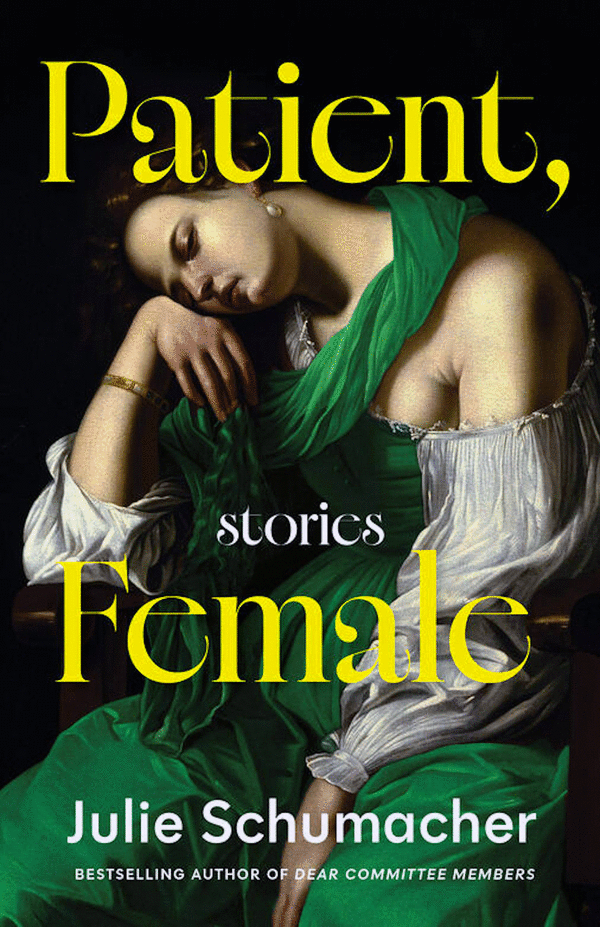
ST. PAUL, Minn. -- It’s no coincidence that all of the protagonists of the 13 stories in Julie Schumacher’s collection, “Patient, Female,” are women.
The St. Paul writer and University of Minnesota professor of creative writing and literature hit bestseller lists with three novels about Jason Fitger, a cranky professor of creative writing and literature: “Dear Committee Members,” “The Shakespeare Requirement” and “The English Experience.” “Committee Members” earned her the prestigious Thurber Prize for American Humor. But, after that trio, she was ready to get her creation out of her brain.
“Fitger took up a lot of real estate in my head. And I thought, ‘I need to start writing about women,’” said Schumacher, 67, sipping a Sprite at St. Paul’s Day by Day Cafe.
The result is the wry, moving “Patient, Female.” Written over the course of 20 years, its characters include a girl who volunteers at a nursing home where residents teach her to play bridge, a woman named Terry whose failed-to-launch brother Frank is not helping her figure out what to do with their late mother’s remains, middle-aged women who form a field hockey team and, in the title tale, a woman who makes a living instructing (and being a mock patient for) gynecology students.
They’re a varied bunch of characters, united by their author’s evident affection for them:
A: That’s typically where my mind goes. Fitger was an anomaly, but he took over for a while. That was not envisioned as a trilogy at all. It was really an exercise: Could I write a book as a series of reference letters? And then I fell in love the with the guy. He was a terrible jerk, but I loved him.
A: I need to like them, even if they’re not pleasant or kind. I was just talking to a student who is beginning to write a novel about a character who has done something awful. The student was saying, “I’m not sure how to write from that awful point of view,” and I said, “You have to find them sympathetic in some way, even if you would not want to meet that person in real life.” Even a serial killer. “Silence of the Lambs” — that guy must be fascinating somehow.
A: Maybe Terry and Frank. She’s so angry. And Frank is so awful, but I also love Frank, and Terry loves Frank, even though he’s so annoying. He’s ridiculous. There were moments where he thinks he may be a dad but nothing is going to work out and clearly he’s not going to be a model parent. But the momentary yearning he experiences, I can identify with that.
A: I have a sense of shape early on. I started writing poetry when I was twentysomething. I was a terrible poet. I was writing tiny stories, cut randomly into lines. I didn’t get how to make a poem. But, periodically, an idea will come in to my head and I think, “That would be a good poem.” It’s not the right shape of a story or a novel so I have to think, “Well, forget it. I can give it to somebody else but I can’t do it.”
A: I played lacrosse into my late 40s. Worse and worse every year, but I always loved being on a team. That’s where that story came from. Some of these are based on little pieces of my life. I never worked in a nursing home, but I was a candy striper, filling water jugs.
A: Yes, these women are not patient. But one of them is a patient.
A: I think on the surface we appear more patient than men, perhaps. These characters, mostly female and especially the ones of a certain age, have been raised to be gentle and kind, etc., but some of them are really pissed off. That’s one reason, when Milkweed showed me this cover, I instantly loved it. Mary Speaker [Milkweed Editions’ creative director] said to me, “I imagine this woman as someone who if you woke her up, would be roaring mad.”
A: On the surface, yes. [She chuckles.] That was the fun of writing Jason Fitger. He can be blindingly angry and stamping around, which I don’t tend to do. People ask why I made Fitger a man and it’s that I think women couldn’t get away with that.
A: I hope not. I don’t think I was ever considered very funny before that. It’s weird. Laurie Hertzel wrote, “funniest woman in America” and I was like, “Really?” My husband [political scientist Larry Jacobs] was looking at me like, “You?” To me, most things that are funny also aim for sadness. They have difficulties in them. But I can’t tell a joke to save my life.
____
Patient, Female
By: Julie Schumacher.
Publisher: Milkweed Editions, 250 pages.
©2026 The Minnesota Star Tribune. Visit at startribune.com. Distributed by Tribune Content Agency, LLC.










Comments