Coffee's 'fourth wave' rides into Bay Area with Brewbird's high-tech, single-serve machine
Published in Business News
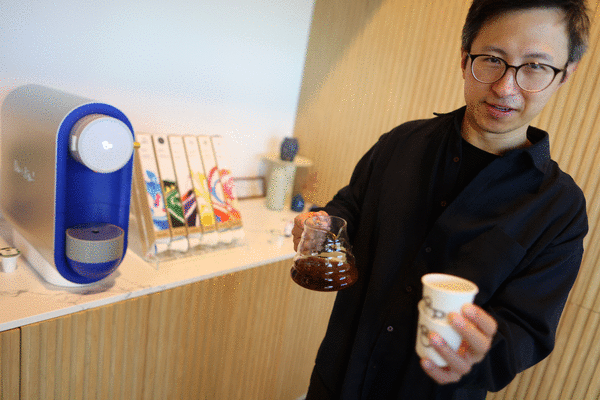
SAN CARLOS, California — Mickey Du was wandering through San Francisco’s Hayes Valley during a college break when he noticed some commotion in a dead-end alley. Curious, he moved closer, finding himself in front of a rolled up garage door with a barista inside making freshly-roasted coffee.
On that morning in 2005, he drank a perfect cup of coffee from local roaster Blue Bottle’s first brick and mortar kiosk. He had unwittingly stumbled into the “third wave” of the coffee industry that was less commodity and more art form.
“The flavor explosion blew my mind,” Du said. “It made me realize what was possible.”
That meant, 20 years later, joining the “fourth wave,” reinventing single-serve coffee and raising $32 million in Series A funding along the way. Combining robotics and engineering with a coffee fiend mentality, Du invented his “Brewbird” smart coffee machine that brings the “perfect pour-over” from local specialty roasters into the office break room — all in a compostable pod. The key? Filling the pods with whole beans that are ground inside the Keurig-like machine for each cup. Using a QR code on each pod to calibrate the coarseness of the grind and measurement of the water, a hot cup is delivered in 60 seconds.
Brewbird sources coffee beans from 14 local roasters, from Verve Coffee Roasters in Santa Cruz, California, to Mother Tongue in Oakland. The machines are so expensive — about $10,000 each — they are marketed only to corporate offices for now. About 30 companies have them, including Meta, LinkedIn, Gap, Palo Alto Networks, SAP, Sephora and the Wilson Sonsini law firm.
In the meantime, one has to ask: in a world where many employees prefer to work from home, could a perfect cup of coffee lure them back to the office?
In an interview from his San Carlos headquarters, edited for length and clarity, Du started by selecting a pod from a local roaster:
Q: I’ll have what you’re having.
A: Because you guys are the San Jose Mercury News, we should try a local San Jose roaster — Academic Coffee. This is a light roast that’s going to be a little more delicate, a little more fruity and floral.
Q: Mmmm. So how does this thing work?
A: The machine reads a QR code. It’s understanding what type of coffee is in here, how much coffee, whether it’s 19.1 or 19.2 grams, how fresh it is, and then using all those parameters to come up with the right recipe — how we grind, how we brew, how we heat the precise amount of water to the right temperature to deliver you that perfect cup every single time. The moment you grind coffee, you lose 95% to 99% of that flavor profile within just 10 to 20 minutes. It’s so important that we brought a system together that combines the convenience that people want with the quality that today they can only maybe access if they go to a really great roaster like Academic in San Jose, or take a lot of time to invest in a lot of self training.
Q: How would you describe a perfect cup of coffee?
A: It really depends. You want to be using a different recipe for a dark roast versus a light roast, versus a light roast with particular flavor profiles. That’s what we do automatically in our machine, so you don’t have to worry about it, and you know that you’re getting perfectly extracted coffee every single time.
Q: What’s so special about the Bay Area’s coffee culture?
A: The roots of it are because the Port of Oakland is one of the biggest places that imports green coffee beans internationally. So it’s been a Cambrian explosion for really great coffee to find its footing here in the Bay Area. And I think that’s what’s led to the Bay Area being such an experimental hotbed for incredible roasters that are really pushing boundaries for this industry forward.
Q: How would you describe the four waves of the coffee industry?
A: The first wave was Folgers and Maxwell House just bringing coffee as a category into the world. The second wave was Starbucks and Peet’s bringing it into the real world. Third wave is coffee as craft and terroir (like wine.) Fourth wave is the same craft and terroir, engineered for consistency and impact (data, automation, more scalable.)
Q: How did you get local roasters on board?
A: The first reaction was universally skepticism, because to them, as a specialty roaster, quality and craft is so sacred. And so they’re like, ‘Oh, a system that can brew really great coffee in a machine. Yeah, right.’ But then when they tasted the coffee, it very quickly evolved from skepticism to wow.
Q: Can’t you do that with a bag of coffee beans you grind at home?
A: You could, but it takes time. It takes training, and you’re not going to get it perfect every single time. There are all those variables that matter a lot because coffee is so sensitive.
Q: What challenges did you face to please consumers?
A: We need to ensure freshly roasted beans. We need to ensure that we have a machine that can do the work of freshly grinding and freshly brewing it on demand. And we needed to ensure that it happens really quickly, because people don’t have the patience. If you have to wait four to five minutes like it takes in a cafe, that’s not good enough in this world.
Q: How far have you traveled for a great cup of coffee?
A: To this day when I travel, I will seek out really unique cafes. I was in Amsterdam a couple weeks ago and went by this incredible local roaster called Dak, and this is a coffee that I brought back that has tasting notes of, I kid you not, bubble gum.
Q: How did you convince Sequoia Capital, Kyber Knight, the former CEO of Peet’s Coffee and other big venture capital firms to invest in Brewbird?
A: Coffee is one of the largest markets that has yet to be disrupted by technology. Coffee is a half-trillion dollar market. It’s very large. There’s a trillion cups of coffee being served every single year, and we think we can put a meaningful dent in transforming a lot of those cups from bad cups to good cups.
Q: What’s your competition?
A: There are no other pods that have whole beans, which only takes one touch to be able to operate. There are whole beans in consumer pods, but you have to do a lot of the manual work yourselves.
Q: Can a good cup of coffee lure workers back to the office?
A: Brewbird has actually driven strong return to office with an upgraded workplace and employee experience, which sounds crazy. And our own customers have told us exactly that — they can see the badge swipe data on their own employees. One customer in particular has told us they saw so much more traffic coming to this one location where our machine was installed. They started with two machines. They have 43.
Q: A coffee pot for $10,000, though? That’s a lot. Where are you taking the business from here?
A: We’re on a path to continue to lower the cost and make it even more accessible for everyone, everywhere. We’re going to start offering a way to have companies outside the Bay Area start to be able to access it in just over six months from now, and eventually the home consumer at an even lower price point.
Q: How many cups of coffee do you drink a day?
A: Too many.
©2026 MediaNews Group, Inc. Visit at mercurynews.com. Distributed by Tribune Content Agency, LLC.




Comments