Escondido has some of San Diego County's priciest water. Avocado growers have waited a decade for a lifeline
Published in Business News
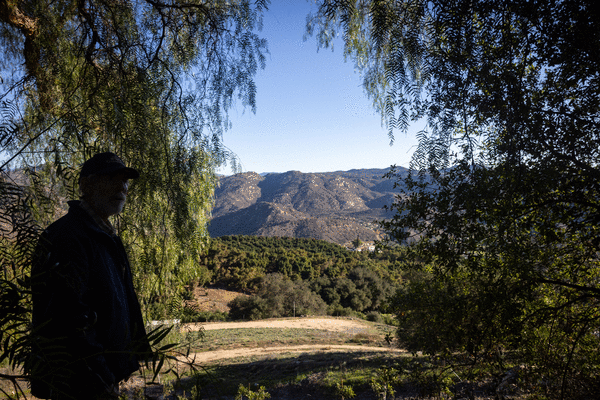
SAN DIEGO COUNTY, California — Burnet Wohlford’s family built Escondido’s water supply.
More than a century ago, his great-grandfather, Alvin, directed water to the area from the San Luis Rey River along a rock and brush canal. It’s a legacy built into the landscape, the dammed reservoir northeast of town bearing the family’s name.
But all these years later, the water system Wohlford’s family helped build is the very thing making life harder for him.
Wohlford owns his family’s avocado and citrus grove on the outskirts of Escondido, a patrimony passed down to him through the generations. But for him and other avocado growers in the city, one cost can eat into their budget more than any other — water.
“This ranch hasn’t made a profit in probably five or six years,” Wohlford said one morning as traffic on Valley Center Road roared by the edge of his grove.
Escondido and surrounding environs are the center of the San Diego region’s avocado industry. The cities and towns of the avocado belt, especially Escondido, also have some of the priciest water in San Diego County, a region notorious for its high water costs.
For growers of a water-intensive crop like avocados, those high costs are exceptionally burdensome. On average, 60% of operating costs for Escondido avocado groves go just to water, according to a 2024 report from the California Avocado Commission.
“It’s been a struggle,” Wohlford said. “I’m very very fortunate that my ancestor bought property. If I was making payments on the property or on my mortgage, boy, that’d be tough.”
Of the 22 water utilities connected to the San Diego County Water Authority, Escondido has the second-highest average monthly cost per person trailing only Del Mar, according to a report last year from the Policy and Innovation Center, a local think tank.
Escondido’s volumetric water rate — how much customers pay for the water itself, not other fixed costs that get built into a water bill — is among the region’s highest, too. Only three other districts — San Diego, Carlsbad and Encinitas’ San Dieguito Water District — are more expensive, according to a report last year commissioned by the Local Agency Formation Commission, or LAFCO.
Those high rates prompted a major change for the county water authority nearly three years ago, when two other water districts in the heart of avocado country — Fallbrook and Rainbow — split from it to join the Eastern Municipal Water District in Riverside County instead.
For Fallbrook farmers, monthly water bills have since fallen by 25%, said district spokesperson Noelle Denke. But after the two agencies’ departure, the county water authority had to recoup the cost of losing sales to those districts by raising rates for customers. The split caused monthly water bills to raise anywhere between $2 to $18, depending on a customer’s location.
Escondido water officials have no plans to secede. But like the districts that did, they also blame their high costs on the county water authority, which over-built the region’s water supply with agreements that require it to buy more water than it needs. The county water authority still has to cover its fixed costs — and that gets passed on to customers.
But in North County, many other factors influence water prices in the avocado groves.
Servicing a mountainous areas like Escondido drives up costs, as an expensive network of pipes and pump stations is needed to move water up and down considerable inclines, said Kyle Morgan, the city’s acting director of utilities and wastewater.
Old infrastructure doesn’t help, either. In some areas, Escondido still relies on infrastructure from more than a hundred years ago, Morgan said. Historically, the city took a “reactive” approach to its water infrastructure, opting to fix aging infrastructure instead of replacing it, he added.
That dynamic points to a crucial balancing act water officials have to make when deciding how to invest taxpayer dollars: If water rates are kept too low, that denies money to necessary, big-ticket infrastructure upgrades. And in the long term, deferring maintenance and upgrades only make inevitable rate hikes even worse.
“You can sit there and not raise rates and be the public hero, but you’re eventually going to have a massive jump in rates,” Morgan said. “We’re not growing grass; we’re running very complex equipment that’s expensive.”
A shrinking industry
As a young man, Eddie Grangetto didn’t see himself as an avocado grower. But he grew up immersed in his family’s avocado business, which included a small agricultural supply company and a grove where there’s now a Costco in San Marcos.
When Grangetto finally came around to joining the family business, he first saw it as a way to make a living. But in his years as an avocado grower, he’s come to cherish the crop, seeing it as an important legacy of the region’s rural economy and vast open spaces.
“What we bring to Escondido goes way beyond just the business part of it,” Grangetto said. “We want to do our part, but we can’t do it if we can’t be sustainable.”
San Diego County accounts for about a quarter of California’s overall avocado acreage, contributing $148 million in economic output and employing thousands of people as of 2024, according to the state avocado commission.
Escondido accounted for about a tenth of the county’s output and employment. But from 2014 to 2022, the area lost about a quarter of its avocado acreage, falling from about 2,000 acres to 1,500, according to the commission.
Extreme heat and rising water costs have fueled that trend.
In the late 2010s, a series of heat waves hit north inland San Diego County, with temperatures hitting 112 degrees in 2018 and 115 just two years later. Avocado trees struggle above 100 degrees, and after that kind of heat, a tree will drop its fruit once temperatures moderate, said Enrico Ferro, an avocado grower in Valley Center who is president of the community’s water district.
Meanwhile, certain agricultural water rates in Escondido more than doubled.
In 2016, agricultural water customers that use the county water authority’s special rate for farmers paid $3.31 for every 1,000 gallons of water they use. Today, that rate is $7.82.
By comparison, Fallbrook growers pay $6.12 for every 1,000 gallons of water. Farther north in Ventura County, another major avocado region, growers in the Casitas Municipal Water District pay $2.40 per 1,000 gallons.
“Those extreme weather events could knock off half or three-quarters or even all of your crops,” Ferro said. “If you’re investing all your money every year in just water for your crop, and it ends up on the ground, that could take you out.”
That’s prevented San Diego County’s growers from reaping the benefits of booming appetites for avocados. The average American went from eating about 2 pounds every year in 2001 to 9 pounds today, per the commission.
In that time, imports from cheaper markets like Mexico have soared as domestic production has stagnated.
The U.S. produces anywhere from about 150,000 to 200,000 tons of avocados a year, similar to production two decades ago. Meanwhile, Mexican imports have soared from about 60,000 tons in 2002 to 1 million tons in 2024, according to the U.S. Department of Agriculture.
“Mexico owns this market now,” said John Burr, an avocado grower in Escondido. “We’re not benefiting. We’re hanging on, and it should be viable for all.”
Even as Mexican avocados flooded the U.S. market, water costs are the main thing holding back domestic production in many areas, said James Sayre, an agricultural economist at the University of California Davis. Acreage is falling in San Diego County, but in other California regions with cheaper water, like Ventura and San Luis Obispo counties, it’s growing, he noted.
“If you look at the trend for California, you might say clearly it’s been hit by Mexico,” Sayre said. “But I don’t think that’s true. It’s that water in San Diego is just really, really expensive.”
A lifeline long delayed
On water costs, the interests of growers and Escondido city officials have converged: Growers need cheaper water, and the city needs to upgrade its strained and aging water system at the lowest possible cost.
Escondido relies on an outfall pipe that transports the city’s runoff to the ocean via Escondido creek. But growth has pushed the outfall pipe to near capacity, and replacing it is estimated to cost $1 billion.
So in the mid-2010s, avocado growers lobbied the city to opt for an alternative that would benefit them both — recycling much of that runoff to irrigate farms. A water-recycling facility would ease the strain on the outfall pipe and help service avocado growers with cheaper water.
Escondido’s MFRO facility — short for membrane filtration reverse osmosis — is capable of processing up to 2 million gallons of water a day. It’s different from other recycled-water plants, like Pure Water in San Diego: Water processed in Escondido’s new facility isn’t fit for human consumption, but it’s still good for irrigating avocados.
“There’s a community benefit to providing a high-quality water that the trees love for their crops,” said Morgan, the Escondido utilities and wastewater official.
But actually getting this lifeline to growers has been slow going. After approving the facility in 2016, Escondido estimated it would cost $33 million. Growers would get the water by 2019, city officials said at the time.
That still hasn’t happened. Lawsuits and environmental review delayed construction for years. By the time building was complete in 2023, the final cost had ballooned to $65 million.
A $6 million distribution system to carry water to avocado groves is also still delayed, with no timeline for going online. Part of the system failed during final testing recently and is currently being redesigned, Morgan said.
Once growers get connected to the city’s new filtration facility, they’ll pay just $3.08 per 1,000 gallons for the recycled water. For now, those set to get recycled water have been paying a tentative interim rate of $3.20.
Even with the delays, the growers are understanding.
“I feel bad for the city,” Wohlford said. “Obviously we’re all frustrated, but they’ve had a bad go of it.”
From his grove on a hillside overlooking the San Pasqual Valley, Grangetto has seen the creep of housing development encroach upon the bucolic views he’s loved for so long. He has a perfect view from the southern end of his grove, where a tank that will soon hold recycled water now sits empty.
Like other growers, Grangetto’s attitude toward the MFRO plant delays is that it’s better late than never. In the end, it’s “probably going to save” the city’s growers.
“Once this land is gone, once it becomes a gated community, once it becomes an asphalt jungle, it’s never going to go back,” he said.
©2026 The San Diego Union-Tribune. Visit sandiegouniontribune.com. Distributed by Tribune Content Agency, LLC.










Comments