Instagram, YouTube found liable in lawsuit alleging they were designed to addict kids
Published in Business News
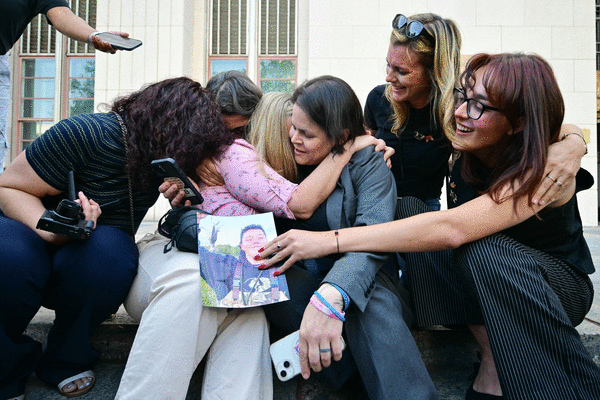
LOS ANGELES — After a grueling seven weeks of court proceedings and more than 40 hours of tense deliberations across nine days in one of the country’s most closely watched civil trials, jurors handed down a landmark decision in Los Angeles Superior Court on Wednesday, finding Instagram and YouTube responsible for the suffering of a Chico woman who charged the platforms were built to addict young users.
Kaley G.M., the 20-year-old plaintiff, arrived in court just before 10 a.m. wearing the same rose-colored maxi dress she’d donned to testify in February. She remained stoic as the verdict, the $3 million damages award and the decision warranting punitive damages were read out. A companion fought back tears, her chin quivering. Several observers wept silently despite Judge Carolyn B. Kuhl’s repeated warning not to respond.
“We need to have no reaction to the jury’s verdict — no crying out, no reactions, no disturbance,” Kuhl warned. “If there is we will have to have you removed from the courtroom, and we sure don’t want to have to do that.”
Attorneys for Snapchat and TikTok also appeared in court Wednesday morning to hear the decision. The two platforms settled with Kaley out of court for undisclosed sums before the trial.
“We respectfully disagree with the verdict and are evaluating our legal options,” a spokesperson for Instagram’s parent company Meta said.
The verdict arrived less than 24 hours after a New Mexico jury found Meta liable for $375 million in damages related to Atty. Gen. Raúl Torres’ claim it turned Instagram into a “breeding ground” for child predators — a decision the platform has vowed to appeal.
The Los Angeles jury took much longer to deliberate. On Friday, jurors preempted their pizza lunch break to ask Kuhl whether all of them should weigh in on damages, or only those who’d agreed on liability. On Monday they told Kuhl they were struggling to agree about one of the defendants.
Kuhl told the jury to keep trying.
Kaley said she first got hooked on YouTube and Instagram in grade school. Jurors were charged with determining whether the companies acted negligently in designing their products and failed to warn her of the dangers.
Their verdict will echo through thousands of other pending lawsuits, reshaping the legal landscape for some of the world’s most powerful companies. Experts say the payout will likely set the bar for future awards.
It comes on the heels of a Delaware court decision clearing Meta’s insurers of responsibility for damages incurred from “several thousand lawsuits regarding the harm its platforms allegedly cause children” — a ruling that could leave it and other tech titans on the hook for untold future millions.
Until this trial, which began in late January, no suit seeking to hold tech titans responsible for harms to children had ever reached a jury. Many more are now set to follow.
Kaley’s test case was chosen from among scores of suits currently consolidated in California state court. Hundreds more are moving together through the federal system, where the first trial is set for June in San Francisco.
Collectively, the suits seek to prove that harm flowed not from user content but from the design and operation of the platforms themselves.
That’s a critical legal distinction, experts say. Social media companies have so far been protected by a powerful 1996 law called Section 230, which has shielded the apps from responsibility for what happens to children who use it.
Lawyers for Meta and Google argued Kaley’s struggles were the result of her fractious home life and fallout from the COVID pandemic, not social media.
“I don’t think it should have ever gotten to a jury trial,” said Erwin Chemerinsky, dean of the UC Berkeley School of Law and an expert on the 1st Amendment, which also protects the platforms. “All media tries to keep people on [their platform] and coming back.”
Others say social media’s algorithmic ability to capture, cultivate and control attention makes it fundamentally different from teen-friendly romantasy novels, Marvel movies or first-person shooter games.
“These are truly hard and heartbreaking cases,” said Eric J. Segall, a professor at Georgia State College of Law. “They] represent a clash between free speech values and the real harms caused by protecting those companies that engage in free speech amplification for profit.”
“Letting jurors sort all of this out without more guidance is tempting but also risky,” he said.
As deliberations that began March 13 wore on, jurors signaled similar skepticism, asking to see internal Meta documents, and reviewing testimony from a defense expert “in regards to her professional integrity; being the only doctor stating social media was not a contributing factor to KGM’s mental health.”
They appeared to agree on Meta’s culpability by Friday, but labored through Tuesday to hash out a decision for Google, delivering their verdict just after 10 a.m. Wednesday.
“Today, a jury saw the truth and held Meta and Google accountable for designing products that addict and harm children,” said Lexi Hazam, court-appointed co-lead plaintiffs’ counsel in the related federal action. “This verdict sends an unmistakable message that no company is above accountability.”
The outcome will likely transform the already heated debate over social media addiction as a concept, what role apps may play in engineering it, and whether individuals like Kaley can prove they’re afflicted.
The platforms’ attorneys sought to cast doubt on the ailment — emphasizing that there is no formal diagnosis for social media addiction — while also arguing that Kaley had never been treated for it.
“Substitute the words ‘YouTube’ for the word methamphetamine,” attorney Luis Li urged the jury during closing arguments Thursday. “Ask yourselves with your lifetime of experience whether anybody suffering from addiction could say, ‘Yeah, I just kind of lost interest.’”
“She was sitting there for hours without being on her phone,” said Meta attorney Paul W. Schmidt.
YouTube’s team also sought to distance the video-sharing app from Instagram and other social media platforms, saying its functions are fundamentally different.
Kaley’s team called it “a gateway” to her social media addiction.
“YouTube wasn’t a gateway to anything,” Li said. “YouTube was a toy that a child liked and then put down.”
Jurors disagreed, ultimately holding the platform liable, though they split the liability 70-30, weighting heavily to Meta.
Lanier leaned on his down-home Texas folksiness throughout the trial, telling the jury what was on his heart and scribbling with grease pencil on his demonstrative aids. In his direct addresses to the jury, he used a set of wooden baby blocks, stacks of paper, even a hammer and a crate of eggs.
During the punitive phase of the trial late Wednesday morning, he brought out a glass jar filled with 415 peanut M&Ms to represent the $415 billion of stockholder’s equity Google’s parent company Alphabet was valued at in December.
“What are you going to fine them for this?” he probed. “Are you going to fine them a billion?” He plucked a green M&M from the top of the pile. “Two billion?” He pulled out another. “You know a pack of M&Ms has 18 M&Ms in it? You fine them a billion, and they’re not going to notice.”
“The last thing in the world they want you to do is talk about how many M&Ms they’ve got,” the lawyer said, urging jurors to “talk to Meta in Meta money.” “The last thing in the world they want you to do is focus on what it takes to hold them accountable for what they’ve done.”
Conversely, the tech teams relied on slick digital presentations to review evidence and illustrate their arguments.
“Focus on those facts that are at issue in this case,” Schmidt urged the jury during closings. “Not lawyer arguments, not props like a glass of water or a jar of M&Ms, But actual proof in evidence.”
During the punitive phase of the trial, he sought to emphasize that “there wasn’t an intention to do harm” to children, and that it had worked diligently to make its products safer.
The case was the first to get Meta CEO Mark Zuckerberg on the witness stand, where he defended Instagram’s safety record and lamented the difficulty of keeping youngsters off the app.
It also made public tens of thousands of pages of internal documents — documents Lanier argued showed the companies intentionally targeted children, and engineered their products to keep them on the platforms longer.
“These are internal documents that you’re uniquely seeing because you’re the jury that got to sit on this case,” Lanier told the jury during closing arguments on Thursday. “It’s given you exposure that the world hasn’t had.”
Those previously undisclosed materials likely proved critical to the jury’s ultimate verdict, experts said.
“Internal emails here were key — they painted a picture of indifference at Meta,” said Joseph McNally, former Acting U.S. Attorney for the Central District of California and an expert in “technology-related harm.”
The tech titans have already vowed to appeal both the California and New Mexico verdicts, all-but ensuring the issue is ultimately decided by the Supreme Court, experts said.
©2026 Los Angeles Times. Visit at latimes.com. Distributed by Tribune Content Agency, LLC.








Comments