Jury deliberating in Cook County case over Abbott Laboratories' formula for premature babies
Published in Business News
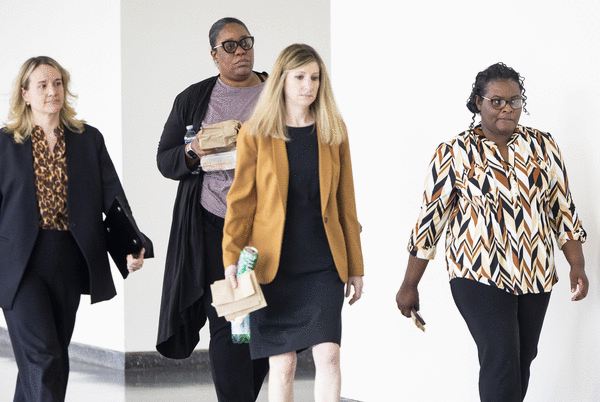
Four babies born at Chicago-area hospitals developed a dangerous intestinal disease because they consumed a special formula for premature infants made by Abbott Laboratories, an attorney for the children’s mothers told a Cook County jury Wednesday, while a lawyer for Abbott argued that the formula did not cause the babies to fall ill.
Attorneys made their closing arguments to the jury Wednesday after a monthlong trial in Cook County Circuit Court in Chicago, involving cases brought by the mothers of the four children against north suburban-based Abbott. The jury began deliberating shortly after closing arguments Wednesday afternoon.
The four Cook County cases — which went to trial together — are being widely watched, with potential implications for both the company and families of babies born prematurely across the country.
Sean Grimsley, an attorney for the mothers, told the jury that they should find Abbott liable and suggested the jury award a total of $52 million in damages partly due to the children’s ongoing medical challenges.
The four lawsuits are among more than 1,700 lawsuits Abbott faces across the country over whether its cow’s milk-based formula for babies born prematurely causes a disease called necrotizing enterocolitis, or NEC, in which tissue lining the intestine becomes inflamed and dies. Research shows that 15% to 40% of infants with the disease die.
They’re the first lawsuits against Abbott over the matter to go to trial in state court in Illinois, and this is only the third time cases against Abbott over the issue have gone to trial at all.
The stakes are high. In the other two trials, which were in Missouri state court, Abbott notched one win and one loss, with a $495 million verdict against the company.
The CEO of Abbott previously suggested the company could pull its formula for preterm infants altogether if Abbott continued to face litigation — a prospect that doctors worry would mean fewer nutritional options for preterm babies.
The four Cook County cases were filed in 2022 by Illinois mothers Antonia Mendez, Casie Thompson, Kara Sharpe and Eboni Williams, whose babies were born before 32 weeks gestation at Chicago-area hospitals between 2012 and 2019.
Two of the babies were born at University of Illinois Hospital, one was born at University of Chicago Medical Center and one was born at what is now Ascension St. Alexius in Hoffman Estates. The babies were all fed a specialized formula offered in hospitals for premature babies called Similac Special Care.
Jurors are being asked to decide whether the formula is unreasonably dangerous for certain preterm babies, whether Abbott failed to adequately warn about the dangers and risks of the formula, and whether Abbott was negligent.
“We’re here because these kids did not have to develop NEC,” said Grimsley, who is a partner at Olson Grimsley. “We’re here because these kids did not have to suffer. We are here because of Abbott.”
He contended that the formula is not safe and should be used only as a last resort for small, premature babies, when mother’s milk and donated breast milk are unavailable. Research shows that formula feeding is associated with higher rates of NEC for premature infants.
“The science is clear,” Grimsley said. “The connection between formula and NEC is clear. … Really, you don’t need to look any further than Abbott’s own internal documents to know that Abbott has long known that its formula causes NEC.”
But Hariklia Karis, a partner with Kirkland & Ellis representing Abbott, maintained the formula did not cause the babies to develop NEC. Though cow’s milk-based formulas for premature infants are associated with higher rates of NEC, that does not mean the formulas cause the disease, she said.
Rather the four children in the cases had a number of other risk factors that led them to develop NEC, Karis said.
“The scientific evidence has shown that these kids were born prematurely, they had a number of other conditions, and, as a result, even without a drop of formula, these kids were going, unfortunately, to develop NEC,” Karis said.
She noted that the formula has been on the market for 45 years, is still used by hospitals and has saved lives. In 2024, a statement was released by the U.S. Food and Drug Administration, the Centers for Disease Control and Prevention and the National Institutes of Health, based on a working group report, that said, “Available evidence supports the hypothesis that it is the absence of human milk — rather than the exposure to formula — that is associated with an increase in the risk of NEC.”
The American Academy of Pediatrics also released a clinical report this year that said preterm infant formula is recommended when a mother’s own milk and donated breast milk are not available.
“There’s no question mother’s milk protects (against NEC) but that doesn’t mean this product is unreasonably dangerous,” Karis said. “… It doesn’t mean this product doesn’t have a place in the NICUs.”
The attorneys offered often differing takes Wednesday on whether the babies in the cases had access to donated breast milk that could have been given instead of formula.
They also gave the jury opposing arguments about whether Abbott should have done more to warn parents about the risk of NEC.
Karis said a warning on the product wouldn’t have made a difference because parents don’t read the labels of formula given in hospitals. Instead, parents rely on doctors’ recommendations, and doctors are well aware of the benefits of mother’s milk, Karis said.
Grimsley called the idea that a warning label wouldn’t have made a difference “absurd,” saying if the mothers had known of the risks of NEC, they would have acted differently.
It’s possible the outcomes of the four cases now at trial could influence the many other, similar cases against Abbott that have also been filed in Cook County Circuit Court.
In addition to the cases in Cook County Circuit Court, hundreds of similar cases have also been filed in federal court in Chicago. Four of those federal cases were chosen as bellwether cases, meaning their outcomes are meant to help guide how all the other cases in federal court in Chicago might proceed, and/or how to settle those cases. So far, three of those federal bellwether cases were thrown out before they went to trial. The fourth is scheduled to go to trial in July.
Abbott is appealing the $495 million verdict reached against it in Missouri state court in 2024. In the other Missouri state court case, in which Abbott and another manufacturer of preterm infant formula, Mead Johnson Nutrition, were found not liable, a St. Louis judge later granted a motion for a new trial citing “errors and misconduct.” Abbott is also appealing that decision.
©2026 Chicago Tribune. Visit at chicagotribune.com. Distributed by Tribune Content Agency, LLC.





Comments