An Amazon-branded plane crashed. It wasn't operated by the company
Published in Business News
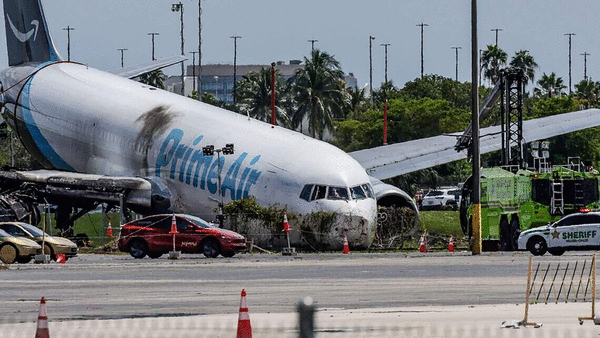
The cargo plane that careened off a runway on Sunday in Miami, killing five people and injuring five others, was emblazoned with Amazon’s Prime Air logo. But the e-commerce giant wasn’t operating the flight.
While Amazon is cooperating with aviation safety investigators working to determine what led the plane to overrun the runway, crashing through fences and into vehicles, the company made it clear in several statements that the cargo airline, 21 Air, was in charge of the flight.
Amazon does not operate its fleet of more than 100 planes, which has grown considerably since the air cargo division launched in 2016. Instead, it relies on the network of at least 13 air cargo companies including 21 Air to run its vast aerial logistics network, an extension of the tech giant's sprawling delivery empire.
Joseph Schwieterman, a professor at DePaul University who has studied Amazon Air, said it’s Amazon’s “standard business practice” to contract services as much as possible.
That model allows Amazon to be more nimble, Schwieterman said. It can add or cut capacity without risking as much financial investment. The company does the same with its ground shipping, as logistics companies contracted by Amazon hire freight and delivery drivers to move goods around the country.
“It allows them to shop for the best deal … also, it hedges their bets,” Schwieterman said. “The downside is that you’re at the whims of your contracts and you can suddenly lose capacity if they jump ship.”
When it comes to aviation, that means, Amazon “relies on the safety record of its contractors,” Schwieterman said.
It's too soon to know what led the plane, a 32-year-old Boeing 767, to overrun the runway, crashing into fences and colliding with two vehicles. The five people who died were inside a van belonging to an airline cleaning company, Professional Ocean Service Corporation.
The National Transportation Safety Board is still investigating the crash, but said Tuesday that the flight crew appeared to attempt a go-around," a common tactic when pilots feel they cannot land the plane safely. Instead, they pull the plane back up, circle and try landing again. Initial investigative information also showed two critical systems meant to slow an aircraft after landing had not deployed, the NTSB said.
21 Air, Amazon and Boeing have all said they are supporting the ongoing investigation and offered condolences to the families of those who died or were injured.
“Our deepest sympathies remain with the families, loved ones, and all those affected by this devastating tragedy,” Amazon spokesperson Kelly Nantel said in a statement Monday.
'Pieces of the puzzle'
The plane that crashed was carrying more than 32,000 pounds of cargo, NTSB chair Jennifer Homendy said Tuesday. Most of that cargo was contact lenses.
Speaking at the second news briefing following the fatal crash, the NTSB’s investigator in charge for this accident, Chihoon Shin, said there was no indication that the plane’s thrust reversers or speed brakes had deployed before the 767 skidded off the end of the Miami runway.
Shin was providing initial data points from the aircraft’s flight data recorder and cautioned it was too soon to determine what those data points indicated and why the thrust reversers and speed brakes had not been deployed.
“Right now, I’m not going to speculate about what should have been,” Shin said. “We have an aircraft performance study; we’re going to do that. Was it normal? Was it not? What was working? What was not? I’m not going to speculate.”
The flight data recorder also showed that about 15 seconds before the end of the aircraft’s recording the plane’s throttle “increased to values consistent with go-around thrust,” Shin said.
In the days since the fatal crash, many aviation safety experts have wondered why the pilots continued to land the aircraft instead of performing a go-around.
NTSB investigators said they had obtained audio from inside the cockpit during the plane’s landing and final moments but did not release the transcript. Investigators plan to interview the two pilots Wednesday to gain a better understanding of what was happening inside and what actions the pilots may have taken.
Shawn Pruchnicki, a professor at Ohio State University, pilot and former accident investigator, said its important to keep in mind that accidents are never the result of one single factor.
“The pilots are playing a big role, but we’re just going to have to wait to see what all of the pieces of the puzzle are.”
Amazon’s network of contractors
Amazon launched its air cargo division in 2016, after a secretive trial run the year prior where it partnered with cargo airline Air Transport Services Group to use leased 767s. The goal was to decrease the time and money spent on shipments and allow Amazon to be less reliant on other cargo conglomerates, like FedEx and UPS.
In the 10 years since, Amazon has grown its fleet significantly, from about 14 aircraft in 2016 to more than 100 in 2026, according to data from aviation analytics firm Cirium.
Most of that growth occurred in 2021, when the fleet reached 95 aircraft, Cirium found. That year, Amazon purchased its first 767s, adding to its existing fleet of leased planes. It purchased 11 used planes, including four from WestJet and seven from Delta.
“Its growth during the pandemic was spectacular,” Schwieterman said. “It emerged from a niche operation to having close to 100 airplanes.”
Amazon Air operates out of at least 28 airport hubs, according to data from logistics consultancy MWPVL International Inc.
The air cargo market has softened since 2021, Schwieterman said, as companies like Amazon opt to rely on trucking for deliveries shorter than 400 miles.
The company has undertaken a massive effort to regionalize its delivery network, focusing on same-day delivery through smaller warehouses in metropolitan areas. Amazon also embarked on a rural delivery network by strategically setting up warehouses in areas that can reach multiple communities in a day. The company has five such warehouses in Washington in Pasco, Elma, Pullman, Moses Lake and East Wenatchee, with another planned for Port Angeles.
To capitalize on its air cargo fleet, Amazon sells space in its largest planes to other companies looking to ship goods. It first offered space to the third-party businesses that sold products on Amazon’s digital marketplace through a program called Fulfillment by Amazon, which allowed vendors to tap into Amazon’s entire delivery network. Now it has expanded that to companies beyond those who sell on its digital store, much like how it now brings Prime membership benefits to other sites.
“They’re really trying to leverage the synergy with their truck and air network,” Schwieterman said. “So if you bring a pallet on the airplane, the trucking network takes it the rest of the way. Very few other companies can do that. FedEx and UPS can, but not even to the same extent. … Amazon’s ground network has just become so vast.”
Amazon often buys equity in the cargo airlines it contracts with.
After Allegiant Travel Co. purchased Amazon Air operator Sun Country Airlines earlier this year, Amazon acquired a stake in Allegiant valued at $17.5 million as of June 30, according to an Amazon regulatory filing. The company has at least 20 cargo planes operated by Allegiant Air, a subsidiary of Allegiant Travel Co., according to data from Cirium.
Amazon also had a stake in Air Transport Services Group, an early operator of Amazon Air, valued at $285.9 million in 2025. Amazon acquired options to buy up to a 19.9% stake in the air cargo company in 2016, according to a regulatory filing. The deal jump-started Amazon Air, with 20 Boeing 767 aircraft scheduled for operations.
The airline has since been dropped from Amazon’s holdings disclosures.
The Miami crash is not likely to materially change Amazon’s air-cargo business, Schwieterman said. It could “put a chill on investments,” particularly if the results of the investigation force changes in Amazon’s fleet or operators.
He pointed to a recent UPS MD-11 crash in Louisville, Ky., that killed three crew members and 12 people on the ground. That crash led safety regulators to ground the plane for months and UPS to accelerate the retirement of its fleet.
At this point, it's too soon to know if Sunday's crash would result in any similar actions.
Either way, Schwieterman said, Amazon’s air cargo “operation is large enough that accidents are a statistical risk, rather than a watershed moment.”
As of this year, Amazon has planes operated by 21 Air, Alaska Air, Allegiant Air, Atlas Air, Cargojet Airways, Quikjet and numerous Air Transport Services subsidiaries.
Amazon’s fleet
Amazon’s fleet is primarily Boeing 767s, but it includes some smaller 737 NGs and, more recently, the larger widebody A330 from Boeing’s European rival Airbus.
It primarily relies on older 767s that first carried passengers and were converted to freighter planes. Earlier this year, it accepted its first production-built 767 freighter, meaning it received the plane straight from the factory, rather than decades into its lifetime.
One of those planes, named Soar, is painted in Amazon’s “classic” Prime Air livery, Raoul Sreenivasan, the vice president of Amazon Transportation Services, posted on LinkedIn.
Two others, named Odyssey and Zenith, will feature Amazon Supply Chain Services on its liveries, a nod to Amazon’s program that offers its fulfillment network to vendors.
Converted 767’s “have long been the backbone of our fleet,” Sreenivasan posted on LinkedIn.
Neither Amazon nor Boeing responded to questions about Amazon’s production-built 767s.
An Amazon cargo plane was involved in a fatal crash in Texas in 2019. In that case, a Boeing 767 operated by Atlas Air, another cargo airline that Amazon contracts with, plunged into a shallow bay as it was descending, killing three crew members on board. Investigators later determined the crash was due to crew error.
The 32-year-old plane that crashed in Miami Sunday first operated as a passenger aircraft for Sobelair, a Belgian charter company, according to Cirium. It was later leased by Vietnam Airlines, Air Europa, Kenya Airways and Norwind Airlines, before it was converted to a cargo plane in 2016, according to Cirium.
Atlas Air operated the aircraft for nearly 10 years. In January 2025, 21 Air took over as operator, according to Cirium.
©2026 The Seattle Times. Visit seattletimes.com. Distributed by Tribune Content Agency, LLC.










Comments