Boeing 737 Max software glitch not a safety risk, FAA says
Published in Business News
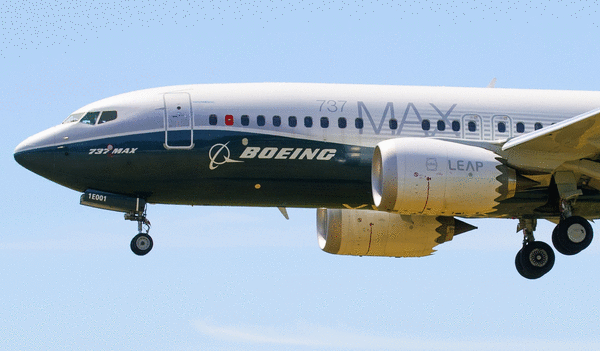
A software glitch that impacts automated flight controls on some Boeing 737 Max aircraft does not present a safety risk, the Federal Aviation Administration said Friday.
The regulator convened a group of safety experts, known as a Corrective Action Review Board, this week to determine if the software issue created an unsafe workload for pilots in certain circumstances.
The software glitch, which only affects Max aircraft using a certain version of the flight software, occurs when a pilot alters the preprogrammed flight path. The glitch causes the aircraft to switch from vertical navigation mode to a simpler level of automation, meaning pilots need to manually perform extra steps for landing on the next approach.
Boeing notified operators of the issue in August and the FAA said Sept. 26 it would study whether the software glitch posed a safety concern.
On Friday, the regulator said its review board had determined there was not a safety risk because “pilots retain full control of the aircraft and the indications to the flight crew are clear and unambiguous.”
“As with any situation, the FAA will consider appropriate action if it receives new information about this issue,” the regulator said in a statement.
The FAA’s determination likely clears the path for Boeing to move forward on two new Max models that have faced years of regulatory delays.
The FAA recently certified Boeing’s Max 7, the smallest Max variant, but the software issue could have complicated deliveries and its entry into service if the FAA had found a safety concern.
The issue similarly would have delayed certification for Boeing’s Max 10, its largest Max variant that the FAA has not yet cleared for passenger flight.
Boeing is working on a software update to permanently address the glitch and is working with airlines to formalize a procedure to reenable automated vertical navigation if the glitch occurs, company spokespeople said this week.
Boeing had expected to roll out a new version of the software, made by GE Aerospace, in 2028 but now may work to accelerate that timeline.
“We will continue to follow the lead of the FAA as our engineers work on the next software update,” a Boeing spokesperson said Friday.
The FAA said Boeing will issue a bulletin to airlines on how to recognize and respond if the software glitch occurs. The regulator will also issue a Special Airworthiness Information Bulletin to U.S. airlines and foreign regulators regarding the issue and Boeing’s message.
John Cox, a pilot and longtime aviation safety expert, said Friday he found the FAA’s determination “reasonable.”
He compared the automated flight controls to a car’s cruise control. If a driver knew that a hard left turn would shut off the system, they wouldn’t necessarily stop using cruise control, they’d just be extra alert of the possible disruption.
“If the pilots know that there is a potential for the autopilot and autothrust to drop out during a missed approach, you can compensate for that,” Cox said. “It’s not unsafe; it's just you need to be aware.”
News of the software glitch immediately raised concern about whether there was any parallel to a faulty software system that caused two fatal Max crashes in 2018 and 2019. In both crashes, the Maneuvering Characteristics Augmentation System, or MCAS, repeatedly forced the plane’s nose down, leaving pilots unable to control the aircraft.
FAA Administrator Bryan Bedford told reporters at a news conference Monday that the two issues were not related. Unlike MCAS, Bedford emphasized, this software issue “doesn’t take control away from the pilots.”
Boeing’s newest Max models have been delayed for years following manufacturing concerns and heightened regulatory scrutiny after the deadly crashes. But Boeing expected it was nearing Max 10 certification; CEO Kelly Ortberg said at a September financial conference that Boeing had completed all flight testing and that the 10 is “coming very shortly.”
That optimism was disrupted this week as analysts waited to hear if the software issue would halt certification progress. Now, with the FAA’s determination, Max 10 certification is likely back on track for this year, analysts wrote in investor notes Friday. Boeing's stock was up about 1% Friday after the FAA's announcement.
The new variants account for about 37% of its total Max backlog, with 254 orders for the Max 7 and 1,535 orders for the Max 10, analysts from RBC Capital wrote in a note to investors this week.
Alaska Airlines, which has several Max 10s on order, said Friday it does not view the software issue as a safety of flight concern."
"Our understanding is that pilots remain in full control of the aircraft, existing procedures provide effective mitigations, and the issue can be safely managed while GE and Boeing develop a permanent software update, a spokesperson said.
©2026 The Seattle Times. Visit seattletimes.com. Distributed by Tribune Content Agency, LLC.








Comments