Lab-grown diamonds are booming. Jewelers are dealing with the fallout
Published in Business News
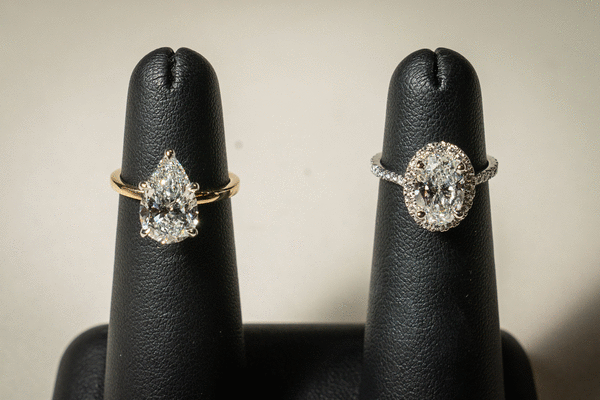
Walk into Henne Jewelers in Pittsburgh's Shadyside neighborhood and you won’t see a single lab-grown diamond.
They aren’t displayed in the showcases. They aren’t advertised. And owner John Henne won’t recommend them to customers.
But if you really want one, Henne will sell it to you — because in recent years he started keeping a stash of them in the back room.
Lab-grown diamonds have become so popular in the past 10 years that even fine jewelers like Henne have little choice but to make them available — even if they prefer not to sell them.
“We have chosen to provide the service of selling lab-grown diamonds to customers who have decided that’s what they want to do,” Henne said.
It’s a sign of how dramatically the diamond business has changed in recent years.
The popularity of lab-grown diamonds has disrupted the economics of the natural diamond industry by hurting the demand for natural diamonds, pushing their prices lower and forcing jewelers to adapt to lab-grown stones in order to survive.
Unlike imitation stones such as cubic zirconia, lab-grown diamonds have the same chemical and physical properties as natural diamonds.
However, they are produced in high-tech laboratories instead of being mined from the earth.
And nobody wants lab-grown diamonds more than young couples shopping for engagement rings, sellers say.
For a generation of brides and grooms who want the biggest possible stones without spending a fortune, lab-grown diamonds offer an irresistible proposition — they are virtually indistinguishable from natural stones and are sold at a fraction of the price.
Ira Helfer, owner of David Helfer Jewelry in Pittsburgh, estimates that roughly 90% of the diamonds that he works with today as a manufacturer of custom jewelry are lab-grown. His family has been in the jewelry business for 90 years.
“Last night, I delivered a ring where the stone was maybe $2,000,” Helfer said. “It was a fairly big stone. If it had been natural, it would have been maybe $40,000 or $50,000.”
That’s not merely a cheaper diamond.
It’s an entirely different diamond economy.
‘Throw it in the freaking river’
In short, the economics of the diamond business have been turned upside down.
While a 1-carat natural diamond can cost anywhere from $4,000 to $7,000, depending on its quality, a comparable lab-grown diamond can cost roughly $400.
And even that $400 price is a fraction of what lab-grown diamonds cost just five years ago when they typically sold for about half the price of a natural diamond.
The plunge in price has made lab-grown diamonds even more of a no-brainer for consumers who care about appearance and price.
The bridal industry has the numbers to prove just how quickly those consumers are changing the diamond market. The Knot’s 2026 Real Weddings Study of 10,474 U.S. couples married in 2025 found that 61% chose a lab-grown diamond for their engagement ring.
More than half — 52% — of couples chose a lab-grown diamond in 2024. Since 2020, the share of couples choosing lab-grown diamonds has increased 239%, according to The Knot.
The shift to lab-grown diamonds is also shown in the size of the rocks.
One Pittsburgh bridal shop owner, who asked not to be identified due to the risk of offending clients, said the size of some engagement rings worn by young women have become impossible to miss.
“I’ve noticed very large stones on very young ladies, and I wonder — how?” she said.
For many brides, there’s no reason to announce that the enormous diamond on her finger is lab-grown. The couple know. The jeweler knows. And nobody else has to.
However, not every couple sees it that way.
Some deliberately choose lab-grown diamonds because they don’t want to support the unethical and environmental concerns that have been associated with some natural diamond-mining operations, including a history of conflict and violence and exploitation of mine workers, dangerous working conditions and environmental damage. For those couples, buying a lab-grown diamond is a deliberate choice that reflects their values.
Paul Bieker, owner of GeekJewelry.com, estimates that lab-grown jewelry now accounts for about half of his business.
“The working-class consumer, like the Target and Walmart shoppers, they just want the sparkle,” Bieker said. “They just want the rock — whether it’s natural or lab-grown.”
And once shoppers understand how little they have to spend to get that bling, Bieker said the math becomes difficult to argue with — especially when the more expensive product doesn’t look any different to the naked eye.
Bieker’s argument for lab-grown gets even more pointed when he talks about what happens after a diamond leaves the jewelry store.
“Imagine spending $5,000 on a natural diamond,” he said. “You’re very proud of yourself. But things don’t work out. You’re sad. You decide to sell the ring. They’re going to offer you $2,000, if you’re lucky.”
That’s a $3,000 loss.
“In the same scenario, if you spent $1,500 on a lab-grown, you can sell it on eBay or wherever, for $400 and at least get a couple of bucks back,” Bieker said.
“Or, you can throw it in the freaking river — you’re still up.”
‘We are at the low point’
And then there is De Beers.
The 138-year-old diamond giant built one of the world’s most powerful luxury brands around the idea that a diamond is rare, precious and worth paying a premium to own.
But in 2018, De Beers got into the lab-grown business.
The company launched Lightbox, with the idea of differentiating lab-grown diamonds as affordable fashion accessories that were inexpensive, fun and disposable rather than investment-grade heirlooms.
The idea was to drive down the price of lab-grown diamonds.
But the move backfired.
The De Beers name, technology and marketing muscle actually helped cement lab-grown diamonds as a legitimate part of the diamond market.
Nonetheless, the price collapse for lab-grown diamonds has been extraordinary in recent years, and now De Beers is walking away from the experiment. The company announced in May 2025 that it would close Lightbox and refocus its synthetic diamond business on industrial and high-tech applications rather than jewelry.
By then, the damage was already done.
De Beers’ parent company, Anglo American, which owns 85% of De Beers, announced in May 2024 that it intended to sell its stake and exit the diamond business altogether. In 2026, reports put the value of Anglo’s stake at roughly $1 billion, which is a fraction of what De Beers was worth in its heyday. Anglo reported that De Beers’ earnings were hit by another $500 million decline in underlying earnings before interest, taxes, depreciation and amortization in 2025, while Anglo took a $2.3 billion impairment on the business.
As far as Henne is concerned, however, the story isn’t over.
He believes the natural diamond market may have finally reached its floor.
“Whoever buys De Beers is going to do extremely well in the next five to 10 years, because we are at the low point, and we’ve actually probably just exited the low point,” Henne said.
“Prices are firming up and actually growing a bit for natural,” he said.
‘It will have absolutely no value’
For all the damage human-made diamonds have done to the natural diamond market, many customers who can afford to buy the real thing still want natural diamonds.
Tim Juzwick has spent 35 years watching those customers who love natural diamonds walk through his doors at Liberty Avenue Jewelry Exchange in the Clark Building, Downtown.
However, five years ago, Juzwick also got into the lab-grown diamond business. Today, his sales are roughly 75% natural diamonds and 25% lab-grown.
“That’s what the new generation wants,” Juzwick said. “They want a big stone for a small price. That’s the new thing.”
But many of the customers Juzwick has served for decades don’t see diamonds that way. Customers in their 40s and 50s and older mostly prefer natural stones. They want something that holds at least some value if life changes and they ever decide to sell it.
“Something that you create in a 48-hour period doesn’t compare to a natural diamond that takes thousands of years to develop in the earth and be extracted and cut,” he said.
Henne belongs to the camp that believes the economic value of lab-grown diamonds will eventually fall to zero.
“We’ve been in business 139 years, and we’ve had the privilege of seeing people bring in their grandmother’s diamond, and they get to reuse it and put that in their engagement ring and carry all the sentimental value and the heritage of their family along,” Henne said.
“Whereas 50 years from now, people aren’t going to be resetting a lab-grown diamond of their grandmother, because it will have absolutely no value.”
Henne isn’t suggesting people should think of diamonds the way they think of stocks or mutual funds. Its value is something harder to put on a balance sheet.
“It’s something of value that you get to enjoy,” he said. “The value goes beyond monetary. It’s sentimental. It’s heritage.”
He offered a comparison that is personal to him.
“I’m wearing my father’s watch,” Henne said. “Today, I have a nice watch collection. But someone asked me recently, ‘What’s your favorite watch?’ There’s no question. It’s my dad’s watch. That’s my favorite because of the sentimental value and the legacy.
“That actual tangible piece carries so much sentiment and emotion for me, and that’s the same thing that you can get out of a natural diamond.”
©2026 PG Publishing Co. Visit at post-gazette.com. Distributed by Tribune Content Agency, LLC.









Comments