AI robots are roaming LA grocery store aisles. Shoppers and workers are worried
Published in Business News
LOS ANGELES — The robot takeover looks a lot different from what we see in Hollywood thrillers.
Even as artificial intelligence-powered humanoid robots dance, box and beat human running-speed records, the physical bots showing up in our daily lives in Los Angeles are less Terminator and more R2-D2.
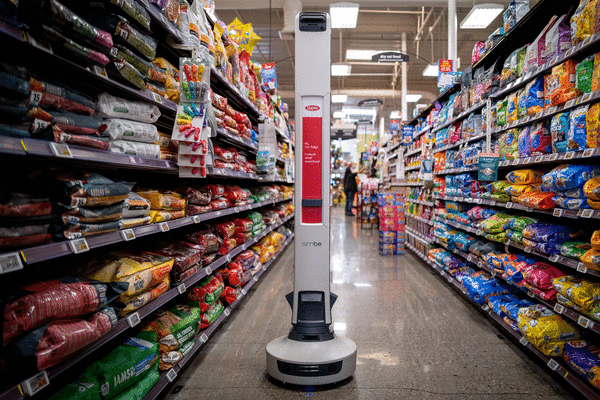
On a Wednesday afternoon at Ralphs on Pico Boulevard, a skinny, six-foot-tall tower of sensors rolled through the aisles. It made low beeping noises, its lights flickering purple and green. A small screen on the top of the tower had two blinking eyes and a small line of text. "Hi, I'm Tally!"
"Robot! Robot!" a young boy yelled. Some adults looked confused; others laughed.
Ricardo Valadez, a 62-year-old real estate agent from Mid-City and Ralphs regular, said he felt like the robot was stalking him around the store but was reassured by an employee that it just checks the shelves to see what is missing or out of place.
"I was kind of like, 'What the hell is that?'" Valadez said. "I don't know why; I felt that it was following me."
With a recent rollout in some L.A. grocery stores, the inventory bot, built by Burlingame, California-based company Simbe Robotics, joins the other free-range forms of physical AI that are already a part of everyday life in L.A. such as food-delivery bots and Waymos.
From inventory management to marketing and checkout, retailers are increasingly adopting automation. The retail automation market could jump to $77 billion by 2034 from $28 billion in 2025, according to estimates from market research company Fortune Business Insights.
Simbe says more than 3,000 of its bots have been contracted to monitor shelves worldwide. Kroger, the parent company of Ralphs, is using hundreds of them after pilot projects that started in Indianapolis and Cincinnati, and recently spread to California.
"Simbe provides shelf intelligence technology that helps store teams more easily identify and address products that are low or out of stock, giving associates better information to support store operations and serve shoppers," said a spokesperson for Simbe Robotics in an email.
Simbe says Tally helps employees dedicate more time to shoppers. In January, the company revealed its latest model of the robot, Tally 4.0, which uses newer Nvidia chips and software that speeds up scanning shelves to create insights.
Tally alerts employees to any misplaced or out-of-stock items. Simbe said the robot "is designed to understand shelf conditions, not identify or track humans."
In a recent news release, Simbe said its bots do more than count; they help stores determine the best shelf placement and pricing for products.
"Every deployment expands Simbe's understanding of how conditions change, revealing patterns across entire store chains — from inventory availability and product location to prices, promotions, and merchandising conditions," the release said.
Other retailers in Los Angeles have also introduced Tally to their aisles, such as Bristol Farms in Santa Monica. Tally has also been spotted at retailers across the country, including Kroger, Lowe's, Tesco and BJ's.
"Last year, Kroger began using robotic technology to gain real-time insights on product inventory," a Ralphs spokesperson said. "This technology means our associates can more easily and quickly identify and address shelves where products are low or out of stock."
The spokesperson declined to provide information about how many Tally bots have been deployed at its Los Angeles locations. A LinkedIn post from a store manager at Kroger-operated Smith's Food and Drug stores said Kroger deployed its 500th robot across all of Kroger in August.
During Kroger's earnings announcement in March, Chief Financial Officer David Kennerley said the company was "investing aggressively" in artificial intelligence and that has helped it save money.
Rachel Fournier, an employee at Ralphs on Vermont Avenue and Adams Boulevard, said the Tally bot "just showed up out of nowhere" a few months ago.
"One day, they were there wandering around the store," she said.
Unions are concerned the bots — which Simbe claims can save employees up to 50 hours of work per week — could put human employees out of work.
In July, the United Food and Commercial Workers International Union branch representing employees in Washington, northeast Oregon and northern Idaho released a statement outlining concerns about deploying Tally across Kroger-owned Fred Meyer locations.
"Union members regularly do this work," the statement said. "We believe outsourcing our union jobs to robots will erode our unity in the worksite, reduce available hours for those who need them to pay the rent, and threaten the stability of our benefits."
Ralphs employee Fournier said she and others worry about job automation and whether the bots could be used to monitor employees. With self-checkout and digital shelf tags already reducing the need for employees, some workers wonder what is next.
"Even an inventory job, like now, that's being shopped out to a computer," Fournier said. "What are they trying to do here?"
There needs to be more discussion ahead of time and sign-off from employees before more robots are deployed, said a local union.
"Our members should not be finding out about major changes to their workplace only after new technology shows up in their stores," said Kathy Finn, president of UFCW Local 770. "Checking shelves, identifying out-of-stock products, and maintaining store conditions are all areas where our members perform important work every day."
While it is not the kind of employee that would be doing inventory, Kroger said this week that it will lay off 3,000 corporate employees over the next three years as it ramps up its use of artificial intelligence to streamline operations.
Some unions have been pushing back on earlier automation efforts at stores.
Last year, union members helped push for an ordinance in Long Beach that requires grocery chains to increase the number of employees relative to self-checkout stands. Meanwhile, consumers are concerned that digital price tags could be used to charge different customers different prices.
The robot makers and the companies using them say the bots aren't to replace humans; they are just shouldering the less-interesting work to free up human employees to be more productive in other areas.
Still, some grocery store customers worry the robots mark a further reduction of interactions between humans as well as fewer jobs.
Jennifer Boulanger, a 63-year-old Mid-City resident, posted a video on Nextdoor complaining about the new Ralphs bot. "More lost jobs to AI junk," she said.
Boulanger now wants to shop somewhere with less automation, even if that means dealing with crowded parking lots and a longer drive.
"I'm going to start going to Trader Joe's more," she said in an interview.
©2026 Los Angeles Times. Visit at latimes.com. Distributed by Tribune Content Agency, LLC.








Comments