Report: Killing Haiti gang members is short-term solution; groups must be dismantled
Published in News & Features
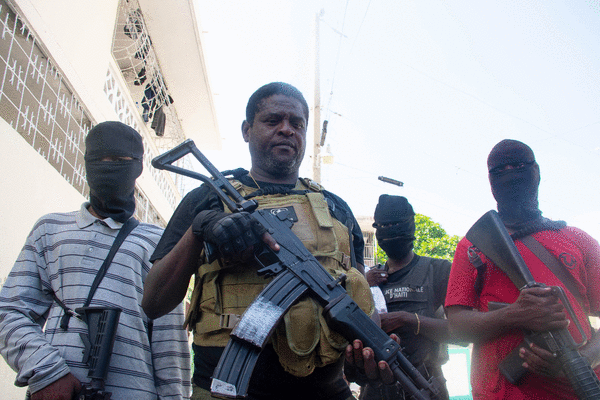
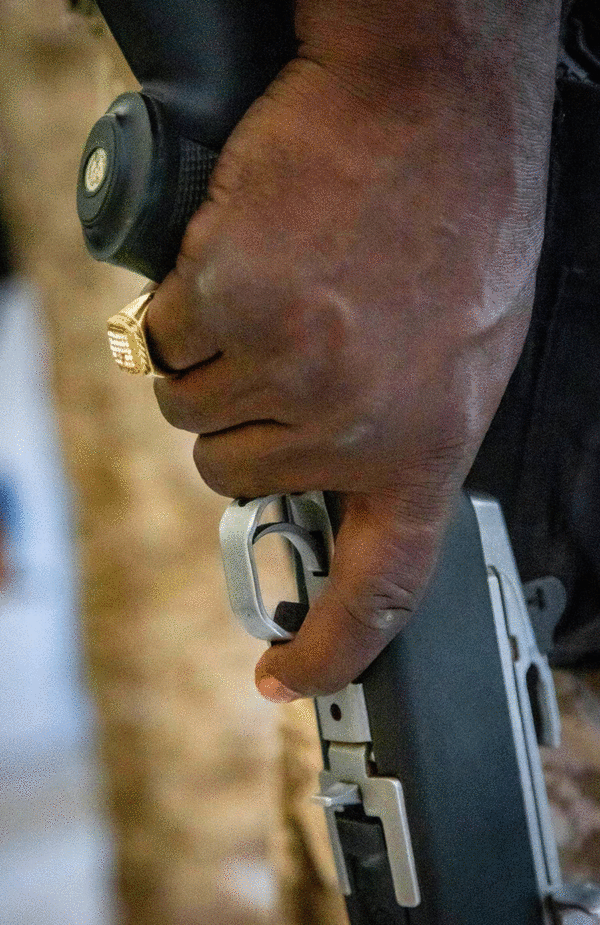
As the United States prepares to bolster Haiti’s fight against increasingly brutal armed gangs, a new report is urging officials and mission planners to heed the lessons of the recent Kenya-led security mission and warns that suppressing gangs cannot be reduced solely to killing their members.
Previous efforts in Haiti, the International Crisis Group says in a new 49-page report, have shown that arresting gang leaders and targeting foot soldiers can bring short-term calm. But violence is likely to return unless the groups are fully disarmed and their political and financial backers are held accountable.
“Achieving armed supremacy over gangs would mark a huge breakthrough for Haiti, but unless more is done to dismantle these groups, halt their recruitment and sever their links to power, it would amount to little more than a pause in the battle,” Diego Da Rin, Crisis Group’s Haiti analyst, said. The International Crisis Group is an independent, nonprofit organization that works to prevent and resolve deadly conflicts around the world.
The report traces the evolution of the country’s powerful Viv Ansanm gang coalition, describing how its members have “mutated from being tools in the hands of the most powerful to overlords of the country,” and issues a call for the protection of civilians once the new U.S.-backed, United Nations authorized Gang Suppression Force deploys. It also notes that Haitian authorities should be weary of gangs' ongoing political crusade to get a foothold in a future government.
“Though the U.S. has been clear that the new multinational force will corral any gang member it encounters, it would be sensible to exploit any early successes with a view to persuading gangs to negotiate their surrender,” the report said.
The brainchild of the Trump administration, the Gang Suppression Force has a deployment mandate of 5,500 personnel and 50 civilians. So far, 18 countries have pledged to field personnel, according to the Organization of American States, whose secretary general recently visited Port-au-Prince.
On Monday, two donors, France and Germany, contributed an additional 3 million euros and 30 million Euros respectively to a U.N. trust fund to support the deployed troops. The voluntary contributions bring total pledges to $151.3 million, of which $113.2 million has been received in cash.
The Crisis Group notes that soon after Kenya offered to lead a Multinational Security Mission to Haiti, the country’s most powerful gangs came together under the banner Viv Ansanm (Living Together) and soon led a full-scale offensive in Port-au-Prince as the final Kenya agreement was being signed in Nairobi in February 2024.
The same unprecedented level of violence could occur, the report warns, with the pending arrival of the Gang Suppression Force. While the first deployments of foreign soldiers are still months away, there are growing fears that the country’s armed groups will seek to exploit an ongoing power struggle over the next phase of the political transition ahead of Feb. 7, 2026, when the mandate of the current government will end without an election.
“Blessed by the U.N., the new Gang Suppression Force could spur a surge in combat, possibly endangering civilian lives,” the report warned.
Viv Ansanm’s political crusade
Once concentrated largely in Port-au-Prince, the country’s armed criminal groups have been rapidly expanding into other regions and becoming more brutal. At the same time, they’re becoming more overtly political, the Crisis Group highlighted.
For example, the Viv Ansanm alliance has announced that it is now a political party, even though it has not formally registered. In August, members sent a letter to the U.N.’s newly appointed special representative in Haiti, Carlos Ruiz Massieu, highlighting his role in overseeing Colombia’s peace process with the FARC and arguing that Haiti’s conflict could similarly be resolved through dialogue.
Last week, as internal clashes among rival factions spilled into the streets of Port-au-Prince, leaving dozens of gunmen dead, Viv Ansanm’s most recognizable warlord, Jimmy “Barbecue” Chérizier, announced the conflict was being carried on behalf of “the country.”
In addition to a group of influencers who carry their messages, Viv Ansanm has tapped Chérizier, who was once a cop, as its spokesman. In between issuing threats to adversaries and acknowledging mistakes made by the gangs in his nearly daily videos on social media, Chérizier frequently comments on political affairs. He routinely casts the gangs’ activities as defending the poorest citizens from the country’s rapacious elites and foreign powers.
But behind the calls for dialogue and political crusades, the Crisis Group report suggests, lies a calculated effort to exploit Haiti’s political turmoil.
“Gangs are acutely aware that the country’s political instability has created opportunities to infiltrate Haitian governing institutions,” the report said. It added that by recasting themselves as defenders of the poor, Viv Ansanm is also seeking influence in Haiti’s next government — and ultimately, amnesty.
“They appear intent on guaranteeing that their allies are part of the next administration,” the report said. “The concrete result they aspire to is a general amnesty for leaders and members.”
It is imperative for Haitian authorities, even as they grapple with how to replace the current Transitional Presidential Council, to block gang members from being part of the new government, the Crisis Group said.
“Eventual negotiations with the gangs are more likely to succeed if Haitians are convinced that their government is intent on dismantling these groups, but not if they suspect that officials are colluding with crime bosses,” the report said.
Escalating crisis
On Tuesday, the International Rescue Committee said Haiti’s escalating gang crisis had made it one of the top 10 on its Emergency Watchlist of countries most at risk of worsening humanitarian crises in 2026. The country is number five, moving up three spots from last year due to gang rule and the failing aid push as millions face worsening violence, hunger and displacement.
“This escalation is fueled by the expansion of gang rule and changes to the conflict dynamics that have left millions without access to basic services and livelihoods, and created catastrophic levels of food insecurity and forced displacement,” the global humanitarian organization said.
Supporters of the Gang Suppression Force argue that, with its larger size and stronger mandate, it will be able to confront a wider range of threats, including drug trafficking and illicit weapons.
But the Crisis Group argues that for the new force to work, U.N. assistance is needed along with personnel trained in offensive urban operations to limit civilian casualties. Most gangs are entrenched in the densely populated slums of the capital.
“Even if the new international force receives the resources it needs, full victory over the gangs would require a prolonged campaign that could result in widespread civilian casualties. To minimize bloodshed and protect the many minors in the gangs’ ranks, the Haitian government and their foreign partners should exploit the shift in the balance of force provided by a more robust security operation to open a negotiating channel with the criminal groups,” the report said.
The report acknowledges that the majority of Haitians are “fervently” opposed to any dialogue with the gangs, fearing that it could lead to impunity for the perpetrators of numerous appalling crimes.
But under the right conditions, Crisis Group said, “the government and its foreign partners should explore ways to mitigate violence through dialogue. Ideally, they should provide incentives to gangs to demobilize while also guaranteeing they will not elude all liability for their acts.”
_____
©2025 Miami Herald. Visit miamiherald.com. Distributed by Tribune Content Agency, LLC.



Comments