The Jeffrey Epstein files are finally set to be released. Here's what to know
Published in News & Features
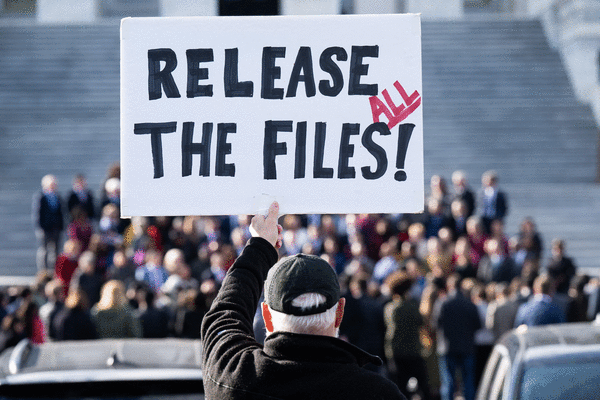
After years of debate, investigations and conspiracy theories, the Department of Justice is scheduled on Friday to finally release the Jeffrey Epstein files.
The release will come nearly 20 years after federal prosecutors in the Southern District of Florida cut a remarkably lenient plea deal with Epstein that allowed him to avoid a lengthy prison sentence and plead guilty to two state charges — one involving a minor — to settle allegations that he had sexually abused dozens of teenage girls.
The release will give victims the transparency they have sought for decades, as Epstein’s agreement with prosecutors was kept secret from them, even as they were denied a sense of justice when Epstein died in federal custody in 2019, a month after prosecutors in the Southern District of New York brought new charges against him.
Last month, Congress passed, and President Donald Trump signed, the Epstein Files Transparency Act. Under the law, the Justice Department has a Dec. 19 (Friday) deadline to unseal the files — some of them dating back as far as 1996, when the first victim reported Epstein to the FBI.
So what will be made public and what should we look for?
Attorney General Pam Bondi is required to release — in a searchable and downloadable format— all unclassified records, documents, communications and investigative materials in the Justice Department’s possession that pertain to Epstein and his accomplice Ghislaine Maxwell.
Look for more flight logs and travel records, names of government or former government officials; immunity or plea agreements; draft indictments and sealed settlements. Also of note, will be FBI reports, prosecutor notes, emails, letters and investigative leads that were never followed.
The law also requires the Justice Department turn over a “list of all government officials and politically exposed persons,” and all DOJ memos, including investigative reports and interviews with victims.
Some things to know
The act mandates that the Justice Department turn over all records pertaining to Epstein’s death, including incident reports, witness interviews, medical examiner files, autopsy reports and other written records of the circumstances and cause of death.
The DOJ cannot withhold, delay or redact on the basis of whether it would embarrass, cause reputational harm or on the grounds of “political sensitivity” — including information pertaining to any government official, public figure or foreign dignitary.
The department can redact or withhold records that identify any victims, or victims’ personal identifying information, such as their addresses or medical information; anything that contains information or images that depict child sexual abuse materials; or materials that have been classified by Executive Order.
The Justice Department can also withhold information on the grounds that that material is under active investigation. This is a broad area, and it’s impossible to know how DOJ officials will interpret this.
All redactions must be accompanied by a written justification published in the Federal Register and submitted to Congress; in other words, the Justice Department has to explain why certain documents are redacted or withheld.
What to search for
The names of Epstein’s friends and business associates — many of whom have already been identified:
• Donald Trump
• Former president Bill Clinton
• Prince Andrew
• Ghislaine Maxwell
• Victim Virginia Giuffre
• Elon Musk
• U.S. Secretary of Health Robert F. Kennedy
• Banker Jes Staley
• Former Israeli prime minister Ehud Barak
• Modeling scout Jean-Luc Brunel
• Billionaire Les Wexner
• Billionaire Leon Black
• Director Woody Allen
• Lawyer Alan Dershowitz
• Hedge fund manager Glenn Dubin and his wife, Epstein’s former girlfriend Eva Andersson;
• Former New Mexico governor Bill Richardson
• Microsoft founder Bill Gates;
• Former treasury secretary and Harvard president Larry Summers
• Democratic Rep. Stacey Plaskett
• Former Democratic majority leader George Mitchell
• Republican political strategist Steve Bannon
• Former labor secretary Alex Acosta.
Survivors and prosecutors have alleged that Epstein and his associates often used coded language to help normalize the sexual abuse and hide criminal conduct, particularly with underage girls. Search for words such as “massage” —which was often used as a code word for sex; “fun” — which was also used in the context of sex; “models” were sometimes used to refer to victims; “talents” were used to describe victims; “tips” usually referred to cash payments to victims; “allowance” was used to describe regular payments; “recruiting” and “scouting” were used to describe efforts to find more girls and young women to abuse; “work” and “private time” often meant sexual encounters.
Important to remember
Epstein was known brag about his associations with wealthy and powerful people. Some of those people he may have just met in passing — and others he may have never met at all. He was a con artist who name-dropped constantly in order to elevate his own social position. Just being named in a document with Epstein does not mean that a person has committed any crimes — or that they were involved with Epstein at all. Read the documents carefully and remember that it is possible that some victims may have mistakenly misidentified individuals, or that Epstein and his associates, in order to help hide his crimes, tried to do reputational harm to innocent people.
What to read
The Miami Herald’s ‘Perversion of Justice’ investigation that detailed how Epstein and his team of high-priced attorneys negotiated a sweetheart deal with federal prosecutors in the Southern District of Florida to settle allegations that Epstein had abused dozens of teenage girls.
Part one of the series described how a secret meeting between Acosta, then the U.S. Attorney for the Southern District of Florida, and Epstein’s powerful, politically connected lawyer Jay Lefkowitz gave rise to an extraordinary “non-prosecution agreement,” in which Acosta agreed to dispose of an already drafted sex trafficking indictment if Epstein would plead to minor state charges and pay off the women he abused. Interlaced throughout the story were the voices of Epstein’s victims, who felt they had been betrayed by the very prosecutors who had pledged to protect them.
In part two, former Palm Beach Police Chief Michael Reiter revealed how he and his detectives were sabotaged by prosecutors as they tried to bring charges against Epstein. Epstein’s young victims were also threatened and followed; they were grilled by his lawyers and disbelieved by prosecutors, who at times treated them like prostitutes, instead of victims.
Part three revealed how Epstein managed to manipulate the criminal justice system even after his guilty plea in state court to minor charges. In a deal blessed by the Palm Beach County sheriff, Epstein was allowed to leave the jail for 12 hours a day, six days a week — and was allegedly able to have conjugal visits with young women. The registered sex offender was rarely monitored, and allowed to disappear by claiming he was visiting Home Depot or out shopping for a new office.
©2025 Miami Herald. Visit at miamiherald.com. Distributed by Tribune Content Agency, LLC.






Comments