Florida airports told to comply with weather modification ban. Have they?
Published in News & Features
Florida Gov. Ron DeSantis stood in front of a Miami crowd in May to announce a new law that would root out dangerous weather-altering chemicals poisoning the state’s skies.
In the weeks before the law took effect, his attorney general, James Uthmeier, echoed the governor’s words and threatened to defund airports that failed to report suspicious activity.
On July 1, the state unveiled resources for residents to report suspected weather modification, and on Oct. 1, it began requiring publicly owned airports to report planes that are equipped with weather modification instruments to the Florida Department of Transportation.
“We need your help to keep our state free and make sure the skies belong to the people,” Uthmeier wrote in a July letter.
Two months into the program, Tampa Bay airports have said they are following the law.
And that they have nothing to report.
Here’s how the weather modification ban is going so far.
A refresher on weather modification
Weather modification is an attempt to modify local weather in the short term. One example is cloud seeding, which is generally used to increase rain or snow.
Geoengineering is an attempt to offset warming from greenhouse gases, aiming to change climate in the long term, according to the Environmental Protection Agency. Solar geoengineering, for example, aims to inject particles into the atmosphere to reflect sunlight back to space.
Previously, Florida law required a permit to modify the weather. In the 67 years the law was in place, no one ever applied for one.
Attempts to modify local weather exist in other areas of the country and are primarily funded at the local and state level, particularly in drought-stricken states where extra rainfall is needed, according to U.S. Government Accountability Office report from 2024.
This year, the federal government confirmed it does not perform geoengineering, according to the Environmental Protection Agency.
The agency said it’s aware of one private company aiming to create solar geoengineering technologies, along with a canceled small-scale experiment led by the University of Washington.
“While there are a few private actors focused on developing different solar geoengineering technologies, the amount of material that has been intentionally released into the atmosphere to date is very small relative to natural events like volcanic eruptions,” the agency wrote.
During this past year’s legislative session, talks of the Florida bill often delved into conspiracies about “chemtrails,” or chemical trails — a debunked theory that the white streaks behind planes are chemicals dispersed into the sky for nefarious purposes, such as mind control.
These streaks actually are called contrails, or condensation trails. A contrail is water vapor emitted from the engines of planes, Michael Diamond, an assistant professor at Florida State University who researches cloud formation, previously told the Tampa Bay Times.
“The warm air that comes out of these planes hold a lot of water, (and) as it cools down, that water becomes ice crystals,” Diamond said.
“That’s basically all you’re seeing with contrails.”
How airports are complying with the new law
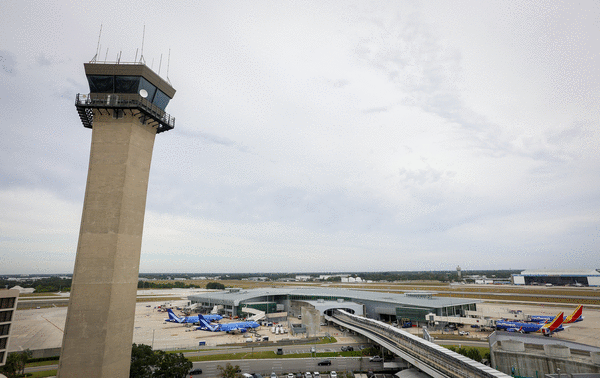
Tampa International Airport and St. Pete-Clearwater International Airport confirmed that neither has had any planes equipped with weather modification devices on their properties over the past two months.
A public, state-run database showed that all public Florida airports remained in compliance with the law as of Dec. 8.
Some airports signaled their compliance by alerting others nationwide that their facilities were closed to planes equipped with weather modification devices.
Palm Beach International Airport and Daytona Beach International Airport were the first in Florida to issue that kind of alert, according to a federal advisory webpage that lists airport delays and closures.
“This is the first time we have ever issued (an alert) related to this new requirement and we will continue to do so as long as the state law remains in place,” Rebeca Krogman, a spokesperson for the Palm Beach airport, wrote in a statement to the Tampa Bay Times.
Tampa International Airport has not expanded any additional resources to comply with the new law, spokesperson Beau Zimmer wrote in a statement.
Instead, airfield operation staff already inspecting the tarmac for debris and planes for airworthiness have been tasked with keeping an eye out for weather modification, according to Zimmer.
“During October and November, (Tampa International Airport) did not observe any weather modification activity or related equipment at the airport,” the statement read.
Are residents reporting weather modification in Florida?
The law created a state-run portal, phone number and email for residents to report suspected weather modification, which are maintained by the Department of Environmental Protection.
The portal opened July 1, according to Alexandra Kuchta, a spokesperson for the Florida Department of Environmental Protection.
By early October, the portal had received more than 6,500 submissions related to suspected weather modification or geoengineering, Kuchta said in an email to the Times.
Asked how many reports have been investigated by state officials, Kuchta said, “Each report is reviewed, and if it contains actionable information, DEP refers it to the appropriate regulatory authority for follow-up consistent with the statute.”
The law gives environmental officials discretion to investigate reports, and they must refer submissions to the Department of Health or the Division of Emergency Management “when appropriate.”
The state did not respond to follow-up questions regarding investigations into these claims.
Some residents have taken to reporting weather modification outside of the portal, instead writing to the state’s public notices of pollution.
“What are they spraying?” one person wrote in a December pollution notice, reporting what he called chemtrails in Broward County.
“I thought we had laws against spraying the skies, what are we breathing?”
________
©2025 Tampa Bay Times. Visit at tampabay.com. Distributed by Tribune Content Agency, LLC.





Comments