Maryland AG sues to block federal cuts to community school programs
Published in News & Features
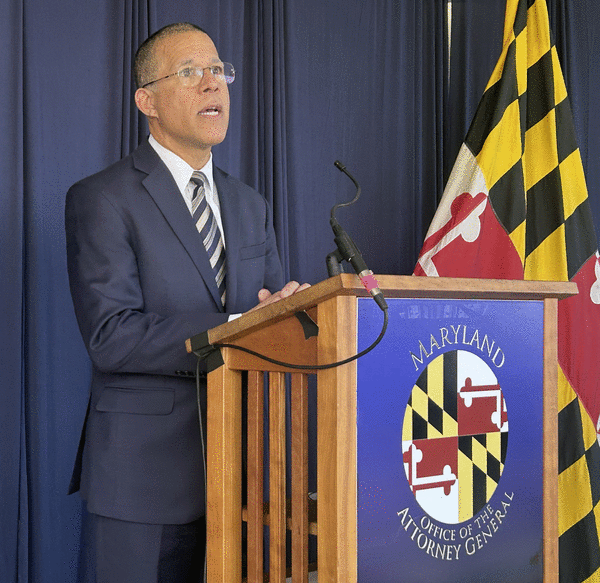
Maryland Attorney General Anthony Brown and attorneys general from North Carolina and the District of Columbia sued the U.S. Department of Education on Tuesday, alleging the agency unlawfully cut congressionally approved funding for community school programs.
Filed in U.S. District Court for the District of Maryland, the suit seeks to block what the attorneys general describe as abrupt and politically motivated terminations of grants that support public schools serving high-poverty communities.
The Department of Education acknowledged The Baltimore Sun’s request for comment but did not provide one before publication.
“The Department of Education’s unlawful decision to abruptly cut funding for FSCS programs will strip hundreds of Maryland students and families of essential support for food, housing and educational resources,” Brown said in a statement. “We’re taking legal action because these programs are lifelines for Maryland families, and our students’ futures cannot be jeopardized.”
Full-service community schools (FSCS) operate as neighborhood hubs, pairing classroom instruction with health care, food assistance, housing support and other social services aimed at removing barriers to learning. In Maryland, the number of community schools has grown rapidly under the state’s landmark, multibillion-dollar education plan, the Blueprint for Maryland’s Future, increasing from about 454 in fiscal 2023 to 621 in fiscal 2025, with plans to reach nearly 700.
Baltimore has an estimated 154 community schools based on the district’s latest data, including elementary, middle and high schools.
Getting into the legal argument
Federal law authorizes the Department of Education to award community school grants for five-year periods, with annual funding decisions based solely on program performance. Federal funding for the program has risen through the years, from $5 million in Fiscal Year 2008 to $150 million for Fiscal Year 2025.
The way it works is that the DOE first funds the initial one-year budget period for all FSCS grants and then funds subsequent years of the project through annual one-year continuation awards.
But Brown’s lawsuit alleges that in mid-December, the department sent form notices to grantees nationwide stating their programs conflicted with Trump administration priorities and would be immediately discontinued.
One of the larger programs affected is run by the University of Maryland, Baltimore, which in 2022 received a five-year grant worth about $1.9 million to support students at Renaissance Academy and Augusta Fells Savage Institute of Visual Arts in Baltimore.
The lawsuit said the program boosted attendance at both schools and provided hundreds of students with food distribution, housing assistance and help with their families’ utility bills.
Pulling back funds
Just two weeks before Christmas, the Education Department informed UMB that its grant would be canceled at the end of the month, citing two references to “anti-racism” in the original, previously approved application. The decision cuts roughly $800,000 in remaining funding over the next two years, the lawsuit says.
The attorneys general argue the funding cuts violate the Administrative Procedure Act by ignoring required performance-based standards and failing to provide a lawful explanation. They are asking a federal judge to declare the terminations unlawful and issue an injunction restoring the grants.
If allowed to stand, Brown said, the cuts would dismantle critical academic and social supports for students in Maryland and across the country.
________
©2025 The Baltimore Sun. Visit at baltimoresun.com. Distributed by Tribune Content Agency, LLC.





Comments