With outgoing governor and limited revenue, Alaska legislators consider priorities in lead-up to session
Published in News & Features
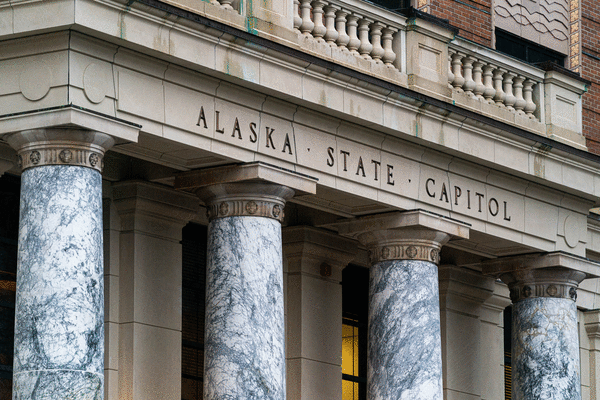
As Gov. Mike Dunleavy enters his final year in office, some lawmakers are approaching the coming legislative session with mixed expectations.
The Legislature is set to convene in Juneau on Jan. 20 with a packed agenda, including debates on a fiscal plan that Dunleavy committed to introducing, a long-promised natural gas pipeline, and a Rural Health Transformation Fund that could bring more than $1 billion in federal dollars to the state in the next five years.
But some lawmakers say that Dunleavy's seven-year record as governor — marked by vetoes of bipartisan legislation and their criticism over the limited time he has spent building political goodwill in Juneau — along with the state's strained revenue projection make it unlikely that significant legislative reforms will be adopted in the coming year.
Dunleavy's spokesperson Jeff Turner asserted in response that the governor has been in regular communication with lawmakers and that vetoing bills is part of the governor's constitutional prerogative.
Both the House and Senate are governed by bipartisan coalitions that have largely similar goals, but those goals often put them at odds with the Republican governor.
"I think we're just doing the best we can to stop bad things from happening, because the idea that we're going to get any meaningful policies passed through both bodies and then signed by the current governor — I think (the odds) are extraordinarily slim," said Rep. Andrew Gray, an Anchorage Democrat who serves in the House majority caucus, in a recent episode of a podcast he hosts.
"It's part of expectation-setting. If folks are expecting, in a low-revenue environment, with oil prices super low, that we are somehow going to make big important changes that folks are going to see this year, I just think I gotta lower that bar," Gray said.
Dunleavy is termed out from seeking reelection next year, and already all eyes are on a packed race to succeed him. But with some state agencies facing crisis-level staffing shortages, urgent needs to repair crumbling infrastructure and a structural deficit that has dogged Dunleavy's tenure, some lawmakers say that the Legislature cannot afford to bide its time until there is a new governor at the helm.
Ahead of last year's session, House and Senate leaders said one of their top objectives was to increase the education budget significantly for the first time in Dunleavy's tenure. They succeeded, mustering the votes needed to twice override Dunleavy's attempts to veto the funding increase after lawmakers refused to adopt his desired education policies.
In the process, caucus leaders showed that they had lost patience with past efforts to earn the governor's goodwill and were now more inclined to achieve their goals — whether or not they were backed by Dunleavy.
"A lot of times when people talk about gridlock, they're referring to the legislative bodies themselves," Senate Majority Leader Cathy Giessel said. "In our Legislature, that isn't true."
"In terms of gridlock, the word can only be applied to the barricade that we meet when we send something to the governor's office," said Giessel, an Anchorage Republican.
Dunleavy through his spokesperson declined an interview request for this story. When asked to respond to criticism about the governor's veto record, Turner said that Dunleavy "is not sure where this is coming from." Turner also said that Dunleavy has met with lawmakers and spoken with them on the phone "countless times" during his tenure.
"The Governor has also worked with many legislators on passing a number of bills during his tenure and looks forward to working with legislators again this coming session," Turner wrote in an email.
After the bipartisan coalitions succeeded in their effort to increase education funding, it's not immediately clear what goals they will focus on in the coming months, particularly with little available revenue to fund additional education investments and other cost-driven priorities.
Both lawmakers and Dunleavy agree the state needs more revenue to meet its obligations. But a question remains on whether lawmakers and the governor can agree on where that revenue should come from, after Dunleavy in recent months vetoed or promised to veto a series of revenue ideas that garnered support from members of the House and Senate majorities.
Republicans in the House and Senate minorities are holding out hope that the governor's final year in office can bring a measure of legislative accomplishments.
Rep. Justin Ruffridge, a Soldotna Republican who serves as minority whip, said lawmakers should "at least make an attempt" at advancing legislative policies, despite the headwinds created by dwindling revenue.
Ruffridge said he's "excited about the conversation" on the governor's proposed fiscal plan, which has yet to be outlined.
"If we don't talk about it every single year until we finally get something that we can all agree on, I think that would be a mistake," he said.
Giessel said Dunleavy's fiscal plan "is about seven years too late." She also referenced Dunleavy's past promises to introduce fiscal measures that never materialized or fizzled out. In 2023, Dunleavy said he would introduce a statewide sales tax, but never did.
"He never had the courage to put it on the table and actually talk to Alaskans about it, so we'll see," said Giessel.
Giessel said it's "certainly true" that some legislators are having trouble trusting Dunleavy. "And when we offer something — he vetoes," she added. "So there's no way to meet his criteria for what should be successful. It's very arbitrary and a moving target."
In an email on Wednesday responding to questions about the governor's approach to working with lawmakers, Turner said that "the Alaska Constitution grants the governor the power to veto bills. The legislature has the power to try and override the veto."
"Exactly how does that make the governor responsible for violating trust?" Turner asked.
The revenue question
During a previous phone interview in December, Dunleavy said he hopes that legislators "don't fret over tackling the items regarding the fiscal plan."
"We believe that fretting is a waste of emotional energy," said Dunleavy.
He has not yet offered specifics, but at the time said the fiscal plan will include new revenue measures and provisions to expand and diversify the state's economic base.
"There's going to be things in there that I have a hard time swallowing, but I know it's needed for the state of Alaska," said Dunleavy.
"... This is a great opportunity for the Legislature to show the people of Alaska that they sent the right people to Juneau," he said. "That's another quote for you."
Dunleavy's forthcoming fiscal plan will seek to tackle the imbalance between the state's revenues and expenditures. That imbalance has been a hallmark of his entire administration, except for a brief reprieve when oil prices spikes in 2022 amid Russia's attack on Ukraine.
"I'm providing a solution to the problem. If (lawmakers) have a better solution, terrific, let's look at it," Dunleavy said.
Despite the majority coalitions' challenges in working with the governor, Giessel said one of her priorities for the coming session is to advance bills that will increase the revenue the state has at its disposal.
Dunleavy's recent budget proposal calls on lawmakers to spend roughly $1.8 billion from the state's $3 billion savings account, increasing pressure on lawmakers to shore up revenue in the short-term.
Last year the Senate majority put forward a series of revenue proposals, including a bill that will impose the state's corporate income tax on privately held corporations like Hilcorp, a Texas-based oil and gas company that has been exempted from Alaska's tax thanks to its corporate structure.
Giessel said applying that tax to Hilcorp, which could bolster the state's coffers by tens of millions annually, is "a no-brainer," though it is not clear whether enough of her legislative colleagues agree for the bill to advance.
"The question people ask me is, 'Well, won't Dunleavy veto it?'" said Giessel. "If he were to veto additional logical, balanced tax provisions, that simply adds to his legacy."
When lawmakers meet in Juneau, one of the first questions they will face is whether to convene a joint session to override Dunleavy's veto of a bill that would apply the state's corporate income tax to companies that operate online. That bill, which Dunleavy vetoed in September, would bring tens of millions to the state annually from corporations based outside the state.
Dunleavy said at the time that he vetoed it because it was not part of a "comprehensive fiscal plan."
Giessel said the state has to "close these loopholes" that have enabled corporations to operate in Alaska without paying state taxes. However, mustering the 45 votes needed to override the governor is "a high bar," and will necessitate support from a number of minority Republicans.
Whether or not the Legislature reaches that bar in the first five days of the session — the constitutionally mandated time frame for overriding the governor — will "depend on how many of those minority members actually understand the fiscal situation that the state is in," Giessel said.
"We don't have the room anymore to say, 'Well, we can limp through another year.' That time is gone," she said.
________
(Daily News reporter Alex DeMarban contributed to this report.)
©2026 Anchorage Daily News. Visit at adn.com. Distributed by Tribune Content Agency, LLC.




Comments