Iran president tells security forces not to harm protesters
Published in News & Features
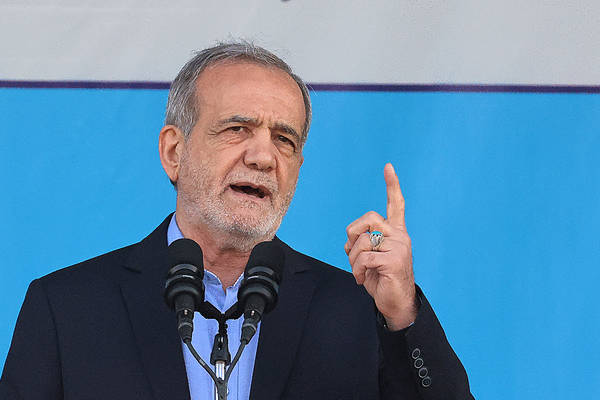
Iran’s president ordered security forces not to target peaceful protesters, a bid to defuse violent unrest that activists say has left at least 36 people dead.
“No security action should be taken” against those protesting economic hardship as long as they don’t compromise national security, President Masoud Pezeshkian’s deputy Mohammad Jafar Ghaempanah cited him as saying on Wednesday, according to the semi-official Fars news agency.
“Those who take up arms are a different matter,” Ghaempanah said, describing anyone who attacks police or military facilities as a “rioter.”
Pezeshkian, a political moderate, has sought to present a sympathetic image to protesters, who have taken to the streets nationwide for more than a week after the local currency crashed to a record low. His comments jar however with the actions of security forces, who have forcibly broken up demonstrations and raided hospitals.
“Islamic Republic security forces are again gunning down protesters and killing and disappearing children in a systematic effort to crush dissent,” said Hadi Ghaemi, executive director of the U.S.-based Center for Human Rights in Iran, a nonprofit organization.
Iran has multiple security forces under different chains of command. Pezeshkian’s government oversees the police force but not the volunteer Basij paramilitaries, who are part of the Islamic Revolutionary Guard Corps that answers to Supreme Leader Ayatollah Ali Khamenei.
Both have been deployed in the current protests, which began in Tehran as a demonstration against the weakening currency and associated rise in prices. They’ve since spread to other cities to encompass broader economic and political grievances against the Islamic Republic, including calls for Khamenei’s overthrow.
Hardline officials have accused foreign adversaries like the U.S. and Israel of fueling the unrest.
The deputy governor of the central bank responsible for foreign exchange markets resigned on Wednesday, Fars reported, after the rial hit a new low this week. Central Bank Governor Mohammad-Reza Farzin quit on Dec. 29, shortly after the outbreak of demonstrations.
The U.S.-based Human Rights Activists News Agency said late Tuesday that at least 36 people have been killed in the protests so far and over 2,000 arrested. Most of the deaths occurred in western Iran’s Lorestan province, followed by Ilam and Fars, according to Center for Human Rights in Iran.
The protests are the biggest to rock Iran since nationwide unrest in 2022 over the death of a young woman, Mahsa Amini, in police custody.
“This regime has shown it will slaughter as many civilians as it needs to quiet the streets—the international community must speak out against this carnage,” Ghaemi said.
--------
—With assistance from Patrick Sykes.
©2026 Bloomberg L.P. Visit bloomberg.com. Distributed by Tribune Content Agency, LLC.



Comments