After Maduro's capture, Venezuelans in the Chicago area face difficult choice: 'People are afraid to stay and people are afraid to return'
Published in News & Features
Yvette Hernandez has four grandchildren she wants to meet someday. But they’re halfway across the world.
Hernandez came to the U.S. about a decade ago after fleeing Venezuela’s authoritarian regime in search of a better future. She lives in Elgin, Illinois. Her daughter is in Venezuela, with Hernandez’s grandchildren.
“I haven’t been able to hug them, I don’t know them,” said Hernandez, 54, who is seeking asylum after arriving in the U.S. with a visa. “When the situation changes and I obtain my residency to travel back and forth … I can go hug them. That is the hope all of us here have.”
Her path toward a reunion is uncertain. After the U.S. captured and imprisoned Venezuelan President Nicolás Maduro last week, many Venezuelans are left with conflicting emotions: hope for the prospect of democracy in their home country yet mistrust that President Donald Trump — who has vowed to “run Venezuela” — will have their best interests at heart.
“We don’t want to live the same thing over again,” Hernandez said.
Meanwhile, some Venezuelans in the Chicago area who entered the country illegally or are without granted status have no protections from immigration enforcement under a second Trump administration — even as they seek to stay in the U.S. through legal avenues, experts say.
Many now feel up against a wall, safe neither here nor there.
“People are afraid to stay and people are afraid to return,” said Ana Gil, founder of the Illinois Venezuelan Alliance. She said Maduro’s capture has further destabilized the country. Because of that instability, many Venezuelans in the Chicago area do not feel safe returning home, but also fear detention and deportation in the U.S.
The uncertainty comes as the Trump administration has launched mass deportation actions across the country, including the fall’s Operation Midway Blitz in the Chicago area that saw more than 4,300 people arrested, with Venezuelans among those. On Wednesday, Immigration and Customs Enforcement shot and killed a U.S. citizen in Minneapolis as it expands increasingly dangerous enforcement across the country. And Thursday, Border Patrol officers shot and injured two people from Venezuela in Portland, Oregon, during a targeted operation.
“People have seen the way ICE has treated Venezuelan migrants, even if they have an asylum case. People are afraid of being tortured inside detention centers or of being deported to other countries,” Gil said.
Luciano Pedota, also a member of the Illinois Venezuelan Alliance, said that although he rejoiced when he heard about Maduro’s capture, he is concerned over his compatriots who recently lost temporary protected status, which provided a job permit and protection from deportation.
After a back-and-forth under the Biden administration, which extended TPS to Venezuelans first in 2021 and again in 2023, the U.S. Supreme Court last year allowed the Trump administration to cancel TPS protections for roughly 350,000 Venezuelan immigrants.
Some have likely applied for asylum, a yearslong process, but if the Trump administration can argue that conditions have improved in Venezuela, experts say it could set the stage for asylum cases to be rejected, putting them in line for deportation, something that was already happening during court check-ins and interview appointments.
Angelika Charczuk, an attorney at ADC Immigration Law, called it the “million-dollar question” how conditions in Venezuela will affect the asylum cases of her clients from the country. She’s already bracing for the government arguing a “fundamental change in country conditions,” which she said would likely decrease the merits of someone deserving refuge in the United States.
After more than five years in Chicago under TPS, Luis Jose Castro decided to return to Venezuela. Without protection and with little hope of obtaining asylum, he felt trapped. He also longed to see his two children and his parents who live there.
More than anything, he said, he wants to see his ailing father.
“It’s not worth it (staying here). I feel persecuted and I have never felt persecuted in my life,” Castro said of immigration enforcement.
After arriving in Chicago, Castro worked as a construction worker before becoming a paralegal, helping thousands of recently arrived migrants assess their legal cases and apply for asylum.
On Jan. 27, Castro, an attorney by trade, plans to board a plane with a one-way ticket, hoping to take part in the creation of a new democracy in his country.
“Venezuela needs us more than ever,” Castro said.
Though there is uncertainty about who will lead, how change will come or when it will happen in Venezuela, he believes the U.S. and Venezuela will eventually establish a strong diplomatic relationship that will benefit those who remain in the U.S., those who return home and those already living there.
After all, his wife and son have chosen to remain in Chicago.
Mary Meg McCarthy, executive director of the National Immigrant Justice Center, said her team and other immigrant rights advocates are trying to gauge what the capture of Maduro, and the Trump administration’s attempt to take over running the country, means for migrants’ access to protection in the United States.
But “the resulting chaos and Venezuela’s governmental instability should strengthen existing claims for protection, despite the Trump administration’s repeated attempts to railroad people’s access to asylum and other legal status,” McCarthy said.
“It is apparent that the U.S. government has no plan to ensure human rights protections for Venezuelans who will be directly impacted by the fallout of the Trump administration’s removal of President Maduro,” she added.
NIJC has provided immigration legal services to hundreds of Venezuelans who arrived in the Chicago area since August 2022, when Texas Gov. Greg Abbott started busing immigrants to Chicago.
Carmen is one of about 50,000 Venezuelans who came to Chicago in those years. She and her family crossed the perilous Darien Gap, a strip of land dividing Colombia and Panama that has become a dangerous crossing point for migrants seeking asylum in the U.S. She declined to use her last name for the article because she feared immigration enforcement.
Back home in Venezuela, her children were frequently denied school access because there were not enough teachers; they had fled the country, Carmen said. Some mothers would let their children sleep until noon because they could only afford to feed them once a day, she said.
When she first heard about Maduro’s capture by the Trump administration in her native Venezuela last week, she ran to the bathroom. Her hands were shaking and she was overwhelmed with mixed feelings of anxiety and happiness.
“We felt it would be the end of so much suffering after so many years and so many things that only we, the Venezuelans who lived through it, know,” said Carmen, 41, who lives on Chicago’s South Side.
Now, after Maduro’s capture, Carmen sees a “light at the end of the tunnel” for those in her home country. But a sense of unease overshadows it.
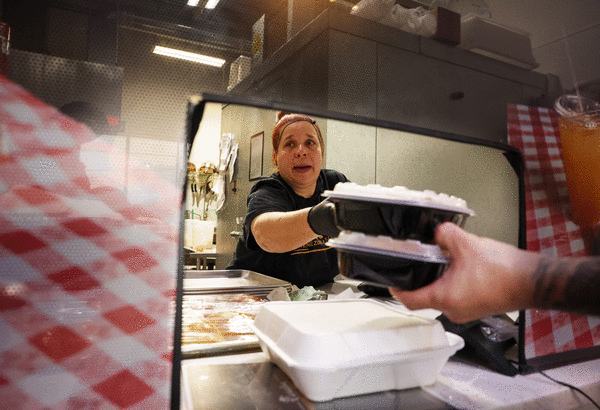
Her husband was arrested in October while selling arepas, and after his release weeks later, the couple decided to stop selling out of fear of immigration enforcement activities. And as her asylum case remains pending, she fears deportation where she could face retaliation in her home country.
“Everything is mixed up right now,” she said in Spanish. “We came here, have freedom of expression … and now they’re deporting us.”
Advocates are urging Congress to step in. They are calling for the immediate reinstatement of TPS to restore legal protection and work authorization for nearly 600,000 Venezuelans currently living in the United States.
Until meaningful change happens in Venezuela, said Gil of the Illinois Venezuelan Alliance, protecting the Venezuelan diaspora is not just an immigration issue, it is a matter of safety and human rights.
Gil arrived in Chicago about a decade ago. There were only two Venezuelan restaurants in the city, she recalled. At the time, a small but growing group slowly established a community on the North Side.
“They used to call it ‘Buenazuela,’” Gil said. It was near West Buena Avenue and North Broadway.
Those who first arrived came by plane with visas and eventually requested asylum, fleeing political persecution, she said.
By 2017, more than 6,000 people attended a meeting that Gil organized to discuss their role in the elections in their home country. That was when she founded the Illinois Venezuelan Alliance, an organization created to provide humanitarian aid to those in need in their home country and that now provides guidance and resources to those who recently arrived.
In Illinois, Venezuelan culture and its influence have now expanded to include a number of restaurants, food stands, artists and traditional celebrations across the city, Gil said. The population particularly skyrocketed after thousands of Venezuelan migrants arrived in the city during President Joe Biden’s administration, most of them bused to the city in 2022.
Many of them made a home on the city’s South Side, where they were given housing through city and state programs after shelters were closed. Over the last year, nearly 20,000 babies were born to Venezuelan immigrants, according to the census.
“That means that the Venezuelan community and its culture will only keep growing in the city for years to come,” Gil said.
_____
©2026 Chicago Tribune. Visit chicagotribune.com. Distributed by Tribune Content Agency, LLC.





Comments