Schools of Hope, Charlie Kirk top Florida lawmakers' 2026 education agenda
Published in News & Features
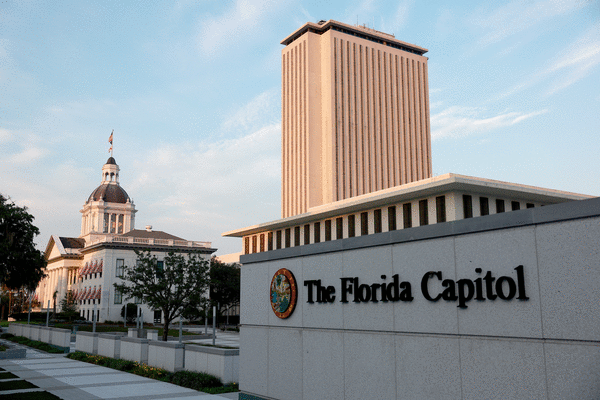
MIAMI – As lawmakers return to Tallahassee for their 2026 session, education and its underlying budget — more than a quarter of the state’s annual spending — again are poised to play a pivotal role in the legislative process.
Some of last year’s more contentious issues, including voucher funding and Schools of Hope charter schools, already are shaping up to resurface. Much like previous sessions, many of the education measures are expected to become part of the horse-trading that drives debate to the bitter end.
And although the key topics appear to be in view, there’s no telling what might pop up when committees take up measures and amendments surface. If we’ve learned anything lately, it’s that no idea is off the table until the hanky drop of sine die, representing the official end of session.
Schools of Hope
One of last year’s surprises, which figures to replay this winter, was a last-minute revival of a charter school bill that had died during regular session. The resurrected proposal, tacked onto an education train bill, allowed “Schools of Hope” charter providers to claim space in underused district campuses without having to pay for rent or services.
When providers began staking their claim to the space with more than 600 applications statewide, district officials and parent groups cried foul. Some called for a complete reversal of the measure, while others asked for rule revisions. Sen. Darryl Rouson, D-St. Petersburg, and Rep. Ashley Gantt, D-Miami, filed companion bills to delete the 2025 changes.
Questions are swirling over whether anything will change given Gov. Ron DeSantis’ strong support for the measure, which was heavily promoted by supporter Ken Griffin, a billionaire who has pushed to bring New York’s Success Academy to Miami under the program.
Vouchers
Bolstered by a scathing state audit report that detailed how voucher money does not follow the student as intended, the Senate has for a second year advanced legislation aimed at ensuring the $4 billion system is run more effectively.
The House spent weeks this fall reviewing the problems and discussing the need for solutions, such as more accurate tracking of voucher recipients. One idea leaders panned, though, was creating a line item for vouchers separate from the traditional K-12 budget — something the Senate, Governor’s Office and state auditors all recommended.
The desire for change is strong, as Republican lawmakers want to maintain Florida’s leading role in the national school choice movement. The Senate bill is poised to pass the floor in the first days of session. Whether the sides can reach consensus, or who will blink, remains the question.
Enrollment
Though still growing overall, state economists reported in early January that K-12 enrollment numbers were nearly 42,500 lower than predicted, with signs of continuing downward trends moving forward.
The funding implications remain unclear, as few expected to see this “atypical contracting” of student numbers. Questions such as whether to hold schools harmless for the unanticipated dips are certain to surface, particularly as lawmakers seek to decrease spending ahead of projected revenue shortfalls.
Guns on campus
Two Panhandle Republicans are advancing a bill allowing certain trained faculty, staff or students to carry firearms on public university and college campuses.
The bill’s sponsors, Sen. Don Gaetz, R-Niceville, and Rep. Michelle Salzman, R-Escambia County, are proposing an expansion of Florida’s guardian program — currently used in K-12 settings — to higher education.
The voluntary program allows local districts and private schools to train employees or hire armed specialists to respond to active threats.
Critics argue that allowing guns on campuses could create new risks and undermine safety norms. But supporters say the expansion would address escalating instances of campus violence, including the assassination in Utah of conservative activist Charlie Kirk.
“It’s not a situation I ever wanted there to be a need for,” Gaetz said recently. “But now there is.”
Charlie Kirk roads
Kirk’s killing sparked a separate proposal to require each of Florida’s 40 public universities and colleges to rename one campus road after him.
Filed by state Rep. Kevin Steele, a Pasco Republican, the bill would mandate changes like redesignating University of Florida’s Stadium Road — a thoroughfare at the heart of campus — as “Charlie James Kirk Drive.” USF would have to bestow the same name on Alumni Drive.
The proposal may face steep odds. Beyond potential political resistance, implementing the name changes saddles campus administrators with costly and time-consuming busywork, including updating legal documents, maps and physical signage.
The bill also risks reigniting broader debates over state-directed campus symbolism. Opponents argue it overrides campus-level governance, forcing schools to absorb the logistical and financial consequences of a state mandate. Supporters counter that it’s a fitting tribute to Kirk’s free speech advocacy.
Presidential searches
House Republicans are weighing the revival of a 2025 bill aimed at counteracting DeSantis’ increasingly outsize influence on university presidential searches.
A similar bill passed the House with bipartisan support last year but died in the Senate. Sponsored by Salzman, it would bar the governor and his staff from interfering with or even discussing searches with state and local university leaders, as well as roll back a 2022 law that shielded searches from public view.
A visibly furious DeSantis threatened the bill with his veto pen, calling it an attack on his authority. But one of the governor’s biggest GOP foes, House Speaker Danny Perez, told the Miami Herald on Monday that plans to reintroduce the bill are “on the table” — teeing up what could potentially be another high-stakes showdown between House Republicans and a governor bent on cementing his legacy as a culture warrior.
©2026 Miami Herald. Visit at miamiherald.com. Distributed by Tribune Content Agency, LLC.





Comments