Trump reasserts Greenland claim as diplomats arrive in US
Published in News & Features
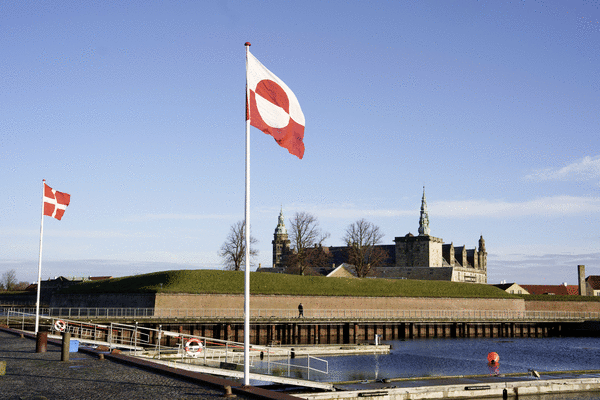
U.S. President Donald Trump reiterated his assertion that the U.S. needs Greenland for national security, urging NATO to back his efforts to gain control of the Arctic territory before a meeting of top diplomats in Washington.
“NATO becomes far more formidable and effective with Greenland in the hands of the UNITED STATES,” Trump said in a post to Truth Social on Wednesday. “Militarily, without the vast power of the United States, much of which I built during my first term, and am now bringing to a new and even higher level, NATO would not be an effective force or deterrent - Not even close! They know that, and so do I.”
Trump said Greenland was vital to the success of his Golden Dome missile defense plan.
Later on Wednesday, Vice President JD Vance and Secretary of State Marco Rubio will meet with Danish Foreign Minister Lars Lokke Rasmussen and his counterpart from Nuuk, Vivian Motzfeldt, just hours after the island’s prime minister said that if made to choose, Greenland would opt for Denmark.
The Europeans sought the meeting to work out the real intentions of the Americans and convince them there’s no need to take over Greenland.
Trump has declined to rule out the use of military force to get the world’s biggest island, saying the U.S. needs it for national defense. Rubio has walked back those comments, arguing the goal is to buy Greenland. The Danes have said it’s not theirs to sell, and Greenlanders that there’s no amount of money that could buy their “national soul.”
What, then, can happen?
The Danes argue that a comprehensive defense agreement dating back to 1951 already allows the U.S. to use the territory as it needs to for defenses — rendering any takeover futile.
Given one of Trump’s central claims is that Denmark has failed to adequately safeguard Greenland, Copenhagen could respond by further boosting its military presence and investment on the island while deepening coordination with the U.S. and other NATO allies. Denmark could also offer to grant Washington expanded access.
On Wednesday, broadcaster DR reported Denmark has already sent more troops and military equipment to Greenland.
Donald Trump is demanding to take control of Greenland, either through economic means or military force.
Greenland and Denmark appear to have taken two options off the table: a purchase and any rapprochement through independence. Greenlanders have ruled out selling their land regardless of how much money would be offered in exchange for ownership, and secession is on the back burner for now.
A move labeled the off-ramp option would be for Greenland to offer Trump a Ukraine-style minerals deal where the U.S. gets access to the island’s rare earths in exchange for security guarantees. Such an agreement would allow Trump to claim victory without annexation and shift the focus from geopolitics to commercial success.
If the U.S. decides it has to have Greenland, there are two key ways the events could unfold.
The U.S. could deploy additional troops in Greenland under the existing defense agreement from 1951, which imposes few formal constraints on expanding its military presence in Greenland, provided it notifies Copenhagen and Nuuk.
Once in place, those forces could move beyond routine activities to take control of government functions and key institutions. It is this shift in purpose — rather than troop numbers — that would signal an occupation, allowing control to be established with far less drama than a conventional invasion.
What’s still widely seen as the least likely scenario, the U.S. could take Greenland by force, seizing key infrastructure. Trump has already bombed Nigeria and extracted Venezuela’s Nicolás Maduro in a raid on Caracas, showing such options are in the toolkit. While the US would almost certainly prevail militarily, Danish forces would be legally obliged to resist, raising the risk of casualties and imposing heavy political costs.
For Europeans, Vance’s role hosting Wednesday’s meeting alongside Rubio raises concerns. The two are known for their differing approaches to diplomacy: while Rubio at the same time embraces Trump’s aggressive approach and seeks ways to deal in private, Vance displays Trump’s penchant for disruptive and unpredictable dealmaking.
In an open display of his antipathy for Europe at last year’s Munich Security Conference, Vance lambasted the continent and told them they were afraid of their own voters. He’s chided Denmark for “not having done a good job by the people of Greenland” and famously instigated a fiery exchange with Ukrainian President Volodymyr Zelenskyy and Trump in the White House last February that almost ruined the relations between the two countries.
Greenland and Denmark go into Wednesday’s meeting with the U.S. with a broader backing from Europe.
France announced it plans to open a consulate in Greenland on Feb. 6, and German Defense Minister Boris Pistorius said annexing Greenland would be a “grave violation of the fundamental principles of international cooperation.”
Jointly defending the security in the Arctic and North Atlantic within NATO “best serves the legitimate interests” of the U.S., he added in a guest article for weekly newspaper Die Zeit published Wednesday.
U.K. Foreign Secretary Yvette Cooper underscored how “Arctic security is a critical transatlantic partnership issue for the security of Britain and NATO,” according to a statement on Wednesday. “Coming together as an alliance allows us to unify and tackle this emerging threat,” she said.
Uncertainty around Trump’s plans for Greenland has helped push the Danish krone to its weakest in six years, fueling speculation the central bank will step in to support it. Still, there is also a mix of other factors behind the krone’s depreciation against the euro.
Trump on Tuesday responded bluntly when asked by reporters about Greenland Prime Minister Jens-Frederik Nielsen’s comments — categorically ruling out joining the U.S. and saying the Arctic territory prefers to be in a union with Denmark.
“That’s their problem. I disagree with them. I don’t know who he is. Don’t know anything about him, but that’s going to be a big problem for him,” Trump said.
With the future of the Kingdom at stake, Danish Prime Minister Mette Frederiksen is seeking to cast the U.S. approach as more than a land grab in a bid to rally allies in the North Atlantic Treaty Organization and the European Union. Speaking at a press conference on Tuesday, she said that while Greenland would bear the most immediate cost, the confrontation reaches far beyond the island, putting the foundations of international order at risk.
“We are standing up not only for ourselves, but for the world order that generations before us have built — our democracy,” she said. “This is not just about Greenland or about the Kingdom. It is about the principle that borders must not be changed by force, that peoples cannot be bought. It is about ensuring that small countries do not have to fear the big ones.”
---------
—With assistance from Sanne Wass, Iain Rogers, Samy Adghirni and Naomi Tajitsu.
©2026 Bloomberg L.P. Visit bloomberg.com. Distributed by Tribune Content Agency, LLC.






Comments