Senate OKs fixes to Florida's school voucher funding model
Published in News & Features
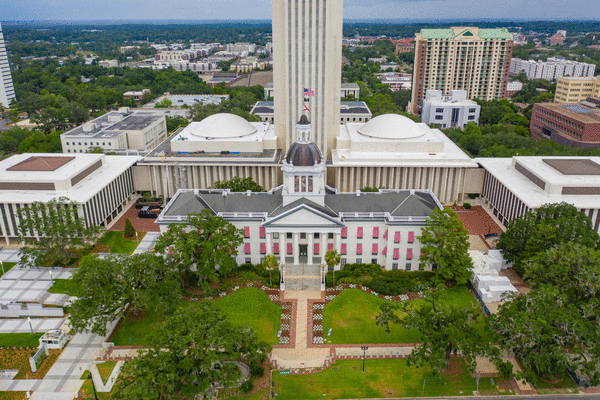
The Florida Senate took a step Wednesday toward reforming the funding model for the state’s $4.3 billion school voucher system, unanimously adopting legislation aimed at fixing problems identified in a recent scathing Auditor General’s report.
Among other things, the measure would move voucher funding into a budget line that’s separate from the money that pays for public schools. It also would require the state to issue identification numbers to all students, and have families regularly confirm where their child is being educated before their education funding is released.
Those steps, recommended in the audit, should help ensure that education funding follows the student as school choice advocates desire, said bill sponsor Sen. Don Gaetz, R-Crestview. Under the existing model, Gaetz said, thousands of students and millions of dollars could not be accounted for on a daily basis.
Some schools did not get funding for students who were attending them, while some voucher recipients paid for services and waited in vain for reimbursements.
The state’s 1972 education funding structure, which relies on predictability and low mobility, “just doesn’t work” in the world of universal choice that Florida rolled out in 2023, Gaetz said.
The 149-page bill, which the Senate immediately sent to the House for consideration, should “save and preserve the (choice) program so it continues to grow and thrive and live up to its potential,” said co-sponsor Sen. Danny Burgess, R-Zephyrhills, chairperson of the Education K-12 Appropriations Committee.
House leaders have indicated a resistance to separating the budgets, contending such a move could lead to a reduction of available vouchers. Gaetz told reporters after the floor vote that he understood the concern, but expected them to be overcome as the chambers work through the details in the coming weeks.
He suggested the Senate’s inclusion in the bill of a $250 million “stabilization” fund, designed to ensure there’s money in case more students apply for vouchers than the base budget covers, should help ease the anxiety.
“I have faith that the House will help solve this problem, because to not solve it is just a terrible thing to do,” Gaetz said.
Last year, the House rejected a similar Senate bill in large part because it aimed to pull voucher funding out of the main education budget.
Democrats in the Senate rallied behind the legislation, calling it a needed step toward improved accountability and transparency in the voucher system that many of them have opposed. Sen. Rosalind Osgood, D-Tamarac, said she looked forward to a day where “every way we deliver education is done in a way in which we can be proud.”
She and others noted that they raised the alarm that the state was moving too fast when it enacted universal vouchers.
“We are still dealing with a $4 billion program, a $4 billion plan that we asked to slow down and we gave some suggestions,” said Sen. Tracie Davis, D-Jacksonville. “For once since I’ve been elected in 2016, a report has been issued and a chamber, a member, a president have actually listened. We can all appreciate that.”
Sen. Corey Simon, R-Tallahassee, said that when he led the charge for universal vouchers in 2023, he knew there would be things to fix. But the bottom line to him was that Florida provided education freedom to children and families.
“We’re here today,” Simon said. “We’re going to preserve this right for children for years to come. That’s what is important.”
__________
(Times/Herald Tallahassee Bureau reporter Garrett Shanley contributed to this report.)
©2026 Tampa Bay Times. Visit at tampabay.com. Distributed by Tribune Content Agency, LLC.






Comments