Mahmoud Khalil could face rearrest after appeals court strikes down decision freeing Columbia University pro-Palestinian activist
Published in News & Features
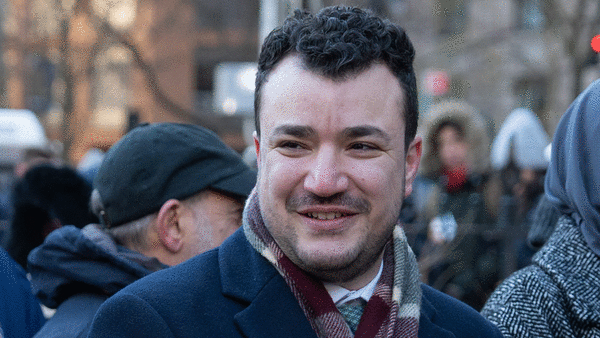
NEW YORK — An appeals court dealt a blow to Columbia graduate and pro-Palestine activist Mahmoud Khalil on Thursday in his legal battle against the Trump administration, reversing a New Jersey judge’s order freeing him from detention while he fights the government’s efforts to deport him.
The split two-to-one decision by the 3rd Circuit Court of Appeals in Philadelphia vacated a ruling by New Jersey Federal Judge Michael Farbiarz freeing Khalil and directed the underlying habeas petition be dismissed. A habeas petition is a legal action brought when a prisoner challenges the lawfulness of their detention.
The court found immigration law mandated that a federal appeals court handle the matter, not a lower level district judge like Farbiarz.
Khalil, a legal permanent resident of Palestinian descent who has not been accused of any crimes, became the face of campus protests at Columbia University against Israel’s war in Gaza, serving as a spokesman and a negotiator between students and the administration.
Last March, he was approached by federal agents at his Columbia-owned apartment and taken into custody, before being quickly transferred to a Louisiana federal immigration detention center. His lawyers brought the habeas petition in federal court soon after he was taken into custody.
Publicly, the Trump administration has accused Khalil of antisemitism and sympathizing with Hamas, a U.S.-designated terrorist organization, vowing to crack down on other pro-Palestinian protesters across American campuses. Khalil has repeatedly denied those allegations, pointing to his public condemnation of bigotry against Jews long before his arrest.
Lawyers for the government have argued that Khalil’s presence in the country ran afoul of U.S. foreign policy interests, citing an obscure provision of the law that allows the Secretary of State to order such persons deported. The government has also accused Khalil of failing to disclose certain info on his green card application.
Farbiarz last year granted Khalil’s request for bail, finding he didn’t pose a danger to the community or a flight risk. He was released in June and reunited with his wife and son, who was born while Khalil was in detention.
The appeals court on Thursday found the Immigration and Nationality Act gave a federal court of appeals, not a lower-level district judge like Farbiarz, jurisdiction over removal proceedings against Khalil.
Lawyers for Khalil did not immediately respond to inquiries. The Daily News reached out to the Trump administration for comment.
“The immigration laws enacted by Congress ordinarily require an alien to challenge his deportation in a [petition for review] — unless he raises questions that a court of appeals could not meaningfully review in that context,” the court wrote, adding he’d raised legal questions that a petition for review could address and that immigration law thus barred Khalil from chalenging his detention in a habeas case.
“That scheme ensures that petitioners get just one bite at the apple — not zero or two. But it also means that some petitioners, like Khalil, will have to wait to seek relief for allegedly unlawful government conduct.”
Khalil’s case against the Trump administration in federal court had become a rallying cry for free speech rights during the president’s second term, sparking protests nationwide and widespread condemnation by Democrats, including those who do not share Khalil’s views on the conflict in the Middle East.
©2026 New York Daily News. Visit at nydailynews.com. Distributed by Tribune Content Agency, LLC.






Comments