Machado: Interim Venezuelan President Delcy Rodríguez is cooperating with US under pressure
Published in News & Features
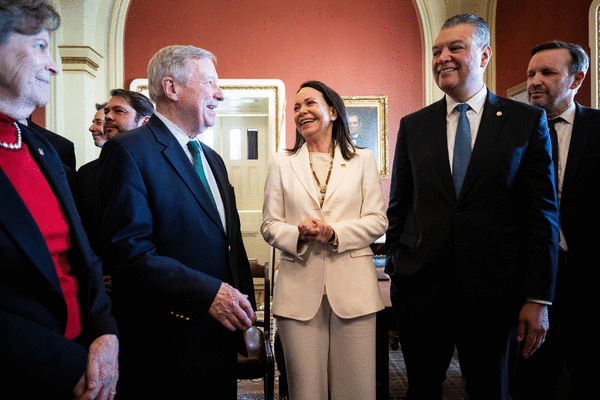
Venezuelan opposition leader María Corina Machado said Friday that socialist interim President Delcy Rodríguez is cooperating with the Trump administration under pressure rather than by choice, and that her main task is to dismantle what she described as a criminal power structure that has sustained repression in Venezuela for more than two decades.
Machado’s comments came hours after The New York Times reported that CIA Director John Ratcliffe had met with Rodríguez in Caracas on Thursday, marking the highest-level visit by a U.S. official since American forces seized President Nicolás Maduro in a raid on the Venezuelan capital nearly two weeks ago.
According to the Times, Ratcliffe’s visit followed a phone call between President Donald Trump and Rodríguez the previous day and coincided with Trump’s meeting in Washington with Machado, the internationally recognized leader of Venezuela’s opposition and a Nobel Peace Prize laureate.
The CIA meeting underscored the Trump administration’s view that Rodríguez represents the most viable short-term path to stability, even as Washington acknowledges her central role in the previous regime’s repression.
CIA analysts assessed that allowing Rodríguez to remain in place temporarily was the best way to prevent Venezuela from “descending into some chaotic situation,” a senior U.S. official told the Times.
The high-profile engagement has frustrated many opposition supporters who expected the U.S. to move swiftly to install Edmundo González Urrutia, Machado’s ally and the winner of Venezuela’s July 28, 2024, presidential election, according to international election experts. Maduro refused to recognize the results and remained in power until his capture earlier this month.
Speaking to reporters in Washington, Machado addressed the CIA meeting directly when asked whether the Trump administration’s engagement with Rodríguez risked legitimizing the interim government.
“She is not acting comfortably or voluntarily,” Machado said. “Delcy Rodríguez is following orders.”
Machado said Rodríguez possesses uniquely detailed knowledge of Venezuela’s repression system, financial networks and sanctions-evasion mechanisms — information that could be of high value to U.S. authorities.
“Few people know as much about the criminal structure of tyranny as someone who helped design it,” she said. “If the United States is obtaining information that it needs, that is the kind of cooperation we expect.”
Machado emphasized that the situation should not be interpreted as a personal rivalry between her and Rodríguez, but rather as a confrontation with what she described as a transnational criminal structure involving state repression, narco-trafficking and alliances with foreign powers hostile to Washington.
“This has nothing to do with tensions between individuals,” she said. “This is about dismantling a cartel structure.”
The news conference followed Machado’s first public appearance in Washington after a clandestine escape from Venezuela by boat, details of which she disclosed publicly for the first time. She said the journey involved waves exceeding 6 feet, strong winds and the simultaneous failure of GPS systems, satellite phones and Starlink communications, leaving her vessel lost at sea for several hours.
“I was injured, we were disoriented, and for hours we had no way to communicate,” Machado said. “It is a miracle that I am alive.”
She declined to provide full details of the escape, citing the risk to people still inside Venezuela who could face retaliation.
Machado said she met with Trump as the legitimate representative of the Venezuelan electorate, citing her 92% victory in the opposition primaries in October 2023 and González’s 67% win in the 2024 presidential election, which she said was carried out under fraudulent conditions imposed by the Maduro government.
“I did not come here as an individual,” she said. “I came representing the Venezuelan people.”
She said Trump assured her that Venezuela could count on U.S. support for democracy, national sovereignty and justice, describing the meeting as frank, extensive and focused not only on economic and energy issues but on humanitarian concerns.
“He asked about children, the elderly, health care, education and families,” Machado said. “This was not just a geopolitical conversation. It was a human one.”
The opposition leader described the current moment as a complex, multiphase transition that began Jan. 3, when decisive U.S. backing altered the balance of power inside Venezuela. She acknowledged that the pace of change has been slower than many Venezuelans hoped but said dismantling a 27-year authoritarian system requires sustained pressure.
“If the Constitution were respected, there wouldn’t be more than 1,000 political prisoners, 9 million Venezuelans in exile, or an elected president living abroad who should have taken office on Jan. 2,” she said.
Machado cited Venezuela’s ranking of 142 out of 142 countries in the World Justice Project’s rule of law index as evidence that constitutional timelines alone cannot guide the transition.
“The process is not constitutional — it is coercive,” she said. “The regime must be forced to dismantle itself, starting with repression.”
She said fewer than 10% of political prisoners have been released and warned against what she called a “revolving door” in which detainees are freed only to be replaced by new arrests. She added that the true number of political prisoners may be higher than previously known, as many families were too afraid to report detentions or disappearances.
“Torture centers must be closed,” Machado said. “Journalists must be able to speak freely. Exiles must be able to return and organize.”
Machado said more than 80% of Venezuela’s armed forces support democratic change, but have been neutralized by the intelligence and counterintelligence apparatus, particularly the DGCIM military intelligence agency. She said Maduro relied increasingly on non-Venezuelan security forces because he no longer trusted the country’s military.
According to The New York Times, U.S. officials believe maintaining Rodríguez temporarily as interim leader could help manage internal tensions within the military and bureaucracy while avoiding a sudden collapse of state authority.
Still, the optics of Ratcliffe’s visit and the administration’s cooperation with Rodríguez have fueled concern among opposition supporters that Washington may prioritize short-term stability over democratic legitimacy.
Asked whether she feared the regime could once again use dialogue to gain time — as it has in at least 17 previous negotiations — Machado acknowledged the concern but said the current circumstances are fundamentally different.
“This time there is real force,” she said. “The cost of remaining in power is higher than the cost of leaving.”
Machado said the Venezuelan people themselves are the ultimate guarantee of a coordinated transition, arguing that popular legitimacy — demonstrated at the ballot box — cannot be ignored indefinitely.
She also revealed that Venezuela has provided nearly 5 billion barrels of oil to Cuba free of charge since 1999, calling it one of the largest transfers of national wealth in the region’s history.
Machado said she has pressed U.S. officials, including Trump, on her desire to return to Venezuela as soon as possible, though she declined to disclose details of private conversations.
“This is not just about my return,” she said. “Millions of Venezuelans want to go home.”
She also described a recent private meeting with Pope Leo as “life-changing,” saying the pontiff is fully aware of the persecution of the Catholic Church in Venezuela and is actively supporting a peaceful transition.
Machado said the United States has become safer since Maduro’s removal and will be more secure once Venezuela completes its transition. She framed the crisis as central to the future of the hemisphere.
“Two hundred years ago, the struggle for Latin American freedom was decided on Venezuelan soil,” she said. “Once again, the future of the region is being fought there.”
She said she intends to return to Venezuela as soon as conditions allow.
_____
©2026 Miami Herald. Visit miamiherald.com. Distributed by Tribune Content Agency, LLC.






Comments