Detroit's new mayor unveiled a host of policy changes in first 30 days
Published in News & Features
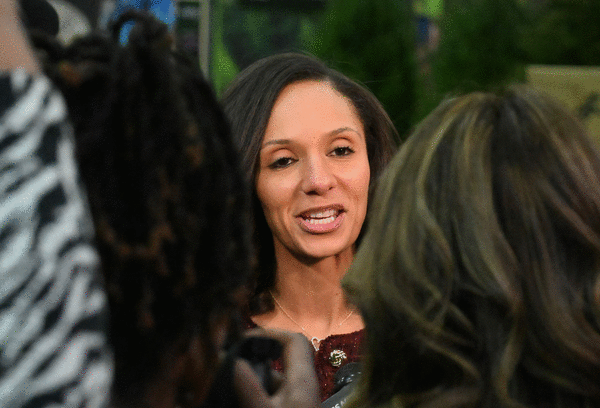
DETROIT — In her first month on the job, Detroit's new mayor launched several major initiatives intended to combat violence and poverty, along with measures intended to expand progress citywide.
Mayor Mary Sheffield said on Jan. 1, the day she was sworn in, she would have a "pretty busy January," and she lived up to that promise. It's too soon to tell the impact of any of her changes, but her plans reveal the more progressive, community-oriented approach she intends to implement, said several of her supporters.
"Progress is only real when it reaches every block, every family and every community in this city," Sheffield said Jan. 9 during a public inauguration ceremony at the Detroit Opera House. "So, the question before us is clear: Where do we go from here Detroit?"
Sheffield, 38, is the city's first new mayor in 12 years, succeeding Mike Duggan, who left the office to run for state governor.
By Jan. 31, she's taken steps to overhaul the city's social services department; expanded a nonprofit program into Detroit that gives cash to every new and expectant mother; created both the Office of Neighborhood and Community Safety and the Human, Homeless, and Family Services Department; instilled a new compliance program for senior citizen housing facilities; and amped up safeguards of home demolition sites, among other measures.
"We have been very serious about our commitment to addressing the issue of poverty in Detroit, uplifting the most vulnerable in our city, and ensuring that we are directly investing in people," the mayor said Jan. 12 when she named the new chief executive of the city's Health, Human Services & Poverty Solutions department. She appointed Luke Shaefer, a University of Michigan professor who focuses on poverty and social policy issues.
The move realigns the city's social services departments, with Shaefer overseeing the city's Health Department, the Office of Immigrant Affairs and Economic Inclusion, and the new Human, Homeless, and Family Services Department. The objective is for the department to bring together services that were scattered across multiple divisions into a single, coordinated system.
In her first week in office, she also unveiled that Rx Kids will launch in the city, giving $1,500 cash to all expectant mothers in the city, along with $500 per month after birth for at least six months. The program is expected to launch within the next 100 days. Rx Kids already operates in several other Michigan cities.
Detroit has a 34.5% poverty rate, and its infant mortality rate has fluctuated in recent years, according to city data. An estimated 8,000 babies are born in Detroit each year, city officials said, and all of the expectant mothers, at least 16 weeks pregnant, and families are eligible for the program.
Tackling overassessments
On Friday, Sheffield signed an executive order intended to improve the way the city determines how much homeowners pay in annual property taxes. The city's property tax assessor office will now align various processes with the International Association of Assessing Officers, which Sheffield described as the "gold standard" for municipalities.
Assessments, particularly assessments of homes of lower value in Detroit, has been a controversial issue for years in the city. In 2020, a Detroit News investigation found the city overtaxed homeowners by at least $600 million after it failed to accurately bring down property values in the years following the Great Recession, roughly between 2009-2016. Tens of thousands of homeowners were likely overcharged. Some lost their homes in foreclosure.
The Coalition for Property Tax Justice called Sheffield's executive order to address overassessments insufficient and vague in key areas.
“The leaders of the Coalition for Property Tax Justice and I are disappointed with Mayor Sheffield’s executive order on property tax assessments because it merely scratches the surface and does not go far enough," said Bernadette Atuahene, a leader with the group.
Atuahene, a law professor at the University of Southern California, said the Sheffield administration sent her a draft of her executive order in January and the group sent back a "mark-up" but "she didn't incorporate any of it."
The group worked with Sheffield when she was a city council member, and Atuahene said it was too early to "pass any judgement" on her mayoral administration.
Sheffield was on the Detroit City Council for 12 years and served as president before being elected in November. She's also a a fourth-generation Detroiter and various members of her family have been active in the Black church, unionism and the civil rights movement for over 100 years.
Council President James Tate said there are "huge expectations" for Sheffield's administration "because this one feels a bit more organic."
"Not just because she's a former council member, but a Detroiter," said Tate in an interview in late January. "She has a heart for the community. She has certainly the intelligence to pull this off."
Tate believes Sheffield's experience and background will play a role in improving many issues in the city, from lowering taxes to combatting violence to cutting red tape for businesses.
"It's about the way you approach things, right?" he said.
Office of Gun Violence Prevention
Many hope her community-oriented approach will translate into policies that improve various issues in both big and small ways.
Dujuan Zoe Kennedy is executive director of FORCE Detroit, a nonprofit that does community violence intervention, has been in discussions with the Sheffield administration about its efforts to create the city's first Office of Gun Violence Prevention, joining a growing national movement.
"She has a firm understanding of how to really address the issue, the preventive steps, specific improvements we can make that can help people," Kennedy said. He also credited her for pursing "best practices" in the formation of the new office. Sheffield has not announced details of the office.
Many await the results of the recommendations from Sheffield's Rise Higher Detroit transition team, which she formed in December, shortly after winning the mayor's race.
The transition effort is being led by 50 business, community and philanthropic leaders who are helping shape and guide policy. There are 18 different "policy committees" who are expected to come up with specific actionable measures, from improving public transportation to cutting red tape. Part of the effort includes a community survey and a series of public meetings.
The results are expected to be released in April.
-----------
©2026 www.detroitnews.com. Visit at detroitnews.com. Distributed by Tribune Content Agency, LLC.






Comments