New Iran deal distant prospect as US talks drag, airstrikes loom
Published in News & Features
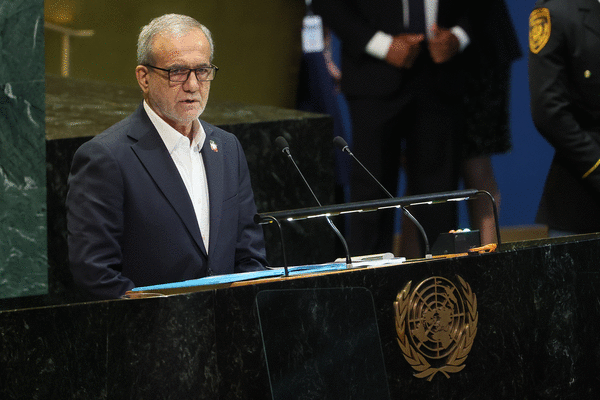
The United States and Iran each struck a positive tone about the start of diplomatic talks, though analysts remain skeptical that the engagement will be enough to head off U.S. airstrikes.
The timeline and terms of the negotiations remain unclear after an opening round of talks on Friday that President Donald Trump cast as “very good” and Iranian President Masoud Pezeshkian hailed as a “step forward.” But developments since those discussions started only underscore the persistent tension between the two sides.
Over the weekend, Iran continued its crackdown on dissidents, risking Trump’s ire after he held back on strikes due to Iranian assurances that it would halt protester executions. On Monday, the U.S. warned American vessels to steer clear of Iranian waters, spooking oil markets and renewing the prospect of conflict.
Analysts see almost no chance of a serious deal given that Iran wants to limit negotiations to its nuclear program. The U.S., meanwhile, has previously demanded that Iran give up its ballistic-missile program, stop supporting military groups and end a crackdown on protesters.
Israeli Prime Minister Benjamin Netanyahu is likely to push Trump to demand more Iranian concessions in a White House meeting on Wednesday.
“Talks will ultimately break down, and so we probably will still see strikes at some point,” said Bloomberg Economics analyst Dina Esfandiary. “The key question is how long talks go before breaking down, and how long Trump’s patience endures.”
Also complicating the talks is the balancing act that Trump has to strike with his repeated and public threats of airstrikes on Iran and his boasts that a U.S. “armada” is assembling in the Middle East.
His administration is also emboldened after a successful special operations raid that captured Venezuelan leader Nicolas Maduro in January. Trump has said on social media that “like with Venezuela,” the U.S. Navy is “ready, willing, and able to rapidly fulfill its mission, with speed and violence, if necessary.”
With the markets weighing the chances of U.S. airstrikes against a TACO — an acronym for “Trump Always Chickens Out” — a Bloomberg Economics analysis found Trump has been more likely to follow through on threats in his second term.
The U.S. also has shifted its position multiple times. Trump originally wanted to protect Iranian protesters and later decided on a deal to constrain Tehran’s nuclear and ballistic missile programs.
“For talks to actually lead to something meaningful, they will have to include certain things,” Secretary of State Marco Rubio said last week, just before the talks began. “And that includes the range of their ballistic missiles. That includes their sponsorship of terrorist organizations across the region. That includes the nuclear program, and that includes the treatment of their own people.”
For Tehran, though, agreeing to the broader slate of U.S. demands would amount to total capitulation — giving up weapons and regional policies that have been core to Iran’s geopolitical, regional and core survival strategies since the 1979 revolution. The country also is grappling with a crumbling economy and months of domestic unrest that have been the most significant threat to the regime in several decades.
At the same time, Trump pulled the U.S. out of the 2015 Iran nuclear accord in his first term — and has even reneged on trade pacts with Canada and Mexico, making any eventual accord unreliable at best — even if the two sides manage to come to some agreement.
“If you were looking at a Venn diagram, there is no overlap,” said Naysan Rafati, a senior analyst on Iran at the Crisis Group, of the conflicting priorities. “When it comes to the potential of a military confrontation, we’re nowhere close to out of the woods.”
While U.S and Israeli strikes in June degraded Iran’s military capabilities — with Trump claiming that its nuclear program had been obliterated following Operation Midnight Hammer — Tehran can still hit back.
With Iran facing threats from within on top of those from the U.S., the country has “cause to fear for its survival” and there’s no real way to tell how fiercely the regime will retaliate, said Michael Singh, a managing director at the Washington Institute for Near East Policy.
“Even if they can’t win, they’ll try to make a conflict costly for the United States,” Singh said, adding that U.S. insistence on a more comprehensive deal increases the chance of clashes. “It’s a very high bar. And so if that’s really your bar, you have to assume that military strikes are definitely the most likely outcome.”
_____
©2026 Bloomberg L.P. Visit bloomberg.com. Distributed by Tribune Content Agency, LLC.





Comments