In State of the State address, Gov. JB Pritzker pitches affordability and Illinois resilience to Trump
Published in News & Features
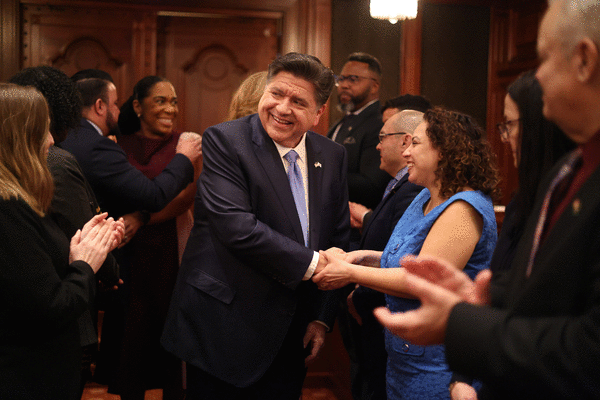
SPRINGFIELD, Ill. — With an eye toward this election year and possibly the next, Democratic Gov. JB Pritzker used his State of the State and budget address to outline a message of resistance to President Donald Trump and the need to push affordability against the economic moves of his White House.
Speaking before a joint session of the Illinois General Assembly, the two-term chief executive, who is seeking reelection and a potential 2028 White House bid, said the Trump administration’s actions federal funding cuts for various programs — which he likened to “proclamations from the Lollipop Guild” — have cost the people of Illinois $8.4 billion.
“When Donald Trump is taking resources away that are rightfully ours, none of us — Democrats or Republicans — should be OK with that,” he said, before issuing a stark warning aimed at Republicans that caused some of the most conservative lawmakers to walk out of the House chamber. “If you want to talk about our fiscal year 2027 budget, you must first demand the return of the money and resources this president has taken from the people of Illinois.”
Pritzker also noted Trump’s aggressive enforcement of immigration laws by federal Immigration and Customs Enforcement and other federal agents in the Chicago area during Operation Midway Blitz. He called Illinois the “canary in the coal mine” for the federal agents’ actions in Minneapolis, where two U.S. citizens were shot and killed.
“It’s a playbook as old as the game — overwhelm communities, provoke fear, suggest that those tasked with enforcing the law are also above it — and drip authoritarianism bit by bit into our veins in the hopes that we won’t notice we are being poisoned by it,” Pritzker said. “The problem for Donald Trump and (Trump senior homeland security advisor) Stephen Miller was that Illinoisans did notice.”
Adopting the refrain of “affordability” that politicians have recited nationally for the midterm elections, Pritzker used his eighth budget speech to say that the state’s “narrative and our economy is changing and improving, and we’re setting ourselves up for even better results in the years ahead.”
“We won’t let headwinds from Washington stop us from addressing the fact that Illinoisans, like Americans everywhere, are still paying too much for groceries, too much for housing, too much for electricity, too much to live,” Pritzker said. “Everything is just too damned expensive.”
For the budget year that begins July 1, Pritzker proposed a rough hold-the-line spending plan, contending the state needs to play financial defense against future Trump moves to slash federal funding in states the president views as his political opposition.
Among his proposals was to drop a state incentive program for large data centers amid concerns over the effect their massive electricity use would have on residential ratepayers. He also issued an executive order directing his staff to identify sites for new nuclear power plants after a state moratorium was lifted.
To encourage more housing, Pritzker is asking lawmakers to limit local governments’ authority over certain residential zoning areas so that multi-family and other structures can be built.
He also sought to resurrect plans lawmakers failed to endorse from last year’s speech to ban students’ use of cell phones in schools and allow community colleges to offer specialized bachelor’s degrees.
On the revenue side, he proposed a new tax on social media companies based on how many users they have in the state — a concept that could raise $200 million earmarked for education. But as the March primary and November general election loom, there was no call for a general tax increase, as he also called on lawmakers to curb their spending habits to create new programs.
Pritzker’s $56 billion election-year budget plan represents one of the smallest increases in state spending the governor has proposed since the governor took office in 2019. The plan, if approved by the Democratic-controlled legislature, would raise spending on day-to-day state operations by only about 1% compared with what Pritzker proposed and ultimately signed into law last year.
In addition to the social media company tax, the governor’s plan also estimated raising $120 million from taxing table games and electronic gambling devices at casinos at the same rates, and $269 million from extending a cap on corporate tax deductions for operating losses.
Spending on many major state programs would remain flat under Pritzker’s proposal, while elementary and secondary education would see a $305 million increase over the current year, for a total of $9.2 billion. For the second straight year, the proposed increase is below the $350 million minimum increase set by a school funding overhaul signed into law by Pritzker’s Republican predecessor. But the governor is proposing to continue a pause approved last year on the portion of the funding increase that goes to a property tax relief grant program.
For public universities and community colleges, Pritzker is proposing an additional $16 million in state funding, a 1% increase from the current year, with $13 million going to universities. Funding for the Monetary Award Program, a program Pritzker frequently touts that provides grants to low-income students, would remain flat at $721.6 million.
The proposal would also put on hold Pritzker’s plan to add 20,000 seats to state-funded preschool programs over four years. Intended as a signature initiative of the governor’s second term, the expansion was paused in this year’s budget after adding 11,000 seats over its first two years.
The state budget year will also mark the launch of Pritzker’s new Department of Early Childhood as a stand-alone state agency, with day care licensing responsibilities and staff transferred from the Department of Children and Family Services. Pritzker is proposing a budget of nearly $2.1 billion from the state’s general fund for the new department, with some of that funding transferred from DCFS and other existing agency budgets.
With Republicans once again campaigning on public safety issues despite falling crime rates, Pritzker’s plan highlights funding for two additional classes of Illinois State Police cadets and to hire 100 additional correctional officers for the Illinois Department of Corrections. The governor also proposes to continue spending $111 million on his Reimagine Public Safety anti-violence initiatives, programs originally launched with federal pandemic relief funds.
The governor’s plan calls for making the state’s full required pension payment of $10.7 billion, though fiscal watchdogs have long said those payments are inadequate to address the state’s gaping unfunded pension liabilities of about $144 billion.
Funding for a program that provides health insurance to some noncitizen immigrants over 65 was proposed at $143.6 million, the same as the current budget year’s appropriation of $110 million. Last year, the governor cut a similar program for middle-aged adults as a way to save hundreds of millions of dollars to close a budget gap.
The state-funded programs were a source of tension among Democrats who control the legislature despite their ardent support from Latino Caucus Democratic lawmakers in Springfield. Last year, a report from the Illinois auditor general’s office showed the programs had cost the state more than $1.6 billion since the initiative began in late 2020 and had been plagued by improper enrollments and a failure to move some recipients who were eligible into Medicaid, the traditional health insurance program for the poor that is jointly funded by the federal government.
Looming over Pritzker’s spending plan are ongoing fights with the Trump administration over federal funding for a wide variety of programs. The governor’s plan assumes that money from Washington, including $1 billion for child care programs, will continue to flow to the state.
But if those federal funds are cut off, the state will either have to find new ways to pay for those programs itself or drastically reduce services, state budget officials said.
Pritzker reserved much of the final minutes of his address to deliver a form of a love letter to Illinois and the country, urging citizens to use that emotion to embolden their hopes despite “the turbulence of Donald Trump.”
“I am begging my fellow politicians, my fellow Illinoisans, my fellow Americans to realize that right now in this country, we are not fighting over policy or political party. We are fighting over whether we are going to be a civilization rooted in empathy and kindness–or rooted in cruelty and rage,” Pritzker said.
“I love my country. I refuse to stop. The hope I have found in a very difficult year is that love is the light that gets you through a long night,” he said.
____
©2026 Chicago Tribune. Visit at chicagotribune.com. Distributed by Tribune Content Agency, LLC.



Comments