In Tampa, storm-weary residents detail the costs of extreme weather
Published in News & Features
TAMPA, Fla. — An Ybor business owner closed her yoga studio repeatedly from worries over moldy, waterlogged walls.
A Pinellas woman’s home flooded in one hurricane, and a tree crushed her car in another.
A Tampa student feared her insulin would become ineffective in extreme, hot temperatures.
On Wednesday night, one after another, Tampa Bay residents spent about two minutes each chronicling how extreme weather, worsened by climate change, has hurt their wallets and health. The testimonies were part of an event called the Extreme Weather People’s Hearing, held by the Climate Action Campaign, a coalition of organizations aimed at influencing federal climate policy.
The latest event in Tampa is part of a series. Similar hearings have taken place in cities like Asheville, North Carolina, where Hurricane Helene washed away homes, and Los Angeles, where wildfires flattened neighborhoods.
A through line emerged from the testimonies in Tampa. Destruction from extreme weather is expensive, and without curbing climate-change-causing emissions, the price will only get higher.
The Tampa event came less than a week after the Environmental Protection Agency revoked its bedrock scientific conclusions, called the endangerment finding, that have been foundational in U.S. regulation of greenhouse gases and combating the effects of climate change.
“When we’re talking about climate change, it’s not just about the weather,” U.S. Rep. Kathy Castor said during the event. “It is about your wallet.”
Castor talked of rising electric bills and the financial toll of rebuilding after hurricanes.
“I’m thinking about the affordability squeeze that people are suffering right now, and how, when you gut pollution protections, you’re making their lives harder,” Castor told the Tampa Bay Times on Wednesday.
“You’re making their lives more expensive.”
Alice Moore, a Tampa resident who spoke at the hearing, said she watched her car float after one of the 2024 hurricanes. In a city with few transportation options, she had no choice but to buy a new car and take on a $500-a-month car payment.
“That means going back into debt,” Moore said.
Another woman, Patricia Tezzas of St. Petersburg, bought her home in 2001.
Her neighbors’ homes flooded, but Tezzas’ did not. Yet, her homeowners insurance doubled after the storms, and rose again in September.
Tezzas now has to pay nearly $8,000 to insure her home in August on a fixed, retirement income.
She’s thought about moving, she said, but homes listed for sale have gone unsold on her street. No one can afford the insurance, she said.
“Our president, of course, calls climate change a hoax, while our area faces destruction,” Tezzas said.
Tampa Bay is no stranger to the ills of a warming climate, experiencing hurricanes strengthened by heated waters and dangerously hot days.
Jeff Berardelli, chief meteorologist for WFLA News Channel 8, spoke during the event and pointed to Tampa’s first recorded 100-degree day last summer.
“Over the past six years, we’ve had one record low temperature in Tampa. How many record highs have we had?” Berardelli asked the audience.
Five, someone shouted. Another guessed 15.
“How about 129,” Berardelli said.
Tampa resident Walter Smith, an environmental civil engineer and community organizer, said the pressure that extreme weather puts on residents, from infrastructure woes to rising utility costs, is a human rights issue.
“The psychological impact, the deaths, the illnesses, the number of people that are telling us that ‘we’re going to move away from Florida, from the Tampa Bay area, because nobody listens to us, nobody cares about us,’” Smith said.
“These are elderly people with fixed incomes who are having to leave here because they can’t afford it.”
Tampa Mayor Jane Castor also spoke Wednesday night. She talked of Tampa’s sustainability accomplishments and resiliency after the 2024 storms. But she agreed: The city can do better.
“We are here this evening to listen to you, to hear your stories, to hear what was done right, some great ideas that you may have, and some things that we as a city could improve upon,” the mayor said.
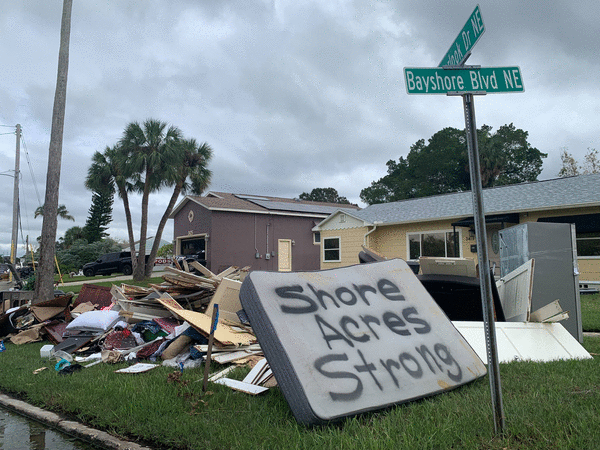
Tami Shadduck, a St. Petersburg resident, works in public health. She asked her Shore Acres neighbors to share how they were feeling one month, six months and a year after Hurricane Helene.
“The sheer scale of the health impacts to my community alone is reason enough to reinstate the endangerment finding and to further support FEMA (the Federal Emergency Management Agency),” Shadduck said.
Residents reported anxiety, depression, post-traumatic stress disorder and chronic stress.
One resident told Shadduck that most days, they feel nothing.
Shadduck made a pointed suggestion to Mayor Castor, saying that local leaders could do better at providing mental health help after major disasters.
The evening closed with Rep. Castor, who said she would take residents’ stories back to Washington, D.C.
“I don’t know how policymakers can look away right now, look away (from) the damage to the health impact, the mental health impacts, the impacts to your bottom line,” she said.
“Tell your story again,” she added. “Tell it over and over again.”
_____
©2026 Tampa Bay Times. Visit tampabay.com. Distributed by Tribune Content Agency, LLC.





Comments