10 cases of measles already reported in Minnesota this year
Published in News & Features
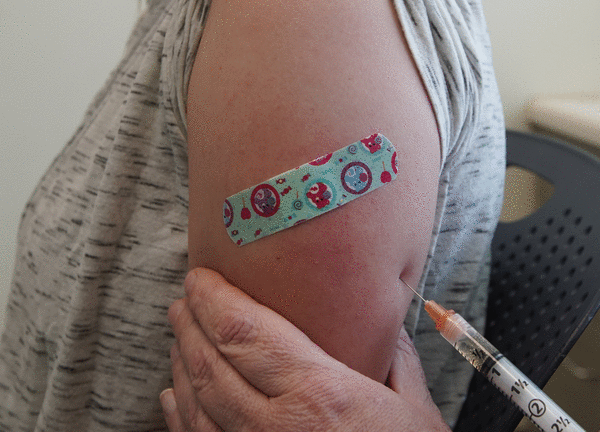
MINNEAPOLIS — Minnesota has reported 10 measles cases so far in 2026 amid a declining vaccination rate that’s left more people vulnerable to the highly infectious disease and its characteristic head-to-toe rash.
The case cluster is raising concerns when considering that Minnesota had 26 infections in total last year. All 10 people were diagnosed after being infected in the United States, according to Thursday’s updated count by the Minnesota Department of Health, showing that the viral disease is gaining a foothold. Minnesota rarely reported more than one or two cases per year in the 1990s and 2000s, when almost all infections involved travel to countries where measles is endemic.
“This is the new era we are in,” said Jayne Griffith, an epidemiologist for the state’s vaccine-preventable diseases unit. “There is a lot of measles in the U.S. right now.”
The latest Minnesota infections centered around a network of friends and relatives in the Twin Cities area and ranged from unvaccinated infants to young adults up to age 25. Griffith said the infected people had minimal contact with others outside that group, raising hope that the cluster won’t result in more infections.
If there are more cases, Griffith said, “we would expect to see them probably starting at the end of next week.”
The measles virus is considered one of the most infectious pathogens on the planet. When infected people cough or speak, they spread particles that can remain suspended in the air for up to two hours. People often have mild or no symptoms in the first four or so days, meaning they can unwittingly spread the virus before rashes and high fevers emerge.
An athlete at the Metrodome during the 1991 Special Olympics reportedly spread the measles virus to others, including two people seated in the upper deck, far above the athletes. Minnesota had the nation’s largest cluster of 75 cases in 2017, when the measles virus spread quickly at two child care centers.
Rare measles complications include pneumonia and brain swelling. None of the Minnesotans in the current cluster had severe complications or needed hospitalization.
Minnesota’s cases in the current cluster weren’t related to a measles outbreak in a federal facility in Texas, Griffith said. Federal agents transferred numerous immigrants there after they were detained during Operation Metro Surge. Quarantine orders designed to prevent further transmission reportedly delayed some immigrants from returning to Minnesota.
The U.S. eradicated measles in 2000 , but that status is in jeopardy. The federal government reported 269 cases in 2024 and 2,256 last year. Already, 2026 is on pace to shatter that total; the Centers for Disease Control and Prevention on Thursday reported 976 cases and large outbreaks in South Carolina and Utah.
“There are many unvaccinated or under-vaccinated communities here in the U.S. that we didn’t necessarily know about because there wasn’t that much measles going around,” Griffith said. “There wasn’t an opportunity to have broader exposure and broader transmission.”
The CDC earlier this year reduced the number of childhood vaccines it recommends from 17 to 11, encouraging parents instead to talk with doctors about whether to immunize their children against COVID-19, influenza and other infections. The federal agency continues to recommend children receive by age 6 two doses of the measles, mumps and rubella (MMR) vaccine, which is considered 97% effective at preventing measles.
The number of vaccinations has declined, particularly since the pandemic, when people upset over COVID-19 vaccines and vaccine mandates lost confidence in other recommended shots as well. Less than 87% of Minnesota children were fully vaccinated on schedule last year, compared to a measles vaccination rate above 93% a decade earlier, according to state data.
The federal response to the declining vaccinations and rising infections has been muddled under President Donald Trump and Health Secretary Robert F. Kennedy Jr., who has long fomented concerns over a debunked link between the MMR vaccine and childhood autism. Studies have disproved any relationship between the two.
Dr. Mehmet Oz strongly recommended the measles vaccine earlier this month when speaking in his capacity as administrator for the federal Centers for Medicare and Medicaid Services. Trump’s nominee for surgeon general, Dr. Casey Means, was less enthusiastic during her Senate confirmation hearing this week. She said parents should make individual decisions in consultations with doctors and that she “accepts” the science showing no link between the MMR vaccine and autism but that “science is never settled.”
The CDC last year stopped recommending an option for parents to seek a first dose that combines the MMR and varicella (chicken pox) vaccines because of a known risk of episodic seizures in toddlers. The practical effect of that change is likely small in Minnesota, though, as only a fraction of parents seek the combination vaccine as the first dose for their children.
Younger adults uncertain of their vaccination status can use the Docket app or file a state request to view their immunization histories. Government records are less reliable for older adults, Griffith said, who instead might need to ask their doctors. As a practical matter, she said, people who served in the military or were born after 1968 and attended public school in Minnesota likely were vaccinated against the measles.
©2026 The Minnesota Star Tribune. Visit at startribune.com. Distributed by Tribune Content Agency, LLC.






Comments