Senators question Pentagon official over El Paso airspace closure
Published in News & Features
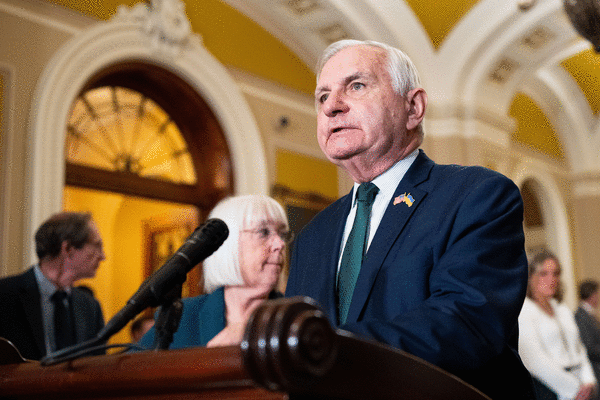
A key Pentagon official on Thursday brushed off criticism from senators over the department’s role in an episode that led the Federal Aviation Authority to briefly close the airspace over El Paso, Texas, earlier this month.
Under questioning during his Senate Armed Services Committee confirmation hearing to become the top Pentagon official in charge of homeland defense, Mark Ditlevson, who currently serves as the deputy to the position he has been nominated for, disputed characterizations that the Pentagon did not properly coordinate with the FAA on the use of a counter-drone laser.
“This was not a failure,” Ditlevson said in the first extended public comments from a Pentagon official about the incident. “We’re confident that this will not be a problem in the future. We’re going to continue to refine how we work with the FAA. And I defer to the FAA on the judgment decision to put up a temporary flight restriction. But we feel at the department we have been incredibly safe, and that’s our commitment to the American people.”
Some senators appeared unsatisfied by Ditlevson’s answers.
“The coordination failed,” said ranking committee member Jack Reed, D-R.I. “When the FAA has to order an airspace closed for 10 days, particularly a critical airspace like El Paso, something is wrong. Somebody made a mistake, and it may be the FAA. But I think it’s critical to recognize there was a failure of coordination and successful coordination required by the statute.”
On Feb. 11, the FAA announced it was closing the airspace over El Paso for 10 days — only to quickly reverse and lift the flight restrictions after a few hours. While ultimately brief, the abrupt closure alarmed lawmakers in both parties.
The Trump administration initially attributed the closure to the Defense Department responding to an incursion from a Mexican cartel drone.
But media outlets later reported that the real reason was that the Defense Department allowed Customs and Border Protection agents to use a military-owned laser system to shoot down a suspected drone without FAA approval, in the middle of a dispute between the FAA and the Pentagon over the safety of testing that system near civilian airports.
Further, according to several reports, the object border patrol agents shot down turned out to be a party balloon, not a drone.
Ditlevson was one of the Pentagon officials who supported using the counter-drone laser despite FAA concerns, according to a Feb. 14 New York Times report.
At Thursday’s hearing, Ditlevson argued that the department met its legal requirements to coordinate with the FAA under so-called 130i authorities. First enacted as part of the fiscal 2017 defense authorization bill and amended most recently in the fiscal 2026 NDAA, 130i refers to the section of law that dictates how the Defense Department can conduct counter-drone operations on U.S. soil.
“The statutory requirement for 130i authorities is to coordinate with the FAA. It does not require approval from the FAA,” Ditlevson said. “We have coordinated with the FAA for over 14 months, sharing technical data back and forth, having our scientists working with theirs so that they know the safety level of this particular system, and we continue to work together.”
Ditlevson also insisted the Pentagon notified the FAA both when the laser system was fully operationally capable and ahead of firing the system.
But Sen. Tim Kaine, D-Va., noted reports suggest the notification came minutes before firing, which he argued would be insufficient.
“We had a crash at DCA-Reagan a little bit over a year ago. Sixty-seven people, including three members of the United States Army, lost their lives because of inadequate communication between the DoD and the FAA, and this was a danger that we had repeatedly warned about,” Kaine said.
“And so when we see something like this in El Paso — and thank goodness, flights were canceled, but there were no injuries or deaths — and then we hear that, ‘No, there was adequate communication between the parties,’ forgive us for being skeptical.”
_____
©2026 CQ-Roll Call, Inc., All Rights Reserved. Visit cqrollcall.com. Distributed by Tribune Content Agency, LLC.





Comments