Iran's 'Axis of Resistance': The proxy forces shaping Mideast conflicts
Published in News & Features
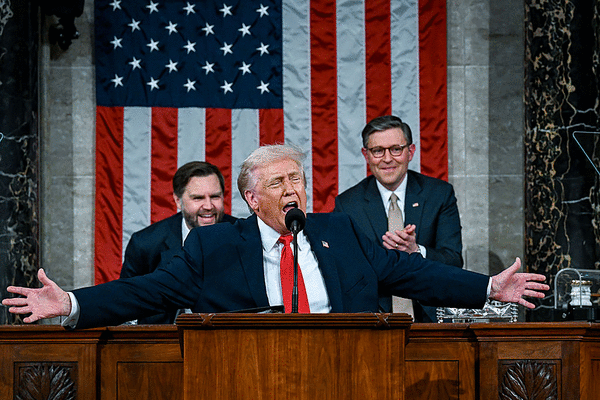
In his announcement unveiling U.S. attacks on Iran, President Donald Trump assailed the Islamic Republic's "proxies" in the region.
"From Lebanon to Yemen and Syria to Iraq, the regime has armed, trained and funded terrorist militias that have soaked the earth with blood and guts," Trump declared Saturday. The United States, Trump vowed, was determined to ensure that Iran's proxies "can no longer destabilize the region or the world and attack our forces."
Iran has indeed provided military, financial and technical support to various organizations dubbed by Iran "the Axis of Resistance." The far-flung militias represent crucial regional projections of Tehran's power, emissaries from the Persian nation to conflict-ridden Arab countries.
Most of the groups are, like Iran itself, composed of members of the Shiite branch of Islam, a minority of global Muslims, but major populations in the "Shiite Crescent" that stretches from Iran to Iraq to Syria to Lebanon and the Mediterranean. Echoing Iranian positions, the groups embrace struggle against what they label U.S.-Israeli hegemony and the illegal occupation of Palestinian lands.
The Iranian proxies are distinct from mostly Sunni Muslim militant organizations like Al Qaeda — responsible for the Sept. 11, 2001 attacks — and Islamic State, an Al Qaeda offshoot.
Despite a shared enmity for the United States and Israel, the Shiite and Sunni militias are bitter sectarian foes. Al Qaeda and Islamic State generally view Shiites as infidels and consider Iran a mortal enemy.
Here are some Iranian-backed groups:
Hamas
The only group that Trump cited by name, Hamas ("Islamic Resistance Movement") was founded in 1987, after the start of the first intifada — or uprising — against Israel.
The Sunni Islamist organization did not receive large-scale aid from Iran until the 1990s, and, according to Israeli press accounts, Israel provided early support as a counterweight to the secular Palestinian Liberation Organization. Since 2007, Hamas has controlled the Gaza Strip, where it has functioned both as a military force and a de facto government dispensing social services.
It was Hamas that launched the Oct. 7, 2023, cross-border strikes against Israel that led to the death of some 1,200 people.
An additional 251 people were taken hostage. The subsequent Israel-Hamas war killed more than 70,000 Palestinians, according to the Hamas-run Gaza Health Ministry, a tally the United Nations and other independent observers considers reliable.
The war, the latest and most extensive Israel offensive in the Gaza Strip, has greatly debilitated Hamas. Israel says it has killed thousands of combatants, including numerous high-level Hamas commanders.
Though Iran is Shiite and Hamas Sunni, a shared opposition to Israel unites the two.
Iran and its proxies accuse Israel of conducting a campaign of mass murder, persecution and ethnic cleansing against indigenous Palestinians, charges that Israel rejects. Hamas is a longtime rival of the secular Fatah faction, which governs in Palestinian-held areas of the West Bank.
Another militant faction, Palestinian Islamic Jihad, is a more direct Iranian proxy than Hamas in both Gaza and the West Bank.
Hezbollah
Hezbollah ("Party of God") is the jewel in the crown of Iran's proxy allies.
A predominantly Shiite Islamist group, Hezbollah has for decades been a major military and political force in Lebanon, which borders northern Israel.
With Iran's patronage, Hezbollah arose from the chaos of the Lebanese Civil War (1975-90) and in opposition to Israel's 1982 invasion of Lebanon and its subsequent 18-year occupation of southern Lebanon.
Posters of the late Ayatollah Ruhollah Khomenei, founder of the Islamic Republic, long adorned walls and lampposts in Lebanon's Bekaa Valley, a Hezbollah stronghold.
Hezbollah also holds seats in Lebanon's Parliament and, like Hamas, operates a large social-service network and has resisted demands to disarm. Hezbollah dispatched troops to neighboring Syria during that country's civil war (2011-24) to assist the government of then President-Bashar Assad, a longtime ally of Iran.
Hezbollah has been in frequent conflict with Israel, including a 34-day war in 2006. An Israeli military campaign in 2024 significantly degraded Hezbollah's capabilities. A major blow was the killing of the group's longtime leader, Hassan Nasrallah, in an Israeli airstrike. Nasrallah did some of his studies in the Iranian city of Qom, a hub for Shiite scholarship.
Houthis
Officially known as Ansar Allah ("Supporters of God"), the Houthis are based in Yemen, on the southwestern tip of the Arabian Peninsula. Yemen is regarded as the poorest country in the Middle East. Like Hamas, the Houthis emerged as a force before receiving substantial Iranian support.
A 2014 civil war resulted in the Houthis seizing control of the capital, Sanaa, and large portions of northern and northwestern Yemen, including a strategic swath of the Red Sea coast.
Tehran has provided weapons, training and other aid to the Houthis, according to Washington, though the Houthis belong to a separate branch of Shiite Islam than the "Twelver" sect prevalent in Iran.
Since the beginning of the Gaza war, the Houthis have launched drone and missile attacks against Israel and vessels in the Red Sea, which it claims were connected to Israel — often erroneously. Last year, Trump said he ended a bombing campaign targeting the Houthis after the group agreed to cease attacks. "They're tough, they're fighters," he said of the Houthis.
Ansar Allah's informal name, Houthis, comes from the surname of the late political and religious leader, Hussein Badreddin Houthi.
Iraqi groups
For years, Iraqi dictator Saddam Hussein sealed off Iranian influence in his country, viewing Tehran as a threat. The neighboring nations fought a bloody 1980s war, initiated by Hussein, with support from Washington.
But the 2003 U.S.-led invasion that ousted Hussein and his Baathist rule opened up Iraq — with its majority Shiite population — to large-scale Iranian presence. An array of Iran-aligned Iraqi militias emerged in Iraq, many hostile to the U.S. presence.
These mostly Shiite militias are now grouped under the umbrella of the Popular Mobilization Forces. The groups are technically part of the Iraqi armed forces, but some receive aid and training from Iran's Islamic Revolutionary Guard Corps.
In January 2020, during Trump's first presidential term, he ordered a drone strike near the Baghdad airport that killed Qasem Suleimani, an important Iranian general and head of the elite Quds Force. Several high-ranking militia commanders were also killed.
Suleimani, an Arabic speaker, was a central figure in the formation of Iran's proxy constellation. He assisted Iranian-linked militias that targeted U.S. troops and bases in Iraq, according to the Pentagon, resulting in the deaths of hundreds of U.S. troops.
____
(Times staff writer Nabih Bulos contributed to this report.)
©2026 Los Angeles Times. Visit at latimes.com. Distributed by Tribune Content Agency, LLC.




Comments