Trump's Iran war widens, forcing reluctant allies to choose
Published in News & Features
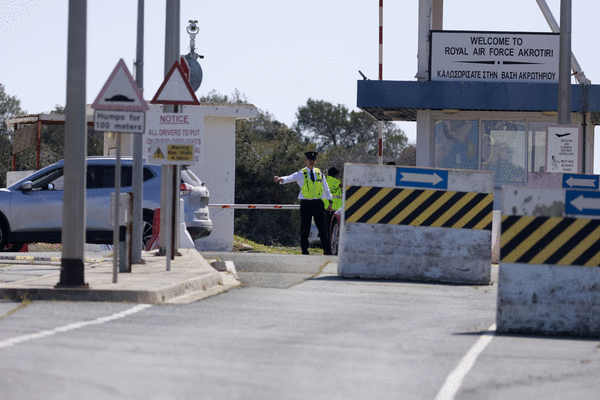
A British base in Cyprus struck by a drone. A French facility in Abu Dhabi targeted. A base hosting Italian troops in Kuwait hit. Saudi oil facilities attacked as ships queue outside the Strait of Hormuz. Missiles over Bahrain and Qatar. Gulf airspace shut down.
In just over 48 hours since the U.S. and Israel began striking Iran, the conflict has widened fast.
Countries that say they aren’t part of it are already being pulled in, their bases, infrastructure and citizens exposed to retaliation. At some point, America’s allies will have to choose. How much U.S. activity do they host? How far do they stretch “defensive” support? What do they do when their own territory is struck? The longer the fighting drags on, the harder it becomes to stay on the sidelines.
The risk is that reluctant states are drawn into it, creating a coalition of the unwilling. Even limited involvement carries consequences. Bases used today can become targets tomorrow. Governments that take even a limited role may face retaliation long after the missiles stop flying — through renewed strikes, proxy attacks or terrorism years down the line.
For some leaders, the calculation is fraught: refuse Washington and risk a rupture with President Donald Trump; lean in and face political backlash at home from voters wary of another Middle East war.
“Allies are in a position where they can’t support it and they can’t not support it,” said Jeremy Shapiro, research director at the European Council on Foreign Relations and a former Obama administration official. “They hate it, but they can’t not support it because the United States is too wound up in their defense and the Iranian regime is too odious.”
No capitals face more immediate danger than those lining the Gulf, where oil terminals, refineries, airports and shipping lanes sit within range of Iranian missiles and drones.
Interceptions and falling debris have already caused damage on the ground. The UAE reported fatalities, and airports in Dubai and Abu Dhabi were struck. Saudi Arabia halted operations at its Ras Tanura oil facility after it was targeted, as Houthi rebels in neighboring Yemen vowed to renew attacks on global shipping.
Gulf governments have publicly urged restraint. But in emergency meetings, officials have made clear they reserve the right to respond in self-defense, even as they stress they are not joining the U.S.-Israel effort.
A senior Western official based in the Gulf said some regional governments believe Trump was pushed into the war by Israeli Prime Minister Benjamin Netanyahu and is now in deeper than he intended. Anger is rising as leaders search for a way to protect their populations, the official added, arguing the only exit may be persuading Trump to declare victory and step back.
It hasn’t helped that the U.S. leader has offered various and often contradictory goals for the war, saying at times that it’ll be three days or five weeks, arguing it’s about Iranian freedom but also that he’ll negotiate with the regime’s remnants.
“Confusion reigns supreme due to the lack of clear U.S. strategy and endgame,” said Bader Al-Saif, an assistant professor at Kuwait University and an associate fellow at Chatham House. Gulf states may be forced to defend themselves, even if they don’t join the U.S.-Israel effort, he said. “Everything is on the table.“
For Britain — Washington’s closest ally in Europe and often expected to stand with the U.S. in moments of crisis — the choice has been fraught.
In the weeks before U.S. military action, the U.K. denied permission to use the joint base at Diego Garcia and an air base in England for a strike, over legal and policy concerns. When the attack went ahead, Britain stressed it had not taken part. Senior ministers declined to say whether they believed the operation was lawful.
Prime Minister Keir Starmer’s Labour Party still carries scars from Tony Blair’s decision to join the 2003 invasion of Iraq. When he shifted course, Starmer invoked the need to avoid repeating the “mistakes of Iraq.”
Still, as Iranian threats mounted against British bases, civilians and Gulf allies, the government concluded it was within international law to allow U.S. forces to use British facilities for a “limited defensive purpose” targeting missile storage depots, Starmer said. Soon after, a suspected drone struck RAF Akrotiri in Cyprus, though a military assessment determined it was launched before his announcement rather than in retaliation.
Trump told the Daily Telegraph he was “very disappointed” in Starmer for initially blocking U.S. use of the Diego Garcia base for strikes on Iran, saying Starmer “took far too long” to grant access to the facility — a reminder of how quickly the U.S. president can turn on even close allies who hesitate.
“That’s probably never happened between our countries before,” Trump said. Though rare, it has happened: Another former Labour leader, Harold Wilson, famously resisted U.S. pressure to deploy British troops to Vietnam in the 1960s.
Trump’s demands put allies in “near impossible positions,” said Rachel Rizzo, an expert in transatlantic relations and senior fellow with the Observer Research Foundation in Delhi.
“They have to weigh multiple things at once: public opinion, their relationships with the United States, and their own national security,” she said. “Trump having to answer to allies’ positions is a constraint and he doesn’t like that.”
Other European governments are trying to draw tighter lines.
France and Germany issued a joint statement alongside the U.K. stressing they didn’t take part in the initial strikes while leaving room for defensive action. European officials are wary of escalation and uneasy about being drawn into a conflict they did not initiate. Yet their bases and personnel sit within the widening arc of the war.
A French military installation in Abu Dhabi was hit, and a base hosting Italian personnel in Kuwait was also struck, though no Italian troops were injured.
President Emmanuel Macron said yesterday that France would “step up its defensive posture” in the Middle East after the U.S.-Israeli strikes, pledging to protect French citizens and bases and to “stand alongside” countries targeted by Iran under existing defense treaties.
According to a senior European diplomat, the scale of the U.S. operation shows how important it remains for the U.S. to maintain bases and assets in Europe to support wars in the Middle East — suggesting the conflict could reinforce, rather than weaken, America’s military footprint on the continent.
Another European official said that the bloc’s own approach is contradictory: It wants to stand with protesters and prevent Iran from gaining nuclear weapons, but it’s not prepared to do much tangible to achieve those aims.
Still, Beniamino Irdi, a senior fellow at the German Marshall Fund and former Italian government official said Trump’s lack of coordination with European allies makes it more difficult to persuade them to participate.
“If neither tactical actions nor strategic objectives are coordinated with allies, it becomes harder to see why they should put skin in the game,” he said.
There’s also the chance, given the Trump administration’s hostility toward Europe, that it won’t ask the E.U. to get involved.
“Capable partners are good partners, unlike so many of our traditional allies who wring their hands and clutch their pearls, hemming and hawing about the use of force,” Defense Secretary Pete Hegseth said at a briefing on Monday.
---------
—With assistance from Alex Wickham, Andrea Palasciano, Donato Paolo Mancini, Alberto Nardelli and Samy Adghirni.
©2026 Bloomberg L.P. Visit bloomberg.com. Distributed by Tribune Content Agency, LLC.





Comments