Republicans from Tallahassee to Miami disagree on developing a booming Florida
Published in News & Features
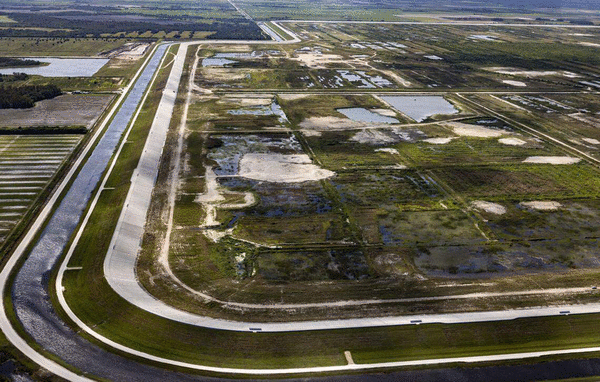
Disagreement over how to develop a Florida still booming with newcomers is dividing Republicans in Tallahassee and in Miami-Dade, where lawmakers are at odds over proposals that could lead to development in protected areas.
Two bills that would incentivize sweeping development changes in rural areas and outside urban boundaries that protect farmland and the Everglades were passed Tuesday off the House floor and in a final Senate committee. The legislation now heads to the Senate floor, where they are expected to meet resistance from Republicans.
At issue: HB 399, which would make it easier to build on protected farmland and the Everglades and would likely push through a controversial water park plan at the Fontainebleau hotel; and SB 354, which would allow developers that own more than 15,000 acres of “contiguous” land to build their own master plans that are locked in for at least 50 years upon approval.
Three Miami Republican senators are trying to stop a provision in the House bill that would allow the County Commission to approve development plans in protected rural and Everglades lands with a simple majority vote. Currently, two thirds of the 13-member board must approve the project, creating a high bar for greenlighting it. The bill is sponsored by Rep. David Borrero, a Hialeah Republican.
Sens. Alexis Calatayud, Ana Maria Rodriguez and Ileana Garcia told the Herald/Times in a joint statement that they “stand united in opposition to HB 399 and any attempt to lower the voting threshold required to push the line outward.”
“Miami-Dade County’s Urban Development Boundary (UDB) is more than a planning tool, it is a promise to protect our drinking water, reduce flooding risk, preserve farmland, and safeguard the Everglades that define South Florida,” they said.
Garcia added over text message that there’s no justification for proposed change.
“We have a UDB line for specific reasons: Protect the Everglades from sprawl, protect wetlands and agriculture and properly manage growth,” Garcia said. “How can we pursue federal funding for the protection and restoration of the Everglades while we pass state legislation to decimate it?“
In Miami-Dade on Tuesday, commissioners approved a resolution by Commissioner Vicki Lopez, a former Republican member of the Florida House, opposing the legislation.
Both the House and Senate versions of the bill propose having the state Office of Program Policy Analysis and Government Accountability study what would happen if Florida lawmakers did away with the Urban Development Boundary altogether. While there are other urban boundaries throughout Florida, the impact would be so great on Miami-Dade, it was singled out in a staff analysis.
The Senate version of the bill, SB 208, is ready for a vote on the Senate floor. The versions differ, and it’s unclear which one senators will take up and vote on. The Senate bill is less aggressive, and doesn’t offer to lower the voting threshold or contemplate having a local government administratively approve projects like the Fontainebleau’s water park.
On Tuesday morning, state Senate Rules Chairwoman Kathleen Passidomo, an influential lawmaker with the power to tank legislation, lamented the many bills the Legislature is considering this year to spur development, potentially at the cost of local control and the environment, without a clear vision to guide lawmakers in the effort.
“Our state desperately needs to shift away from piecemeal changes to local and state development laws,” Passidomo said in her committee before voting against a bill that would incentivize massive development projects across North Florida, as well as further south.
“Is the best path for Florida’s land use regulation likely to come out of throwing a dozen different proposals on the wall to see which one sticks? I don’t think so,” Passidomo continued. “It’s time for us to take a serious look at growth management, not in a piecemeal fashion, as we have been doing these last couple of years.”
Passidomo is leaving the Legislature in November due to term limits. She said Sen. Stan McClain, an Ocala Republican sponsoring both the rural development and urban boundaries bills in his chamber, was amenable to her vision.
“I’ve spoken with Sen. McClain and he’s indicated to me that he is committed to take the lead over the next several years to undertake that task,” she said. “I can’t think of a better person to do it.”
McClain’s rural development bill would allow developers that own more than 15,000 acres of “contiguous” land to build master plans that set aside 60% of the area for “reserve,” which critics said was not strident enough to ensure the land would remain pristine. The master plan would have to be approved by the local government but critics said it did not go far enough in including them in the details.
The master plan would be locked in for 50 years, making changes difficult if not impossible, once it is approved by local elected officials.
“It should be considered as part of an overall discussion of how we want the state to grow and develop over the next 30, 50, 100 years or more,” Passidomo said. “This bill, as it stands today, is not ready.”
McClain said he was trying to plan for development that is inevitable.
“Whether we do this or not, land is going to continue to get developed in Florida,” McClain said during the Rules Committee debate. “By 2030, we’ll be at 25 million [people].”
McClain added: “So there’s another 3 million people that are going to move to Florida.”
Jason Garcia, who publishes the investigative substack called Seeking Rents, reported that a New York investment firm, Ruane Cunniff, is behind the legislation. Garcia reported the firm has “spent at least $230 million buying up more than 80,000 acres across north Florida—amassing giant tracts of rural land near Jacksonville, St. Augustine, and Panama City.”
Ruane Cunniff isn’t registered to lobby on the bill, but Big Lands Transect Collaborative LLC — which Garcia and the Florida Phoenix have reported is controlled by Ruane Cunniff — is. The Herald/Times reached out to a lobbyist registered on the bill on behalf of Big Lands, but they did not immediately return a text message seeking comment. The bill doesn’t require developers to buy the land all at once, increasing the opportunity for companies to quietly purchase land in more rural areas throughout the state, not just the north.
Sen. Don Gaetz, another former senate president, said he didn’t like how the bill seemed to target just a few developers with its requirement that they own such a large amount of land—increasing from 10,000 to 15,000 acres in an amendment McClain filed on Monday.
“Across the state of Florida, there are very few, very few owners who own or will own 15,000 acres of developable land,” Gaetz, a Pensacola Republican, said. “And so, now, what we have is a bill that used to be for a lot of people, but not thousands of people. And now, unfortunately, we have a bill that is for the few and the very few. And for that reason, I’m down on the bill.”
_______
(Miami Herald staff writer Douglas Hanks contributed to this report.)
©2026 Miami Herald. Visit at miamiherald.com. Distributed by Tribune Content Agency, LLC.




Comments