Volunteer is archiving Renee Good memorial site artifacts
Published in News & Features
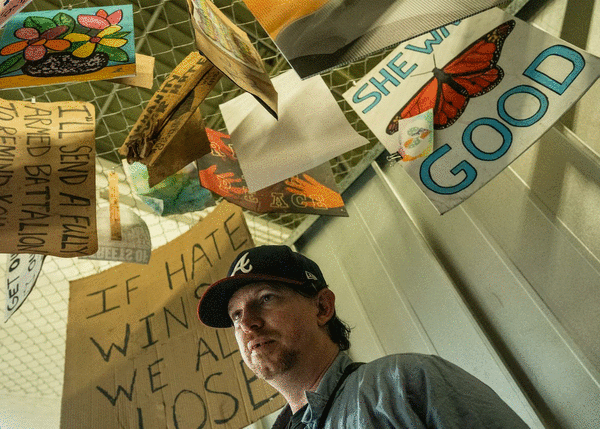
MINNEAPOLIS — Ryan Vizzions started collecting posters from the spontaneous public memorial that sprung up at the site of Renee Good’s killing. The traveling photographer appointed himself the site’s caretaker.
He also gathered many other items — a cookie jar filled with handwritten letters rolled into scrolls, letters addressed to Good’s family, a canvas covered with names of people killed by federal agents since 2025.
“All these are prayers,” Vizzions said. “These are things that people brought because they cared. We owe it to them to try and preserve them and save them and make it so the future can learn about what happened here.”
When it comes to archiving spontaneous public memorials, there are no clear pathways for what to do. The work is fluid, and caretakers volunteer because they feel called to do so. It’s all open-ended and grassroots; people write the rules as they go along. Even the city of Minneapolis doesn’t have timelines for what happens to memorials, city spokeswoman Jess Olstad said.
At Good’s site, it’s unknown where the gathered items will ultimately go, but community members are in contact with the Good family about next steps.
Vizzions initially rented a storage unit for the posters and other items, but moved them to a more secure undisclosed residential location in south Minneapolis.
“These sites emerge when the future feels uncertain and the past feels unfinished,” said Alex Pretti memorial site caretaker Jadah Green, 43, at a “Caring for Spontaneous Public Memorials After State Violence” panel discussion Feb. 27. “They are not permanent installations. They are not yet historical memory. They are living thresholds.”
Vizzions has been guarding, cleaning and organizing the site since the day after Good was killed. The site is vulnerable to changing weather and vandalism ― like when someone poured gasoline on it and lit a nearby pile of wood on fire Feb. 17.
The city doesn’t take care of the sites, but might help with cleanup or security. Caretakers do the daily work of talking to visitors, cleaning the site and keeping it beautiful.
Paul Eaves of Minneapolis helps out at George Floyd Square and the Pretti and Good memorial sites.
“It’s not about ego,” said Eaves, 77. “It’s about service.”
Minneapolis City Council Member Jason Chavez said he would like to see a permanent memorial for Good, but stressed that it’s up to the family, and it isn’t a decision that the city will or should make.
“I’ve heard from so many Latino neighbors, immigrant neighbors, about the courage that Renee Good had to look out for our community in a time when many of us feel like we have been sent back into the shadows,” said Chavez, who called the memorial a sacred space. “She brought light into this world.”
He wants caretakers and people affected by ICE to have a place “to mourn and celebrate Renee’s life, and a place where we can never forget what the federal government did and continues to do to our community.”
Vizzions, the main caretaker at Good’s site, has to return to his hometown of Atlanta by March 16 for jury duty. He isn’t sure when he’ll be back in Minneapolis, but he’ll remain a part of the team from afar.
Vizzions’ favorite piece from the memorial is a painting on cardboard of Good in blue with the American flag.
“When we were doing the watch and we’d sit out there next to the fire, this one was facing us,” he said of painting. “For three weeks I stared at this piece.”
Vizzions raised more than $2,000 to pay for the storage space and equipment, including lights, backdrop, camera stands, tables, storage boxes and more.
In 2017, he published the photo book “No Spiritual Surrender: A Dedication to the Standing Rock Movement.”
He was in northern Minnesota on another project when he heard about Good’s killing. He drove down to Minneapolis and began camping out in front of the memorial in his van.
Through the process, he feels he’s become part of the community, and he’s contributing to the greater good.
Rise & Remember Executive Director Jeanelle Austin said that back in 2020, community members waited nearly two months to reach out to George Floyd’s family.
“You have to be able to give the families the time that they need to do all of the other things that take priority, and then when the family is ready, for them to decide what they want to do,” Austin said. “As caretakers, we’re keepers of the stories ― our job is not to make final decisions or final calls of what’s to come next.”
Austin said they offered the family three options: take everything and put it in your garage; donate items to a variety of museums because no single museum could take everything, or start a nonprofit organization and work to keep the entire collection together.
Floyd’s family chose the third option, and what started as George Floyd Global Memorial transformed into Rise & Remember.
“It was rooted in the decision of the family for us to continue this work,” she said.
At Pretti’s memorial in Minneapolis near 26th Street and Nicollet Avenue, it has been only a little over a month since federal agents fatally shot him. Caretakers are in the early stages of archiving the Pretti site.
There are about 15 dedicated caretakers at the site. They organized a big cleanup on Feb. 11, clearing ice, composting flowers and consolidating the memorial.
People routinely film and take pictures of the site from their cars, as well as walking up and visiting the memorial.
“We’re just holding steady ― holding the space and the beauty,” said Green, one of the Pretti caretakers.
Wesley Hortenbach, 28, said that caretakers plan to ask the family if they have any wishes first, before doing anything.
“If they wanted items here, then we’d give them whatever.”
©2026 The Minnesota Star Tribune. Visit at startribune.com. Distributed by Tribune Content Agency, LLC.




Comments