NC Gov. Josh Stein asks for $1.4 billion to fund state's 'critical needs' now
Published in News & Features
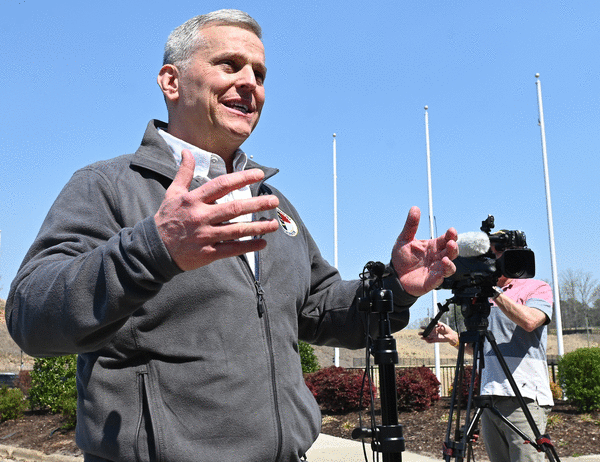
RALEIGH, N.C. — With a state budget almost a year overdue, North Carolina Gov. Josh Stein is urging the General Assembly to spend $1.4 billion on what he calls “critical needs” to keep the state running.
That includes a public safety package with raises for state troopers and correctional officers; raises for teachers and state employees; and Medicaid funding — that he wants funded now, before lawmakers start their next session.
“The state keeps operating at a baseline, limping along, so much so that some things are already breaking the state,” Stein told reporters during a news conference on Monday at the Albemarle Building in downtown Raleigh.
“The state faces certain critical needs that require immediate attention,” Stein said, and state government “cannot wait.”
“Today, I’m calling on the General Assembly to fast-track a stripped down, $1.4 billion critical needs budget to fill the gap. Once that’s done, we can move on to the full budget and all of its complexities,” he said.
Stein, a Democrat, faces an uphill climb persuading the Republican-controlled General Assembly to approve his funding requests anytime soon.
The legislative session begins April 21. Stein will make more budget proposals as the session dates draw closer.
Here’s what Stein wants and why North Carolina is in this position.
Raises for law enforcement, correction officers
There are more than 270 vacancies in the State Highway Patrol, according to Stein’s office. As part of a $211 million public safety funding proposal, Stein wants:
—10% raises for correctional officers, law enforcement officers and youth counselors;
—10% raises for nurses and behavioral health technicians who work in state‑run facilities;
—6.5% raises for juvenile court counselors, probation officers and parole officers;
—$3.7 million for the State Bureau of Investigation and $80 million for the Department of Adult Correction, both to address budget shortfalls.
Raises for teachers
As part of Stein’s pitch to spend for $397 million on public education “critical needs,” primarily raises, he’s proposing:
—Increasing starting teacher pay by 13% to at least $49,518, which includes both state and local supplements.
—5.8% average raise for experienced teachers, instructional support personnel, school psychologists, speech pathologists and audiologists.
—2.5% raises for principals.
—Restoring extra pay for teachers who have master’s degrees.
John Lassiter, principal of Hertford Grammar School in Perquimans County, said his county is losing teachers to school systems in neighboring Virginia because they pay better.
“Educators deserve a raise that reflects the dignity and prestige this profession was once known for,” said Lassiter, who is also president of the North Carolina Principals and Assistant Principals’ Association. He said the state should compete for teachers, so it doesn’t just become a training ground for other states.
Raises for state employees, COLA for retirees
Stein also wants:
—$340 million to fund 2.5% raises for state employees.
—2.5% one-time cost of living adjustment for retired state employees.
Citing 3% inflation, Stein said “our state employees are being asked to do the same job today for less money than they earned a year ago.”
The money would provide a raise of about $1,095 for the average state employee, and the COLA for retirees would average $604, according to proposal documents.
All raises, if passed, would be retroactive to July 1, 2025.
The state’s consensus revenue forecast, which comes from the Office of State Budget and Management in Stein’s administration and the legislature’s Fiscal Research Division, will come out the week of March 23.
Why NC didn’t have a 2025 budget and doesn’t have a 2026 one yet
The General Assembly did not pass a new budget in 2025, which was the main purpose of the legislative long session. The Republican-controlled House and Senate could not come to a final agreement — instead passing three small spending bills. The biggest hurdle in negotiations between Senate leader Phil Berger and House Speaker Destin Hall, both Republicans, is how to implement future tax cuts.
The budget impasse has meant no across-the-board raises for tens of thousands of state employees or teachers.
Berger told The News & Observer in a recent interview that the Senate is willing to discuss legislation to give teachers and state employees raises, but that the House does not want to negotiate raises until they come to an agreement on taxes first. Hall sees the tax cuts and teacher raises as being tied together.
This week there are a few legislative committee meetings scheduled, but no voting sessions. The House and Senate held procedural sessions Monday, which they have been doing for a few days once a month as the General Assembly has still not officially adjourned its 2025 session. However, no votes have been held since October.
Medicaid funding
Another aspect to the House vs. Senate battle last year, tied to the budget fight, was failing to pass additional Medicaid funding. Stein urged lawmakers to pass a bill and set an October deadline for cuts to begin. But after lawmakers failed to act, and then faced lawsuits, Stein’s N.C. Department of Health and Human Services rescinded the cuts.
Money will run out by the end of the fiscal year, which is June 30. Stein wants lawmakers to act on Medicaid funding now, rather than make it part of a big budget deal later. He wants $319 million for the current fiscal year, which has less than four months left.
DHHS Secretary Dev Sangvai said “the sooner, the better.”
“The deadline is now. The result of not getting the funding is we have to go back to think about programs and services,” Sangvai said. He and Stein both said that creates chaos and uncertainty.
Stein also wants the General Assembly to spend $20 million on increasing the child care subsidy rate, $46.4 million for the UNC System to “keep up with student population growth,” and $14.5 million for increased utility costs.
_____
©2026 Raleigh News & Observer. Visit newsobserver.com. Distributed by Tribune Content Agency, LLC.




Comments