Kentucky's Senate candidates divided on how to handle artificial intelligence
Published in News & Features
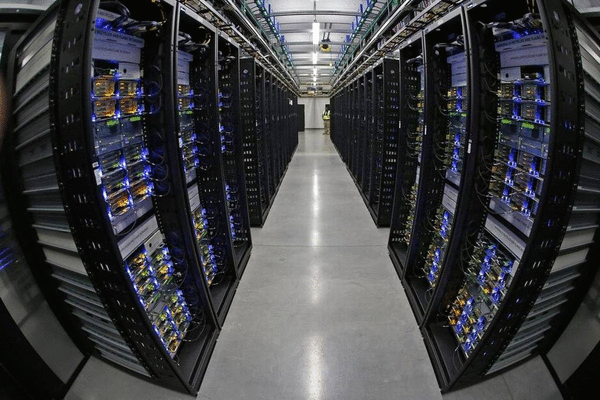
Artificial intelligence is likely the most transformative technology of this generation.
It’s already reshaping industries and raising questions about energy, the environment and the future of the workplace.
What role will it play in Kentucky politics?
The Herald-Leader asked several candidates for U.S. Senate in Kentucky their thoughts on how they’d approach AI if they were to fill the Senate seat currently held by GOP Sen. Mitch McConnell, who is not running for reelection this year.
The majority of Republican candidates supported a preemption on states regulating AI, meaning that individual states could not regulate the industry beyond federal standards. The administration of President Donald Trump has put out an executive order supporting preemption, but it would require an act of Congress for that to go into effect; such a preemption passed the House included in Trump’s 2025 budget bill, but failed to make it in the Senate version.
The three GOP candidates leading in the polls — U.S. Rep. Andy Barr, former Attorney General Daniel Cameron and Lexington tech entrepreneur Nate Morris — all agree with the administration’s push on preemption. They all also hope to secure the president’s endorsement ahead of the May 19 primary.
Michael Faris, a fourth GOP candidate with less name ID and money who is still running a vigorous campaign, rejected the idea of preemption, saying his opponents were reflecting the desires of their “wealthy donors.”
This year’s Democratic candidates are more split. Lexington attorney Logan Forsythe said he could get behind a preemption push under a different president, but didn’t trust the Trump administration to set the rules. Former senate candidate Charles Booker and state House Minority Floor Leader Pamela Stevenson both said they would be against preemption.
All candidates on both sides of the aisle interviewed by the Herald-Leader expressed support for communities who may not want data centers in their backyards.
Aside from that, they weren’t in lockstep. Their responses vary at a time when political messaging on AI across the country is in flux.
Republican elected officials nationwide are largely supportive of Trump’s pro-AI agenda. But some, like Florida Gov. Ron DeSantis, are sounding the alarm on the proliferation of power-hungry data centers across the U.S.
So far, the public is skeptical. According to a recent YouGov poll, a majority of Americans don’t trust AI, and 45% expect it will be more negative for the economy than positive.
What do Republicans say?
Morris, Cameron and Barr told the Herald-Leader they’re with Trump 100% on the matter of preemption.
“I think the president’s been really clear. We’ve got to be for innovation, but we’ve got to be responsible. I know that the president’s heart and what he’s trying to do is protect the American worker, and I think that’s not going to change regardless of the technology that continues to evolve,” Morris said.
Barr’s and Cameron’s responses tracked along similar lines.
They both brought up an oft-repeated point: better the U.S. lead on AI than China, and the regulatory framework for winning that race should be one unified system.
“When we think of this global race in AI, I prefer that we lead on it as opposed to China. Therefore, the regulatory landscape needs to be provided guidance by Washington, as opposed to someone like… California dictating the rules for the rest of the country,” Cameron said.
The majority of the American companies leading on AI, such as Anthropic, OpenAI, Google and Meta, are based in California, a largely Democratic state.
Barr struck the most bullish tone on AI. He made the point that AI, as it currently exists, is a matter of interstate commerce well within Congress’ right to regulate with something like an AI preemption statute.
On the matter of jobs — Anthropic’s CEO has warned it could eliminate half of all entry-level white collar jobs — the sitting congressman said he’s a “free market guy” and would be hesitant for the government to intervene in the marketplace.
“I believe that, just like with the advent of the automobile or the advent of the internet or any other technological breakthrough, it’s disruptive. But the benefits in the long run of productivity can very well outpace the costs,” Barr said.
Barr added that he’d spoken Jensen Huang, CEO of the massive AI chipmaker Nvidia, about his plan to reignite Kentucky’s coal industry by meeting AI power demand. He said Huang, who spent some of his formative years in the region at the Oneida Baptist Institute “was very interested in that idea.”
Cameron, whose home turf in Oldham County recently rebuffed a data center proposal, expressed support for local residents not bearing the energy cost for the centers. The Trump administration recently signaled it wanted to put the onus of power generation on the companies building the data centers.
“To the extent these centers want to come into a community or state, they’ve got to be willing to take up whatever the additional power generation looks like. They’ve got to be willing to take that cost and not have that cost fall on the residents of a particular community or county,” Cameron said.
In sharp contrast to the leading three candidates, Faris expressed skepticism about the industry.
He doesn’t buy the narrative that continuing to allow state-level regulation of AI would cripple America in the AI race against China, arguing “we’re well above and ahead of China already.”
He said he had no interest in “trumping states rights” with a preemption statute. Why are his opponents in support of preemption? Faris had a simple answer.
“I would point to the idea of corruption and pay to play politics. It’s what their wealthy donors want,” Faris said.
The Democrats on AI
None of the five Democrats running well-funded campaigns in Kentucky expressed support for preemption led by the Trump administration.
Stevenson and Booker were the most forceful in their opposition.
“This moratorium saying that the only people that can do it are people that are appointed at the federal level doesn’t work in the current system. We say we have a system where the states are united together through the federal government, and at the same time they have autonomy,” Stevenson said. “Let them have autonomy.”
Booker said he understood the concerns of people pushing for preemption, but he landed on the same side of the question as Stevenson. He also called for a moratorium on new data center construction “while we wrap our arms around this revolution.”
“This is another industry that is built on the data and the ingenuity of hard-working people, and we need to make sure that the people of Kentucky have an equity stake and get dividends from it too,” Booker said.
A longtime progressive, he also said that the effect it could have on the job market strengthens his argument for universal basic income.
Forsythe, McGrath and Romans didn’t say they were opposed to the idea preemption on its face. Forsythe said he understood it could be helpful for the country, but didn’t like the Trump administration at the wheel.
“It makes certain things just easier and more fair when everything is regulated the same, right? However, I don’t trust the current administration to preempt state laws in regards to AI with all the influence from people like Elon Musk, who has a huge incentive to ensure there’s less regulations on this kind of stuff,” Forsythe said.
They all expressed sympathy for communities who didn’t want AI data centers in their backyard.
McGrath — who said she would have to review the executive order, but made clear that communities need input on if a data center can come to town — said “AI growth is inevitable,” but the government needs to be “smart about it.”
“Tech companies need to pay their fair share for any grid upgrades that might be needed, instead of shifting costs onto taxpayers. (Voters) are also very, very concerned about the cost of the energy costs going into that and that being shifted onto people in the community, and they’re also very concerned about the environmental impact,” McGrath said.
Citing her military background, McGrath said she was very concerned about the U.S. continuing to lead in the AI race. Alarm bells were set off last year when Chinese company Deepseek released a large language model with similar capabilities to some U.S. firms, but American companies have continued to be the standard-bearers.
She said it’s “eye-watering” how scary the technology could get in the wrong hands, and pushed back on the Trump administration’s recent deal to provide high-powered chips key to powering AI to the United Arab Emirates. That deal occurred following a $500 million dollar investment from Emirati royalty into a cryptocurrency firm run by Trump’s sons, and experts have worried the chips could end up helping Chinese AI development.
Romans said that communities should have a say on data center placement, but they could be a big positive if they’re well-placed and don’t raise taxes or electricity bills. He expressed mild support for one planned near where he lives in Jefferson County.
“These data centers are going to make a lot of money, but they’re also going to produce a lot of good jobs, so there are a lot of upsides to having them, but they have to be put in the right places and paid for by the right people. It should never damage a community, and I don’t think it would. I think, done properly, it would be a positive for southern Jefferson County,” Romans said.
©2026 Lexington Herald-Leader. Visit at kentucky.com. Distributed by Tribune Content Agency, LLC.






Comments