Industrial chemicals have reached the middle of the oceans, new study shows
Published in News & Features
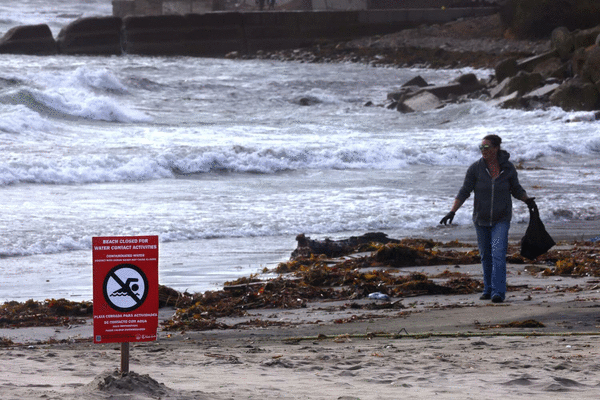
New research shows the chemicals we use to kill pests, heal our bodies and package our foods are spread throughout the ocean, intermingling with the microorganisms that feed marine life. They’ve reached even the most distant and remote places on the planet.
In a new study, Daniel Petras, a biochemist at the University of California, Riverside — together with 29 researchers from around the world — looked at 2,315 seawater samples collected from estuaries, coastal regions, coral reefs and the open ocean. The samples came from the North Pacific, the Baltic Sea and the coast of South Africa, among other places. For each sample, the researchers used a relatively new technique that allowed them to see every chemical present — not just ones they were looking for or suspected.
What they found was disconcerting: Human-made chemicals were everywhere, even in water hundreds of miles from land.
The study was published Monday in Nature Geoscience.
“This presents a pretty sobering view of just how widespread these chemical pollutants have become in the ocean,” said Douglas McCauley, an associate professor in the Department of Ecology, Evolution, and Marine Biology at UC Santa Barbara. McCauley was not involved in the research.
At the mouths of rivers and along the coasts, the research team found large concentrations of pharmaceuticals such as beta blockers, antidepressants and antibiotics. They also discovered cocaine and methamphetamine, as well as insecticides and pesticides, such as DEET and Atrazine. In some cases, including samples taken near Puerto Rico, signatures for these pollutants constituted nearly 20% of the dissolved organic matter.
As the distance from coasts increased, the number and concentration of industrial chemicals decreased, but did not disappear. The researchers found that even hundreds of miles from North America’s Pacific coastline, or floating through the California current, significant levels of other industrial chemicals — namely ones from petroleum-based plastics — were present in the organic material at levels between 0.5% and 4%.
“This finding provides further evidence that plastic-derived carbon, including micro- and nano-plastics, contributes a substantial portion to the marine carbon pool,” wrote the authors, who took care to account for any plastic materials inadvertently introduced in the laboratory or during collection.
“As an ecologist, what is a bit scary here is trying to wrap my head around what this means for ocean health,” McCauley said. “I think there is going to be a lot we need to learn now about how these chemicals, in the concentrations they are being detected ... are affecting ocean species — from plankton to whales.”
He said the open ocean samples upped “the ante on concern about the penetration of pollutants associated with plastics and plastic pollution. We discovered how widespread big pieces of plastic were in the ocean,then micro plastics, then nano plastics. These results highlight the even more invisible risk of chemicals leaking out of plastics and turning some parts of the ocean into a petrochemical soup.”
Petras said the work they did was novel in that it used a method of chemical detection in which the sample is screened not for specific chemicals, but everything in it — a relatively new technology that allows researchers to go beyond targeting the chemicals they suspect might be there.
What’s new, he said, is the technology not only “sees” all the different chemical structures, but identifies them, “so we can give those chemical compounds names, and hypothesize about their origin. I think that this is the first large-scale meta analysis, where we could propose where the different chemicals are coming from. Before that, this kind of analysis was not really possible.”
Researchers looked at 21 publicly available data sets comprising 2,315 samples acquired by three laboratories. Each lab used the same instruments and technologies, allowing Preta’s team to sift through a standardized set of open-source mass spectrometry data to do its own analysis.
Petras said the analysis provides the scientific community with a variety of new questions to ask and test. For instance, how will these industrial pollutants affect or integrate into global carbon cycling?
The carbon cycle is a continuous, biogeochemical exchange of carbon among the atmosphere, oceans, land and geological reservoirs, such as rocks and fossil fuels. The cycle regulates the planet’s temperature and supports life.
“The vast majority of ocean water samples typically consist of metabolites that are made by microbial communities, like the ones that fix carbon through photosynthesis. They release molecules such as sugars and peptides and lipids ... they’re elementally important for carbon cycling,” Petras said. Now, because of this research, as well as other studies on microplastics, “we assume that there might also be a substantial contribution of human made molecules in this cycling. But to what degree this might influence microbial communities and global carbon cycling, is largely unknown.”
In the best-case scenario, he said, the microbes simply incorporate, ingest or “breathe” these chemicals in, recycle them, “and then respire them as carbon dioxide.” But it’s possible these chemicals could be altering this system.
“If herbicides or other molecules are there in large amounts, or if they act in synergy with them, they may have certain effects on the microbial communities ... and those questions we need to address and experimentally test in the laboratory,” he said.
©2026 Los Angeles Times. Visit at latimes.com. Distributed by Tribune Content Agency, LLC.






Comments