Trump belittles allies that rejected his Iran war appeals
Published in News & Features
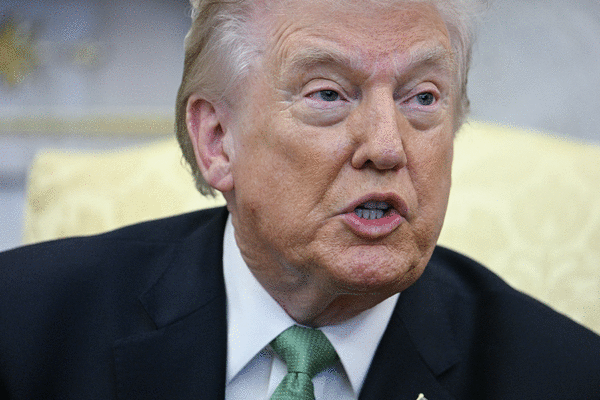
WASHINGTON — U.S. President Donald Trump lashed out against longtime allies, many of which have rejected his appeals for help in the Iran War effort, as the closure of a vital waterway continued to wreak havoc on global energy markets.
Trump scolded North Atlantic Treaty Organization allies in particular, denouncing their “foolish mistake” in not joining the U.S. effort and claiming none in the group posed reservations at the start of the war, which the president has long claimed was needed to remove a potent nuclear threat.
“I’ve long said I wonder whether or not NATO would ever be there for us,” Trump said Tuesday at the White House. “This was a great test because we don’t need them, but they should have been there.”
Trump in an earlier social media post insisted that he didn’t need the help of NATO, Japan, Australia, or South Korea, who have indicated they don’t want to get involved in the U.S.-Israeli military operations.
“In fact, speaking as President of the United States of America, by far the Most Powerful Country Anywhere in the World, WE DO NOT NEED THE HELP OF ANYONE!” he said in a social media post.
Trump’s open frustration illustrates the costs of his go-it-alone approach in the conflict, which has stretched into a third week. Oil has continued to hover around $100 a barrel as the Strait of Hormuz remains all but impassable for commercial shipping.
The U.S. and Israel have nonetheless kept up their attacks with little clarity on when operations would end. Israel said it killed Iran’s security chief, Ali Larijani, in an overnight operation.
“We’re not ready to leave yet, but we will be leaving in the near future,” Trump said Tuesday.
Defense Minister Israel Katz said Larijani, the secretary of the Supreme National Security Council, has been “eliminated,” along with the commander of Iran’s paramilitary Basij unit.
If Larijani’s death is confirmed, he would be one of the most high-profile Iranian officials to be killed since Supreme Leader Ali Khamenei on the first day of the now 18-day long war. Khamenei has been succeeded by his son, Mojtaba Khamenei, with Tehran maintaining retaliatory fire around the Middle East in response to the ongoing Israeli and U.S. assault.
In the U.S., National Economic Council Director Kevin Hassett told CNBC on Tuesday that the expectation is still for a “four-to-six week operation,” while adding that a longer war could “hurt consumers” and thus dictate a potential change of approach.
Iran set a massive natural gas field in the United Arab Emirates ablaze overnight as it steps up attacks on key energy sites, the first time the Islamic Republic has damaged an oil or gas upstream facility in the neighboring country during the war.
The move, combined with a near-halt to shipping through the Strait of Hormuz, triggered a fresh rise in Brent crude futures to as high as almost $105 a barrel at one point on Tuesday. Prices later erased most of those gains.
When asked on Tuesday when cargo ships would be able to pass through the vital waterway again, Trump said “it won’t be, I don’t believe, too long.”
Trump this week had stepped up his appeals for help — from both allies and China — to reopen the Strait of Hormuz. The effective shuttering of the strait has driven U.S. gasoline prices higher, piling pressure on the administration ahead of midterm elections in November.
No government has publicly said it will send warships to escort commercial vessels through Hormuz. Many military analysts have said that, without a ceasefire, it would be dangerous to send ships through the strait even with armed escorts.
Japan, whose prime minister is set to visit the White House on Thursday, has said it’s exploring the legal implications of the U.S. effort while also indicating that the U.S. hadn’t made a specific demand to send ships to the Middle East.
The United Nations has repeatedly called for an end to the conflict and noted that targeting countries in the Gulf runs against recently passed Security Council resolutions. Farhan Haq, deputy spokesperson for the secretary-general, said Tuesday that “diplomacy must prevail.”
Iran has attacked about 20 vessels in the Persian Gulf and near Hormuz since the conflict began. The UAE, Saudi Arabia, Iraq and Kuwait have all reduced oil output as a result of the blockage. Qatar, a top-three supplier of liquefied natural gas, has shut down production of the fuel.
A trickle of vessels are still using Hormuz, most of them bound for countries such as China and India. The prices of LNG, fertilizers, aluminum and other commodities have increased sharply since the start of the war.
Trump said Tuesday that an upcoming summit with Chinese President Xi Jinping would instead take place in five or six weeks because he wants to stay in Washington to focus on the war. China is among the countries Trump has appealed to for naval support.
That decision came amid growing opposition to the war at home, including among his own supporters. Joe Kent, a top counterterrorism official, announced he’s resigning in protest of the war, arguing that Israel had dragged the U.S. into the conflict.
Asked about the resignation, Trump on Tuesday countered that Iran indeed had been a threat. He said Kent was “a nice guy, but I always thought he was weak on security.”
In parallel with the war on Iran, Israel is stepping up an offensive in Lebanon, where it’s fighting the Tehran-backed Hezbollah militant group. Trump on Monday said that “Hezbollah’s a big problem, and they’re rapidly being eliminated,” confirming that he’d discussed the situation in Lebanon with Israeli leaders.
More than 4,000 people have been killed across the Middle East in the war so far, according to tolls from governments and non-governmental organizations. The U.S. has lost 13 military personnel.
Trump has threatened to expand strikes on Kharg Island, Iran’s main export hub that was hit over the weekend, to target oil infrastructure.
Surging oil prices since the start of the war have in turn pushed up U.S. gasoline prices. The average cost of a gallon of gasoline has risen each day since the conflict began to around $3.79, according to the American Automobile Association.
--------
—With assistance from John Bowker, Magdalena Del Valle, Mia Gindis and Courtney Subramanian.
©2026 Bloomberg L.P. Visit bloomberg.com. Distributed by Tribune Content Agency, LLC.




Comments