Baltimore mayor, inspector general clash over contractor fraud probe
Published in News & Features
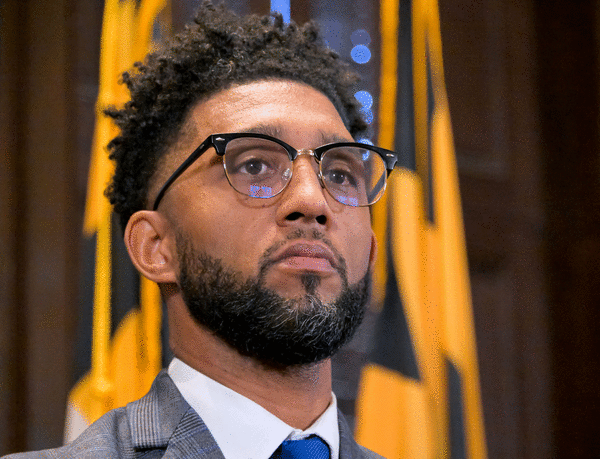
BALTIMORE — Baltimore Mayor Brandon Scott and the city’s inspector general blamed each other’s offices on Wednesday for hampering their ongoing probes into city contractor payments after an oversight report alleged that two community-based organizations submitted fraudulent invoices to the mayor’s public safety office.
Speaking after the Board of Estimates meeting Wednesday, Scott said that if the city’s inspector general had included more information in their report, his administration would be “going after [the contractors] in every way” to claw back any lost funds. He said that Baltimore Inspector General Isabel Mercedes Cumming had not shared the name of the contractor with the city solicitor’s office.
“We will be going after them, but we haven’t gotten that information, which is not typically what would happen,” Scott said.
Meanwhile, Cumming’s office said that its investigation was “limited” because Scott’s administration redacted more than 200 pages worth financial information that the inspector general had requested for its investigation.
Legal battle continues
The standoff comes amid a legal battle over Scott’s office limiting Cumming’s access to city records. The watchdog office sued the city last month after the city’s law department redacted employee names and payments in a batch of documents that it provided to the inspector general’s office in connection with the oversight probe.
Cummings’ office said in Tuesday’s report that it had made a criminal referral after finding that a community-based organization altered invoices to the Mayor’s Office of Safety and Engagement to receive larger payments from the public safety agency. The inspector general’s office is continuing its probe into MONSE contractor invoices, but said in Tuesday’s report that its investigation was “currently limited due to the redacted information.”
In a response to the inspector general’s office, MONSE Director Stefanie Mavronis said that the oversight report “provides virtually no detail about the alleged instances of overbilling that MONSE could use to review or address the concern.”
“The report does not include the organization’s name, the specific amount, the specific date, or any corresponding information, which is surprising given the OIG has referred this matter for criminal investigation,” Mavronis wrote. “Since there is no rationale for the limited detail included in the report, it is unclear to MONSE why this information and the corresponding allegations are provided without specifics and without corresponding exhibits.”
Cumming said in a Wednesday morning social media post that “MONSE & [the city’s law department] have the unredacted documents[,] not OIG.”
“This is why Oversight is needed,” she said, followed by the “boom” emoji.
Report tied to SideStep
The inspector general’s report was tied to SideStep, a youth diversion program that the city piloted in the city’s Western District. The pilot ended in 2024.
In February, while the inspector general was investigating the program, Scott said the mayor’s office would “reluctantly” restrict Cumming’s oversight office’s access to certain city documents.
The city’s law department cited a legal memo from Attorney General Anthony Brown’s office that said Maryland’s Public Information Act prevents agencies from disclosing certain information such as personnel records or documents protected by attorney-client privilege to the public and other agencies, including a local inspector general. Brown later said that the memo, which was responding to a state lawmaker’s inquiry about legislation affecting Baltimore County, was “fairly boilerplate advice” and not an opinion about whether the city’s oversight office is acting “within or out of bounds.”
Cumming is suing the city in Baltimore Circuit Court to enforce her office’s subpoena for the unredacted financial records. Meanwhile, state lawmakers are considering new legislation that would explicitly give inspectors general access to such records.
Asked Wednesday if he supported that legislation, Scott said that he would “let Annapolis decide.”
“We have to make sure that we’re going to follow the law. If they pass the law, we’ll follow the law, period,” he said.
_____
©2026 The Baltimore Sun. Visit at baltimoresun.com. Distributed by Tribune Content Agency, LLC.






Comments