Trump risks dragging out Iran war with debate over seizing Kharg Island
Published in News & Features
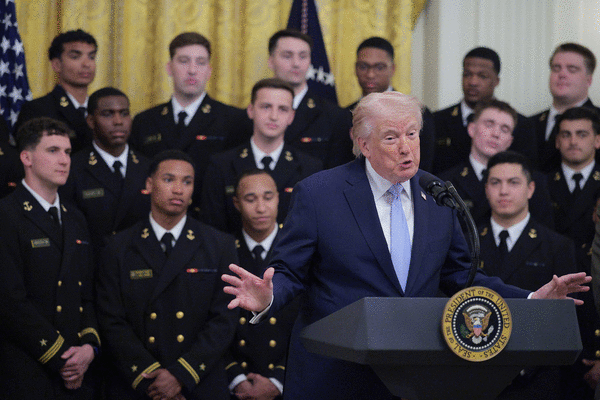
U.S. officials said the White House is sending more than 2,000 additional Marines to the Middle East as it weighs a plan to seize Iran’s Kharg Island oil export hub, a ground operation that would carry huge risks for President Donald Trump.
At the same time, Trump floated the idea late Friday that the war could end quickly — even as he had ruled out an immediate ceasefire earlier in the day.
Trump said in a post on his Truth Social platform Friday evening that the United States was close to realizing its goals “as we consider winding down our great military efforts in the Middle East,” and telling American allies it was their responsibility, not his, to secure the vital Strait of Hormuz.
While Trump’s open musings about how to proceed vary wildly — swinging stock markets, currencies and commodities along with them — some of the options still on the table would entail a substantial escalation that would enmesh the U.S. even deeper into what risks becoming a protracted Middle East conflict.
Any effort to seize and hold Iran’s energy facilities would put American troops in greater danger than they’ve been exposed to in the conflict, which has seen 13 U.S. fatalities to date. It would also add to the cost and scope of a war that so far has been an air campaign.
Just as charged would be the symbolism of American troops landing on Iranian soil and the accusation that Trump — who shot to popularity in part by criticizing the open-ended wars that dogged his predecessors — might be starting one of his own.
Trump’s possible consideration of a ground operation comes as frustration mounts in the U.S., Europe and Persian Gulf over the closure of the vital Strait of Hormuz.
Oil prices surged again Friday with global benchmark Brent ending the week above $112 a barrel, the highest since mid-2022.
While seizing Kharg Island “has tactical advantages, to be sure, but also likely high costs and no clear strategic endgame,” said Michael O’Hanlon, who specializes in defense strategy at the Brookings Institution think tank and previously advised the Pentagon and the CIA.
A ground operation could also heighten the economic and financial damage that’s already accumulating around the world, three weeks into the war.
Along with the disruptions to the flow of oil and natural gas, all kinds of other vital commodities typically shipped from the Persian Gulf are getting squeezed too, including food and fertilizers.
Deploying a Marine Expeditionary Unit would have “substantial risk of casualties, and with no obvious next step as to how such an action really accelerates regime change or even Iran’s willingness to negotiate an end to hostilities.”
A third of the size of Manhattan, Kharg Island could be taken over quickly and serve as crucial leverage in the campaign to get Tehran to end its blockade of the Strait of Hormuz.
Trump has ruled out troops there for the time being — “I’m not putting troops anywhere,” he said earlier this week — but he has ordered Marines to head to the region. They include the 31st Marine Expeditionary Unit from Japan, with more than 2,000 troops.
The administration is also sending the 11th Marine Expeditionary Unit, which left its home port of San Diego on its way to the Middle East, according to another person familiar with the matter. Led by the USS Boxer, it has up to 2,500 Marines along with F-35B fighters.
One person familiar with the matter, who asked not to be identified discussing private deliberations, said the deployments were part of a broader multiweek strategy to reopen the strait amid concerns that elevated oil prices will drag on global growth.
Higher gas prices are also a challenge to Trump before the midterm elections. Retail gasoline and diesel prices in the U.S. have jumped to the highest levels since 2022, with California’s energy regulator already warning against price gouging as some gas stations are charging as much as $8 a gallon.
The Pentagon has asked for an additional $200 billion from Congress to pay for the war, further signaling that the administration is bracing for a more protracted conflict. The regime in Tehran isn’t close to falling and Iranian officials are coalescing around the remaining leaders, according to Western intelligence assessments and people familiar with the matter.
If the U,S, does move to seize Kharg Island, there is plenty of precedent. In the U.S. raid in Venezuela to capture Nicolas Maduro, troops arrived and left quickly, without loss of life. Special forces teams have operated around the world in secret for decades — with the mission that captured Osama bin Laden among the most famous.
“I think that it is a possibility,” said John Bolton, Trump’s former national security adviser who later broke with the president, in an interview. “I don’t think anybody — certainly not Trump — is talking about a huge combat, armed invasion — infantry, armor, artillery — landing in division-size formations.”
The concern is that regardless of Trump’s intentions, the missions could expand like conflicts in the past, from Vietnam and Afghanistan to Iraq. They, too, started out as a small, limited campaigns, but turned into sprawling wars that bogged down the U.S. for years.
A big question is how long the soldiers would stay — and whether they’d be exposed to attack — if Iran doesn’t back down. It would also fan concerns even more among Republicans and some Democrats that Trump was violating a key campaign promise: no new foreign wars.
And while Trump retains strong support among his party, the involvement of ground troops could sour that goodwill. A Reuters/Ipsos survey said two-thirds of Americans think Trump will deploy ground troops, but 55% don’t support such a decision. Just 7% would support a large-scale attack by the U.S.
Officials — including the president — are worried that an assault on the island could ultimately prove counterproductive to their energy goals. Some fear that it would prompt Iran to destroy its own infrastructure there. Others think the move could trigger an even sharper surge in oil prices, even as the Trump administration struggles for policies to lower them.
_____
(With assistance from Nancy Cook, Courtney Subramanian, Magdalena Del Valle, Justin Sink, John Harney, Ben Holland and Kevin Whitelaw.)
©2026 Bloomberg L.P. Visit bloomberg.com. Distributed by Tribune Content Agency, LLC.





Comments