2 years after collapse, Key Bridge rebuild accelerates as major construction nears
Published in News & Features
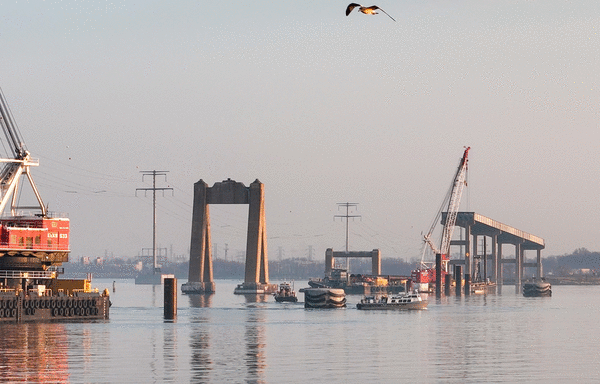
BALTIMORE — Nearly two years after the collapse of the Francis Scott Key Bridge, Maryland officials say reconstruction is accelerating and on the verge of entering full-scale construction.
Speaking at the Port of Baltimore on Tuesday, Gov. Wes Moore said the Key Bridge rebuild is the “fastest-moving large project in the country,” adding that he and U.S. Transportation Secretary Sean Duffy are aligned on its aggressive pace.
The bridge collapsed March 26, 2024, after the cargo vessel Dali lost power and struck a main pier, killing six construction workers and severing a critical harbor crossing that once carried roughly 30,000 to 33,000 vehicles daily. That traffic has since been rerouted onto already congested regional roadways.
Moore said the pace of the rebuild reflects an unusually fast federal and state process. “I am very clear: I want to be the governor that cuts the ribbon on this,” he said. “That is my plan, and that is how fast we are moving when you consider that just for permitting, it could take five to seven years, and we got it done in months. To get to a 70% design build, it could [have taken] five years, and we got it done in 14 months.”
Additional revenue has also been lost due to the collapse. Key Bridge tolls that would have otherwise supported maintenance on Maryland’s highway system statewide can no longer be collected. Without this revenue – approximately $56 million in 2023 – the Maryland Transportation Authority, which operated the bridge, has less ability to repair roads.
Where it currently stands
Work on the project is going through Phase One, which is expected to run through this Spring.
During this period, engineers are finishing detailed design work on the bridge’s foundations, towers and spans, while pre-construction activities are on track to continue through the end of this year to prepare the site for major construction.
Through the end of this year, crews are expected to continue demolition of all remaining land-based structures tied to the former bridge and finish up their test pile program in the Patapsco River to confirm subsurface conditions for the new foundations. These efforts will set the stage for full-scale construction.
Residents who were near the bridge site this fall heard the bell-like sounds as workers stabilized the piles and drove them into the riverbed with a hydraulic hammer, transportation officials said.
The main construction is expected to start in the next few months, as the project enters into Phase Two.
From this summer through 2028, approach spans leading into the bridge are expected to take shape, while construction of the bridge’s main pylons is scheduled to run from the end of this year through 2028. These towers will form the structural backbone for the new cable-stayed design.
The most visible transformation is expected between 2028 and 2029, when crews install the cable-stayed spans that will connect the roadway deck to the pylons. Final construction, systems installation and testing are expected to follow, with the new bridge projected to open to traffic in 2030.
Who is paying for it?
Congress committed in December 2024 to cover 100% of the replacement cost, as the Maryland Transportation Authority moved forward with an updated rebuild plan now shaped by higher construction costs and revised engineering requirements.
The original rebuild estimate ranged from $1.7 billion to $1.9 billion, with an expected 2028 opening. But officials now say that timeline and cost environment have shifted significantly. The Federal Highway Administration has reported highway construction costs have risen about 72% over the past five years, driven by materials and labor increases.
_____
©2026 The Baltimore Sun. Visit at baltimoresun.com. Distributed by Tribune Content Agency, LLC.






Comments