US, Israel hit Iran nuclear sites as Houthis threaten neighbors
Published in News & Features
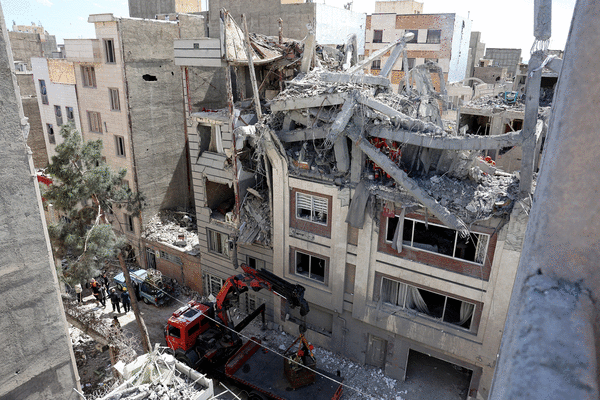
The U.S. and Israel bombed Iranian nuclear and steel facilities on Friday, while Iran retaliated across the Persian Gulf including a reported hit on a base in Saudi Arabia, as markets reacted to fears of the conflict’s drag on the global economy.
Airstrikes on Friday targeted a heavy water research reactor that’s part of the Arak nuclear complex and a yellowcake production plant in Yazd province, as well as two of Iran’s biggest steelmakers, according to Iranian state media. A strike on Prince Sultan Air Base in Saudi left at least 10 US troops wounded, including two seriously, and damaged several refueling aircraft, the Associated Press reported.
Tehran fired numerous drones and missiles at Persian Gulf neighbors, damaging two ports in Kuwait and prompting missile alerts in Doha, while warning of retaliation against steel plants in Israel and across the Gulf. Israeli authorities said a man was killed Friday night in an Iranian missile attack on Tel Aviv.
Also on Friday, Houthi militants in Yemen, who are backed by Iran, said they were ready for direct military action if any other countries joined the U.S. and Israel, if the Red Sea was used for hostile operations against Iran, or if escalation continued against Tehran’s proxy groups, according to spokesperson Yahya Saree. That might be a threat to Gulf nations frustrated by Iranian attacks that have considered joining the US and Israeli campaign.
Israel Defense Forces on Saturday said it identified the launch of a missile from Yemen toward Israeli territory, and aerial defense systems are operating to intercept the threat.
The latest escalation came after President Donald Trump pushed back his deadline for Iran to agree to reopen the Strait of Hormuz or face strikes on power plants.
The 10-day extension was Trump’s second since Saturday’s threat to destroy the infrastructure in the absence of Tehran reopening the critical waterway, a chokepoint that’s become increasingly urgent with global energy and commodity shortages mounting.
U.S. stocks sold off sharply Friday, falling to their lowest level in more than seven months and taking the closely watched Nasdaq 100 into correction territory, as the attacks escalated despite Trump’s insistent demands for Iran to agree to a ceasefire. European benchmarks were largely in the red, while Asian markets ended the day mixed. Treasury 10-year yields climbed toward their highest since July.
“They are talking now. They want to make a deal,” Trump told reporters in Miami on Friday afternoon. “Very simply, our military is the greatest in the world, by far. Iran is being decimated.”
The president discussed the military campaign at an event shortly after that, saying “we have another 3,554 targets left and that’ll be done pretty quickly.” Asked after his speech how he wanted to be remembered, Trump said: “I’d love my legacy to be made as a great peacemaker, because I really believe I’m a peacemaker.”
“It doesn’t seem it right now,” he added, “but I think I’m a peacemaker.”
Brent crude rose about 4% to end the session above $112 a barrel on Friday, extending its climb this year to about 80%. The international benchmark is on track for a record monthly gain in March as oil flows through the critical Strait of Hormuz remain severely curtailed. The conflict has caused fuel shortages and fears of stagflation across major and emerging market economies.
On Friday, Iranian Foreign Minister Abbas Araghchi blamed Israel for a strike on a power plant, saying it violated Trump’s pledge to avoid energy facilities and vowing to exact a “heavy” price on Israel.
A projectile struck the grounds of the Bushehr Nuclear Power Plant at 11:40 pm local time Friday, Iran’s Fars news agency reported, adding preliminary assessments indicate the impact did not damage any sections of the facility.
Bushehr is “currently operational and contains significant quantities of radioactive material,” and any damage to the facility “could trigger a serious nuclear incident with irreversible consequences for the region,” Fars said, without citing anyone.
Fars also reported explosions across several districts of Tehran early Saturday, including strikes near Mehrabad Airport west of the capital, the main hub for domestic flights.
Trump’s extended deadline allows more time for the U.S. to amass troops in the region, with speculation growing of an imminent land deployment.
Yet his administration is signaling to allies that it has no immediate plans for a ground invasion of Iran, even as it deploys thousands of troops to the Middle East, according to people familiar with the matter, who asked not to be identified discussing private deliberations.
Secretary of State Marco Rubio told reporters on Friday that the U.S. “can achieve all of our objectives without ground troops,” but that “we are always going to be prepared to give the president maximum optionality and maximum opportunity to adjust to contingencies should they emerge.”
The Wall Street Journal reported the Pentagon is considering sending as many as 10,000 additional soldiers to the Middle East. Asked about the Journal report, White House spokeswoman Anna Kelly said all such announcements would come from the Pentagon and Trump “always has all military options at his disposal.”
Those new troops would be in addition to 5,000 Marines and more than 1,000 paratroopers already ordered to the region, according to people familiar with the matter.
Some European governments think it’s all but inevitable the U.S. will deploy ground troops, despite the high risk of casualties, according to a diplomat familiar with the matter who requested anonymity to discuss sensitive subjects.
Military analysts said that aside from Kharg Island, the US could try to take control of the Iranian side of the Strait of Hormuz in a bid to reopen the vital waterway to oil and gas tankers and container ships. It could also send special forces to retrieve Iran’s roughly 440 kilograms (970 pounds) of highly-enriched uranium. All options would be exceptionally risky for U.S. troops.
Iran has publicly rejected a 15-point list of ceasefire terms delivered by the Trump administration via intermediaries in Pakistan, and has countered with five conditions of its own — including maintaining sovereignty over the Strait of Hormuz.
While the two sides appear very far apart in the effort to reach an agreement, Trump said talks with Iran are going “very well.” On Friday, Rubio said a response from Iran could come at anytime but in the meantime, the U.S. would continue its military operations.
“We’ve had an exchange of messages and indications from the Iranian system — whatever’s left of it — about a willingness to talk about certain things,” Rubio told reporters in France. “We’re waiting for further clarification about who are we – who is it that we need to be talking to, what will we be talking about, and when will we be talking. I don’t have any news for you on that yet. It could happen at any moment.”
Special envoy Steve Witkoff, speaking at a summit in Miami, said the U.S. was awaiting an answer from Iran on a 15-point plan to end the war, adding “we think there will be meetings this week.” Witkoff and Trump’s son-in-law Jared Kushner handled the initial round of negotiations with Iran before the launch of U.S. and Israeli strikes. There are questions about whether Iran is willing to work directly with them again.
The Iranian government has demanded certain guarantees in addition to its request to control Hormuz, including that the U.S. and Israel won’t resume attacks in the future and the payment of war reparations.
Iran also wants an end to the conflict on all fronts, a likely reference to Israel’s parallel war against the Tehran-backed Hezbollah militant group in Lebanon.
Trump has said any peace agreement must prohibit Iran from ever obtaining a nuclear weapon or enriching radioactive material for civilian purposes. The U.S. plan also stipulates that the Islamic Republic can only have a reduced missile arsenal for self-defense only, according to people familiar with the matter. Iran would get sanctions relief in return.
In the U.S., pump prices have risen to almost $4 a gallon on average, which could hurt Trump’s Republican Party ahead of midterm elections in November.
More than 4,500 people have been killed in the conflict so far, according to governments and non-governmental agencies. Around three-quarters of fatalities have been in Iran, while almost 1,100 people have died in Lebanon, where more than 1 million people have been displaced. Dozens of people have been killed in Israel and Arab Gulf states.
(Courtney Subramanian, Iain Marlow, Catherine Lucey, Esha Dey, Devika Krishna Kumar, Omar Tamo, Golnar Motevalli, Eltaf Najafizada and Arsalan Shahla contributed to this report.)
©2026 Bloomberg L.P. Visit bloomberg.com. Distributed by Tribune Content Agency, LLC.






Comments