Trump begins Hormuz blockade even as US, Iran eye more talks
Published in News & Features
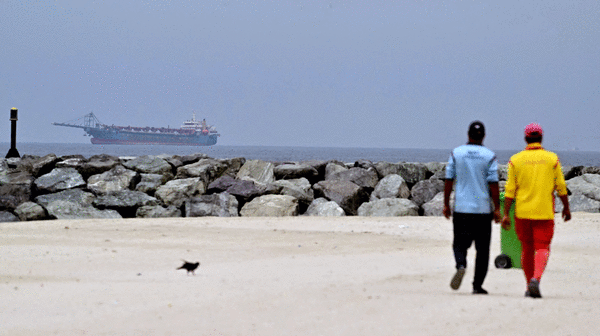
WASHINGTON — President Donald Trump began a U.S. naval blockade of the Strait of Hormuz, a move intended to raise pressure on Tehran, even as the two countries are weighing another round of talks in hopes of cementing a longer-term ceasefire.
A naval blockade took effect Monday after a Trump-imposed deadline passed, with the United States moving to cut off vessels in the waterway from transiting to and from Iranian ports and coastal areas. The move risks further inflaming tensions during the global energy crisis.
But even amid that latest escalation, the U.S. and Iran are in discussions about holding another round of face-to-face negotiations after meetings in Islamabad over the weekend ended in failure, according to people familiar with the matter. The goal is to hold fresh talks before a two-week ceasefire announced April 7 expires next week, according to the people.
Trump signaled further talks earlier Monday, telling reporters at the White House that Iran had reached out to his administration.
“We’ve been called this morning by the right people, the appropriate people, and they want to work a deal,” Trump said, without elaborating on who participated in the conversation.
The U.S. president once again claimed that negotiations had failed due to Iran’s insistence on maintaining a nuclear program. Trump said he was “sure” Iran will eventually agree to abandon nuclear ambitions, and reiterated there would be no deal without that concession.
Vice President JD Vance, who led the U.S. delegation in the first round of talks, signaled a more positive note Monday. “We did make some progress in the negotiation,” Vance said in an interview on Fox News, adding that the talks helped clarify red lines and even how Iranians were engaging.
Asked whether there would be another meeting, Vance called it a question “best put to the Iranians, because the ball really is in their court,” and reiterated U.S. concerns about Tehran’s nuclear ambitions.
Iran blamed the collapse of talks over the weekend on the U.S., but has also left the door open for more negotiations. President Masoud Pezeshkian said Iran was prepared to continue discussions within a framework of international law and regulations, according to a statement on a government news portal.
Oil prices rose as investors braced for further supply shortages if the U.S. blockade curtails the flow of Iranian oil to global markets. Prices remained choppy though as trading costs have surged, in turn sapping liquidity.
Crude’s gains were capped, with U.S. oil wiping out nearly all of the session’s gains, after Trump said Iran had reached out Monday for a deal. Both benchmarks settled near $99 a barrel.
The U.S. president said again that there are countries willing to support the U.S. mission in Hormuz, but declined to name them and said he would provide further details Tuesday.
Trump’s blockade will test the durability of a fragile ceasefire with Iran and intensify a global energy crisis in a six-week war that has seen thousands of deaths across the region. It marks the latest move by the U.S. president to strong-arm Iran into easing its own chokehold over the strait after talks in Pakistan on extending the ceasefire failed to reach a deal.
“We can’t let a country blackmail or extort the world,” Trump said. He also claimed, without evidence, that “many ships are heading to our country right now” to load up with U.S. oil and repeated that “we don’t use the strait — we don’t need the strait.”
Iran has said it would target all ports in the Persian Gulf if its own shipping hubs are threatened, setting up a fresh standoff in waters that typically see flows of about a fifth of the world’s oil and liquefied natural gas.
The security of ports in the region is “either for everyone or for no one,” Iran’s armed forces said in a statement Monday, according to the state-run IRIB News. The U.S. blocking the strait would be “an act of piracy,” it said, reiterating plans to permanently control the critical waterway even after the war.
Trump has warned Iran against charging fees for vessels to transit the strait. Vance, in his Fox News interview, sidestepped a question about whether that would be a red line for Iran in talks, saying that “we need to see the Strait of Hormuz fully open.”
“The Iranians tried to move the goalposts during the negotiation. We made very clear that that’s unacceptable,” he said.
Trump had warned shortly after the deadline passed that the U.S. would target Iranian ships, using the same tactics it did against alleged drug-running boats in the Caribbean Sea in recent months.
“What we have not hit are their small number of, what they call, ‘fast attack ships,’ because we did not consider them much of a threat. Warning: If any of these ships come anywhere close to our BLOCKADE, they will be immediately ELIMINATED, using the same system of kill that we use against the drug dealers on boats at Sea,” Trump said in a social-media post.
Still, Trump looked to downplay concerns around the further potential shock to global energy markets, claiming in a separate post that 34 ships had transited the strait on Sunday, “by far the highest number since this foolish closure began.” Bloomberg reported earlier that 19 vessels passed through the waterway in either direction on Sunday.
Shortly before the deadline, the U.S. published a notice to vessels in the region saying that it would intercept, divert or capture vessels leaving Iran after that time. The note said that neutral ships that haven’t called at Iran would not be impeded, though they may be searched for contraband cargo.
The U.S. blockade will be “enforced impartially against vessels of all nations entering or departing Iranian ports and coastal areas,” according to a Sunday statement from U.S. Central Command.
Disruptions in the strait also pose risks for China, which remains Iran’s largest oil customer and a key trade partner. Beijing has called for an immediate ceasefire, warning that a blockade threatens global trade.
Trump said Monday that he had yet to hear from Chinese President Xi Jinping about the conflict, but added that Xi “would like to see this ended also.”
While the U.S. and Israel have paused the bombing of Iran — and Tehran has in turn stopped firing missiles at Gulf states — Israel has maintained its invasion of Lebanon to target Hezbollah, a Tehran-backed militant group.
That ongoing offensive, which the Lebanese government says has killed more than 2,000 people, was a bone of contention while the terms of the U.S.-Iran ceasefire struck last week were being ironed out. Talks between Israel and the Lebanese government — which has long pledged to disarm Hezbollah without success — are set to take place this week.
The U.S.-Iran two-week ceasefire agreement is set to expire April 22, if the U.S. blockade doesn’t lead to its collapse before then.
_____
(With assistance from Jennifer A. Dlouhy, Laura Davison, Devika Krishna Kumar, John Bowker and Michelle Jamrisko.)
_____
©2026 Bloomberg L.P. Visit bloomberg.com. Distributed by Tribune Content Agency, LLC.






Comments