Israel-Lebanon truce in force as Trump eyes imminent Iran deal
Published in News & Features
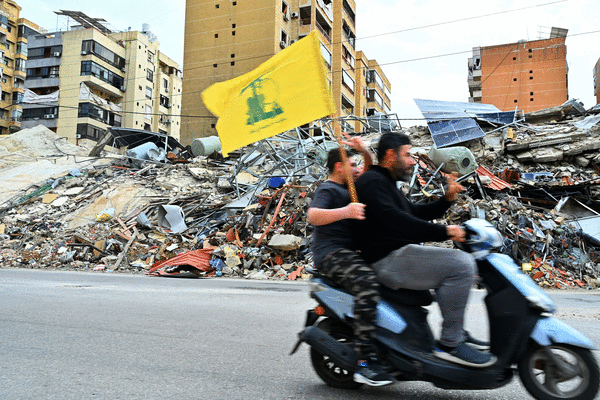
President Donald Trump claimed Iran has made key concessions in an ongoing negotiation to end the seven-week war, while a ceasefire between Israel and Hezbollah in Lebanon increased the prospect of a broader peace.
Trump said it may not be necessary to renew an April 7 truce with the Islamic Republic before it expires next week, defying expectations that an extension will be needed to allow more time for diplomacy.
“Iran wants to make a deal. They are willing to do things today that they weren’t willing to do two months ago,” the president told reporters on Thursday. “We have a very successful negotiation going on right now. If it happens, it will be announced fairly soon.”
Some leaders in Arab states in the Persian Gulf and Europe expect it will take about six months to agree to a peace accord and that the ceasefire should be extended to cover that period, according to officials familiar with the matter, who asked not to be identified discussing private talks. That’s in part to allow for a reopening of the critical Strait of Hormuz waterway, they said.
Iran has yet to comment on Trump’s claims that Tehran has made concessions, including over the key issue of its nuclear program. The U.S. leader reiterated that the Islamic Republic “will not have nuclear weapons,” and pushed back against suggestions that a fixed-term moratorium on uranium enrichment is up for negotiation.
Trump’s predictions of a quick end to the war have been a regular fixture of the conflict, which has killed thousands and triggered a surge in energy prices, but are nonetheless reinforcing optimism in global markets. Wall Street gauges closed at all-time highs on Thursday, while momentum in Asia faded as investors trimmed positions ahead of the weekend.
The MSCI All Country World Index — the broadest gauge of global stocks — slipped 0.1% after a 10-day rally that drove it to a record high on Thursday.
Global benchmark Brent crude fell 1.3% to $98.10 a barrel, still up more than a third since before the war began.
The prospects for a formal peace agreement were given a boost on Thursday when Israel and Lebanon agreed to a 10-day ceasefire, and the truce appeared to be holding on Friday. While the announcement — made by Trump — didn’t mention Hezbollah, but the Iran-backed militant group stopped firing rockets into Israel overnight.
Israeli Prime Minister Benjamin Netanyahu confirmed the agreement, calling it a step toward a broader peace, and Trump said U.S. officials would work with both sides to secure a lasting deal.
Israel has been fighting Hezbollah in southern Lebanon since just after the start of the U.S.-Israeli bombing of Iran on Feb. 28. The Israeli military has occupied large parts of southern Lebanon as part of the campaign, which Lebanese authorities say has killed more 2,000 people and displaced a million more.
Trump said he spoke with his Lebanese counterpart, Joseph Aoun, and Netanyahu before declaring the ceasefire. In a subsequent social media post, Trump said he would invite both leaders to the White House for talks.
Any U.S.-Iran ceasefire would have to address the Strait of Hormuz, which remains effectively shut as both sides block the other from transporting vital energy supplies. About a fifth of the world’s oil and liquefied natural gas flowed through the waterway before the conflict, and the disruption has elevated prices and stoked fears of a global slowdown and inflation crisis.
Trump sought to ease voter concerns about rising living costs and energy prices at a rally that was held Thursday to highlight his economic achievements ahead of November’s midterm elections. Polls show a majority of Americans disapprove of the president’s handling of the conflict and blame him for rising gasoline prices.
Real-world oil prices remain well above futures as near-term supplies are scarce. Dated Brent, the world’s most important gauge of physical prices, is trading around $116 a barrel.
That’s primarily down to the near closure of Hormuz, where the U.S. is now instituting a full blockade to prevent Iranian oil from reaching global markets.
Some Gulf Arab and European leaders want the waterway reopened immediately and warn of a global food crisis if it remains shut beyond next month. Control over Hormuz remains contentious amid the U.S. naval blockade and Iran’s demands to charge ships for transit even after the war ends.
The UK and France will host a summit with about 40 nations to discuss a multinational naval force to secure Hormuz, though deployment remains unlikely until a broader agreement is reached.
Defense Secretary Pete Hegseth said American forces are ready to resume combat “at the push of a button,” while Iran warned a prolonged blockade could breach the ceasefire.
Pakistan’s army chief, Asim Munir, traveled to Iran this week as his nation mediates between Washington and Tehran. Pakistan hosted high-level talks between U.S. and Iranian officials last weekend — discussions that failed to yield a breakthrough.
Trump said Thursday that he “might” travel to Pakistan if a deal with Iran is clinched.
“They’ve agreed to almost everything,” Trump said. “They got to get to the table with a pen.”
Comments from both Iranian and U.S. officials on Thursday suggest the sides remain far apart on key issues, but the ceasefire with Lebanon could provide fresh momentum. Iran’s Parliament Speaker Mohammad Bagher Ghalibaf, who took part in the Pakistan talks, had earlier said a permanent ceasefire must cover the fighting in Lebanon.
©2026 Bloomberg L.P. Visit bloomberg.com. Distributed by Tribune Content Agency, LLC.





Comments