'Fundamentally unfair': Idaho federal judge criticizes immigrant's treatment
Published in News & Features
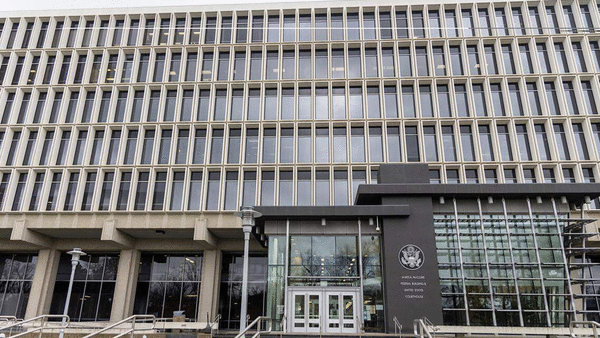
BOISE, Idaho — An Idaho federal judge pushed back against the Trump administration over its immigration agenda in a recent court ruling.
The administration has hardened its attitude toward immigrants since President Donald Trump took office after promising mass deportations, for example, by pressuring immigration judges to deport more people.
The administration has also pushed for mandatory detention of all immigrants, though hundreds of federal judges have rejected those attempts. However, in a recent case, Senior U.S. District Judge B. Lynn Winmill pointed to evidence submitted by an immigrant of a new pattern: After the government loses in court over mandatory detention, immigration judges just systematically deny bond, leaving the person detained.
“It seems like every time we get an inch, the government takes a mile,” said immigration lawyer Casey Parsons, who is representing the immigrant in this case. “We’re stuck in this constant back and forth, and it’s really frustrating, and it’s really heartbreaking to see the effect it has on our clients.”
Immigration judges work for the Department of Justice and such courts are administrative. The Justice Department did not immediately respond to a request for comment.
“Unfortunately, across the country the integrity of these bond proceedings has now been cast sharply into doubt,” Winmill wrote in his April ruling.
But Winmill’s ruling drew criticism from the Department of Homeland Security.
In an emailed statement sent after publication, a DHS spokesperson wrote that an “activist judge” appointed by former President Bill Clinton “RELEASED this criminal back onto American streets.”
“We will continue to fight for the attest (sic), detention, and removal of criminal illegal aliens who have no right to be in our country,” the spokesperson said.
Federal judges around the U.S., including dozens appointed by Trump himself, as well as fellow Republicans Ronald Reagan, George H.W. Bush and George W. Bush, have ruled against the Trump administration’s stance.
Winmill’s order stemmed from the case of Rigoberto Garcia Ortiz, a Mexican man who has lived in the U.S. since 2020. Garcia Ortiz, who lives in Caldwell, has two children, both U.S. citizens. He was taken into custody in January 2026 while attending a sentencing for a misdemeanor charge of driving under the influence, his only criminal history, Winmill wrote.
Immigrants already in the U.S. have due-process rights and in the past have been entitled to a hearing to see whether they were a flight risk or danger, and whether they should remain in detention, according to previous Statesman reporting.
Since Trump took office, people across the U.S. have filed more than 36,000 habeas petitions challenging their detention, including 29 in Idaho, according to ProPublica.
Winmill himself has ruled on several cases challenging mandatory detention, which he warned in his April ruling are straining the legal system. Even though federal courts have “resoundingly rejected” the Department of Homeland Security’s mandatory detention attempts, “the Government continues to detain scores” of immigrants without the chance of a bond hearing, he said.
“This recalcitrance has generated a flood of habeas actions that threatens to overwhelm the federal judiciary,” Winmill wrote.
Garcia Ortiz is one of those people. His lawyers filed their petition on Jan. 25 and Winmill, seemingly exasperated, responded in February with an order. He wrote that the court had already resolved the same issue dozens of times in the past several months.
But because of the DUI, Winmill wasn’t sure that releasing Garcia Ortiz immediately was appropriate. Instead, he ordered officials to either release him or give him a bond hearing within seven days.
But things didn’t go as planned.
At his Feb. 10 bond hearing, Garcia Ortiz entered scores of evidence, including the birth certificates of his U.S. citizen children, his tax filings and “numerous” letters of support from community members, Winmill wrote. The government’s only evidence was a 2022 form from when Garcia Ortiz was apprehended by U.S. Border Patrol in Texas.
But the immigration judge used evidence not in the record: the police report from Garcia Ortiz’s DUI, Winmill wrote. The immigration judge determining he was dangerous and must stay detained was “pure speculation,” Winmill ruled, because he didn’t rely on the evidence in the record.
Garcia Ortiz could prove he wasn’t a danger only by “rebutting evidence that the court had neither admitted nor examined.”
The immigration judge’s actions made it seem as if he was trying to find a reason for a predetermined outcome, Winmill wrote. And the judge didn’t record the hearing or create a written transcript.
Winmill called the hearing “fundamentally unfair” and ordered Garcia Ortiz to be released.
“This ‘rubberstamp’ denial is a violation of due process,” Winmill wrote.
esman. Visit idahostatesman.com. Distributed by Tribune Content Agency, LLC.






Comments