Minnesota anti-ICE cases put Trump administration's legal tactics under scrutiny
Published in News & Features
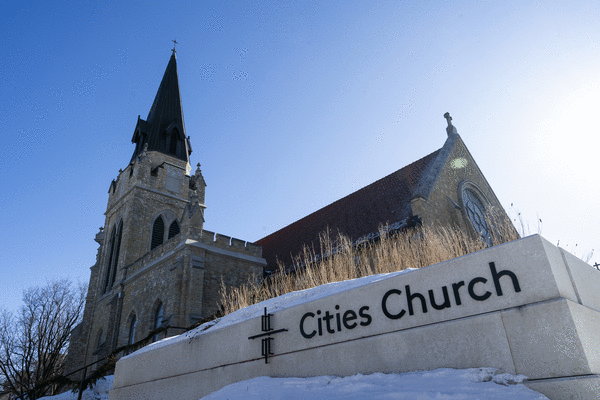
MINNEAPOLIS — The latest court filings challenging federal indictments against protesters who staged an anti-ICE demonstration inside a St. Paul church have also questioned the investigation into the protest — an allegation bolstered by a judge’s unorthodox order to review the evidence the government used to level the charges.
The case is one of the major federal prosecutions in Minnesota stemming from the Trump administration’s aggressive crackdown on anti-ICE demonstrators during Operation Metro Surge. In a second case, federal prosecutors have charged 15 Minnesotans with conspiring to impede or injure officers during the wintertime immigration operation. Minnesota U.S. Attorney Daniel Rosen has called the accused members of antifa, which President Donald Trump designated a domestic terrorist group.
But legal scholars say both cases are part of a broader trend by the Trump administration to test the bounds of law enforcement and investigative norms by bringing cases against those the president deems political enemies. And they question whether such prosecutions will ultimately fall apart.
Jessica West, a Mitchell Hamline School of Law professor who studies prosecution of protesters, said governments are increasingly bringing criminal charges for demonstrations that disrupt daily life. Historically, such sanctions have been reserved only for the most serious circumstances.
“The First Amendment doesn’t create a constitutional right to take over someone’s religious service, but the fact that expressive conduct occurs inside a church doesn’t remove the First Amendment from the case,” West said. “So there’s going to be some constitutional balancing in there.”
In a series of motions filed Monday, attorneys for the church demonstrators asked a judge to dismiss the case they portray as an unprecedented and politically-driven prosecution built on a faulty investigation into the Jan. 18 protest, which they contend was protected speech.
“By seeking to punish the Defendants on the basis of their views, the Justice Department initiated a prosecution in a manner that is unequal, oppressive, and has a clear and dangerous chilling effect on the Defendants and anyone else who wants to voice their opposition to U.S. Government policies,” the lawyers wrote.
The U.S. Attorney’s Office, which has until Oct. 1 to respond to the motions in court, declined to comment.
Some defendants in the case, including former CNN host Don Lemon and local journalist Georgia Fort, who documented the protest, have already asked a judge to toss out their cases. The indictment alleges the group flooded Cities Church in St. Paul during a Sunday service to protest a pastor believed to be serving as the acting director of a local ICE office.
The 39 defendants are accused of violating the FACE Act, which has historically been used to prosecute someone who restricts others from accessing reproductive health facilities. The attorneys argue that the defendants’ case is likely the first prosecution under the FACE Act’s provision that protects houses of worship.
In another filing, the demonstrators attacked the government’s investigative methods, questioning Homeland Security’s role leading the investigation because it is beyond the role of the agency to “investigate every federal crime.”
The group specifically took aim at Homeland Security’s use of administrative summonses to obtain information about phone records, airlines, rental cars and social media. The administrative summons at hand are typically used for customs, immigration or border security matters.
Amy Sweasy, a law professor at the University of Minnesota and former Hennepin County prosecutor, said it is unusual for investigators to issue summonses after charges were filed.
“A prosecutor wants, generally, as much information as possible before she issues a criminal complaint and wants to present as much information as possible to a grand jury before you ask for an indictment,” Sweasy said, saying there are occasional exceptions to that.
But for the crimes alleged in the Minnesota church protest case, Sweasy said those exceptions are not apparent.
U.S. District Judge Laura Provinzino’s order issued last month to turn over the grand jury transcripts came after attorneys for Lemon asked the court to unseal them, alleging recent examples of misconduct by the Justice Department warranted the move.
To West, the order underscores the irregularities in the case and speaks to an erosion of trust seen across the country between the courts and the Trump administration’s Justice Department.
“Courts generally presume that prosecutors act in good faith, and that presumption has held for a really long time,” she said. “And that has started to wear away.”
©2026 The Minnesota Star Tribune. Visit at startribune.com. Distributed by Tribune Content Agency, LLC.





Comments