ICE agent federally indicted over shooting of Minneapolis immigrant during Operation Metro Surge
Published in News & Features
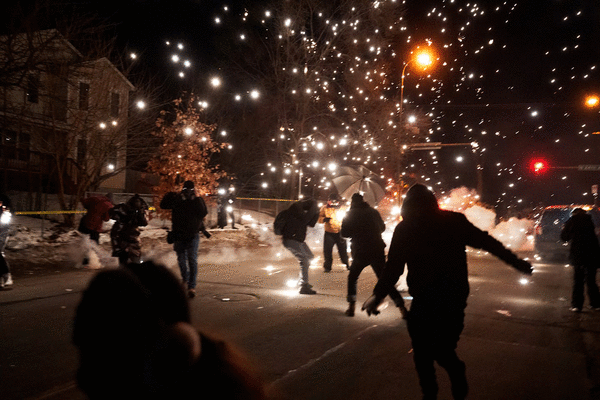
An ICE agent has been charged federally over his alleged actions tied to the shooting of a Venezuelan immigrant in north Minneapolis during Operation Metro Surge.
A federal grand jury indicted the agent, Christian Castro, but the charges remain under seal, according to people familiar with the indictment. One of those people confirmed that the charges are related to Castro’s false statements to law enforcement about his shooting of Julio Cesar Sosa-Celis on Jan. 14 in north Minneapolis.
The indictment comes one week after Castro was released from a Texas jail following a legal battle over Gov. Greg Abbott not signing extradition paperwork that would have returned Castro to Minnesota to face state charges.
The state of Minnesota sued Abbott, alleging that his delay was politically motivated and violated the U.S. Constitution. A federal judge rejected that argument, ruling that Minnesota could not put a timetable on Abbott’s decision to sign off on the extradition.
At the time that Castro was released, the federal case against him appeared to stall after an indictment seemed imminent last week, according to multiple people familiar with the situation. That included a sense that Castro was going to be charged with violating the civil rights of Sosa-Celis, which would have been the same charge that prosecutors levied against former Minneapolis police officer Derek Chauvin in the murder of George Floyd.
Frederick Goetz, the attorney who represented Alfredo Alejandro Aljorna, the roommate of Sosa-Celis who was also detained after the shooting in north Minneapolis, said earlier this week, “It appears that political considerations by high-level government officials in Washington have derailed the federal prosecution.”
In response, a Justice Department official said in a statement last week that the “Department has not yet reached a conclusion on this matter and will never rush an investigative process and the thorough review of all evidence.”
Messages seeking comment on the charges against Castro were left with the Justice Department and the Minnesota United States Attorney’s Office on Thursday.
The charges against Castro mark a significant decision by the Trump administration, which has largely stood behind federal agents throughout a massive surge in immigration enforcement across the United States during his second presidential term.
That support was initially extended to Castro.
In the immediate aftermath of the shooting, then-DHS spokesperson Tricia McLaughlin said Sosa-Celis and Aljorna “began to resist and violently assault the officer” and that Castro — whom they never identified — fired a defensive shot while on the ground because he feared for his life.
Castro’s statements led federal officials to charge Sosa-Celis and Aljorna with assaulting a federal officer. Trump administration officials widely publicized their mug shots and former Department of Homeland Security Secretary Kristi Noem accused them of “attempted murder.”
Gabriel Alejandro Hernandez-Ledezma, a third man who lived in a different part of the duplex and had nothing to do with the situation, was publicly identified as attacking the officer and sent to Texas. He was detained for weeks without charges. Two women in the home, who had no criminal record and were never accused of a crime, were shackled and sent to a Texas detention facility where they remained for two weeks, separated from their two small children.
That initial narrative unraveled when security footage of the shooting from a Minneapolis street camera was turned over to the BCA and the federal charges against Sosa-Celis and Aljorna were dropped at the request of federal prosecutors.
That evidence led Hennepin County Attorney Mary Moriarty to charge Castro with four felonies for firing into the home and striking Sosa-Celis in the leg before the bullet ultimately lodged in the wall of a child’s bedroom.
Castro was arrested on May 29 by the Texas Rangers, with members of the Minnesota Bureau of Criminal Apprehension present.
He was held in a Cameron County jail near the Mexico border for 90 days. During that time, Minnesota officials made multiple attempts to convince Abbott to sign extradition paperwork to bring Castro to Minnesota. That process, Minnesota officials alleged in a federal lawsuit, was administrative and had never required such a lengthy delay.
Abbott argued that it was unclear if Castro was actually a fugitive from justice and also noted that a federal investigation into his conduct was ongoing.
_____
©2026 The Minnesota Star Tribune. Visit startribune.com. Distributed by Tribune Content Agency, LLC




Comments