Trump pushes 2030 census to exclude immigrants, not ask about race
Published in News & Features
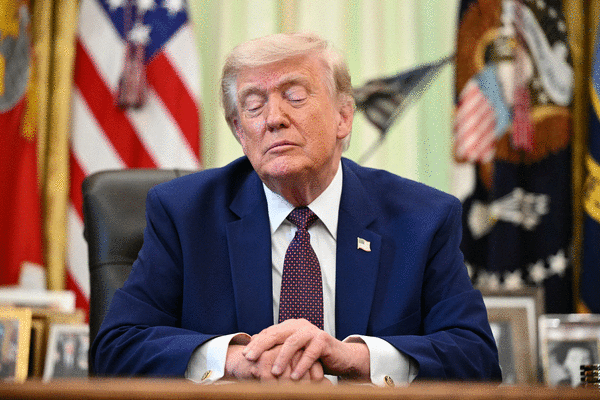
The Trump administration Wednesday unveiled proposed new rules for the census that would order the national count to exclude undocumented immigrants and not ask about race, ethnicity or sexual orientation.
The proposals, which would likely face fierce objections and legal challenges, aims to reshape the once-a-decade count of people living in America starting with the 2030 census, with widespread impacts on government spending and political representation.
The most significant change would call for the census to only count legal permanent residents, excluding millions of undocumented immigrants and other immigrants who do not have green cards.
Critics say that shift would appear to be a clear violation of the constitution, which says the census must count the “whole number of persons in each State,” and makes no reference to their legal status.
The census would also scrap questions about race and ethnicity that it has included since 1790 and some about same-sex relationships that it recently added.
If implemented, the changes could have a dramatic impact on political representation because one of the most important uses of the census is to divvy up the 435 seats in the House of Representatives according to the population figures it finds in each state.
Excluding many immigrants could result in an undercount of people in Democratic states with higher concentrations of immigrants, although it could also result in lower counts in Texas and Florida, the two biggest red states.
The lower count would also lead to immigrant-heavy states receiving less federal aid because funding for most government programs are determined by state population as determined by the census.
New York Attorney Gen. Letitia James slammed the proposals and vowed to defeat them in court.
“The Constitution is clear. Every person living in the United States, regardless of immigration status, must be counted in the census,” James said in a statement.
The new proposals to stop asking about race, ethnicity and sexual orientation would have less direct and immediate impact but would also be far-reaching.
Without reliable figures about which racial and ethnic groups live where, it would be far more difficult to create congressional and state legislative districts to reflect those groups’ share of the overall population.
Researchers also use racial breakdowns for countless economic, health and social studies because they are among the most trusted independent data sources.
President Donald Trump’s Commerce Department framed the proposed shifts as a return to what the founding fathers intended the once-a-decade headcount to be.
“These proposals are intended to ensure fidelity to the Constitution, improve and protect the core decennial census data, and promote efficiency,” the draft rules say.
It says undocumented immigrants should be left out because “they are not true inhabitants, members of the body politic, or persons with a ‘usual residence’ in the United States.”
_____
©2026 New York Daily News. Visit nydailynews.com. Distributed by Tribune Content Agency, LLC.






Comments