Census overhaul proposed by Trump administration could reshape Congress
Published in News & Features
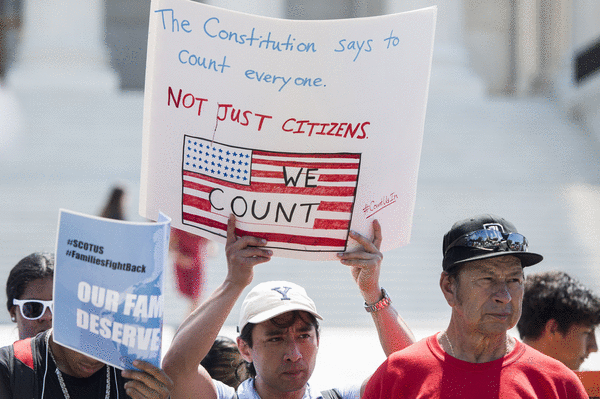
WASHINGTON — The Trump administration proposed on Wednesday to exclude undocumented and temporary immigrants from the data used to apportion House seats after the 2030 census, continuing a push from his first term.
The changes, coupled with reducing the demographic data collected about Americans, could mean shifts in congressional seats among states after the 2030 count. The proposed rule, set to be published in the Federal Register Thursday, would exclude undocumented immigrants and those without permanent legal status, commonly known as a green card, from the data used to apportion congressional seats among states after the upcoming census.
The rule argues that the Constitution, which requires counting the “whole number of persons” in each state, meant that “illegal aliens (among others) should not be included in the apportionment count, as they are not true inhabitants, members of the body politic, or persons with a ‘usual residence’ in the United States due to their lack of a sufficient tie and allegiance to the United States.”
The proposal also contemplates adding a citizenship question to the census questionnaire — echoing an effort from Trump’s first term that sparked a major court fight — in order to exclude noncitizens from the count.
Additionally, the proposal would reduce the demographic information collected about Americans’ race and ethnicity — data that is frequently used to prove racial discrimination in redistricting, among other uses by the federal government.
The proposed rule will likely draw legal challenges, as well as fights in Congress over its implementation. In Trump’s first term, Democrats sought to add amendments to spending legislation to stop the use of a citizenship question on the census.
Before the end of his first term, Trump launched a last-minute effort to exclude undocumented immigrants from apportionment in the 2020 census. That included a fast-moving court fight that went up to the Supreme Court.
However, delays stemming from the coronavirus pandemic caused apportionment to be delayed into the Biden administration, which dropped Trump’s effort.
“We stopped the Trump administration’s census attacks in 2020, and we’re exploring our legal options to fight back again,” New York Attorney General Letitia James posted Wednesday on social media.
Trump has publicly pushed the effort in his second term, including in a Truth Social post last year arguing for a new mid-decade census.
“People who are in our Country illegally WILL NOT BE COUNTED IN THE CENSUS,” Trump posted.
Republicans in several Southern states have pursued the exclusion of undocumented immigrants from apportionment for decades, including in Congress.
In 2024, House Republicans passed a bill that would exclude noncitizens entirely from apportionment. Sen. Bill Hagerty, R-Tenn., sponsored a Senate bill that would exclude undocumented immigrants from the apportionment for the 2030 census.
In 2020 the Pew Research Center estimated that excluding undocumented immigrants from apportionment would have impacted the distribution of three House seats; California, Florida and Texas may have lost seats to the benefit of Alabama, Minnesota and Ohio.
A 2025 study published in Proceedings of the National Academy of Sciences Nexus found that at the national level the exclusion of undocumented immigrants would have a roughly neutral effect on House control and the Electoral College since 1980.
Neither estimate took into account the impact of excluding legal, temporary immigrants from apportionment.
_____
©2026 CQ-Roll Call, Inc., All Rights Reserved. Visit cqrollcall.com. Distributed by Tribune Content Agency, LLC.





Comments