Coloradans were exposed to radiation for decades. Now Congress might make them eligible for compensation.
Published in News & Features
DENVER — New legislation in Congress would make Coloradans who became ill after living near two of the state’s nuclear sites eligible for tens of thousands of dollars in federal compensation.
A proposed expansion of the 1990 Radiation Exposure Compensation Act would recognize the Cotter uranium mill near Cañon City and the former Rocky Flats nuclear weapons plant northwest of Denver as Manhattan Project waste sites.
The designation would open the door for people who live or have lived in 57 zip codes near the sites — and who developed certain illnesses — to apply for reimbursement for medical expenses as well as a separate payment of $150,000.
The bill would also designate Colorado as a “downwinder” state from nuclear weapons testing conducted in Nevada in the 1950s and 1960s. Winds carried radiation hundreds of miles from the open-air tests, exposing thousands of unknowing people to nuclear fallout. People who lived in Colorado during that time frame and who developed illnesses like leukemia and breast cancer could be eligible for restitution if the bill passes.
Rep. Brittany Pettersen, the Democrat representing Colorado’s 7th Congressional District, is one of the lawmakers leading the bipartisan Radiation Exposure Compensation Reauthorization Act of 2026, which was introduced last month. Her district includes both Rocky Flats and the Cotter uranium mill. The bill would also expand compensation eligibility to sites in other states connected to the country’s nuclear program, like Ohio’s Portsmouth Gaseous Diffusion Plant.
Pettersen pursued the legislation after repeatedly hearing from constituents who had lost family members or were ill but did not qualify for compensation, she said.
“It’s a huge step for Coloradans and their loved ones who have been impacted by radiation illnesses,” she said.
Along with money, the bill would offer recognition of the harm inflicted on generations of residents who lived near the two Colorado nuclear sites, community members said.
“It could finally mean recognition and compensation for the damage we have suffered down here,” said Jeri Fry, a co-chair of Colorado Citizens against Toxic Waste, a nonprofit dedicated to educating people about the Cotter site and advocating for the surrounding community.
For more than 30 years, the federal government built parts for nuclear weapons at Rocky Flats, located 16 miles from Denver and tucked into the edge of the city’s northwest suburbs. Workers at the factory used plutonium to build triggers and other components for the military’s nuclear warheads during the Cold War.
Contaminated waste from the site seeped into the soil, flooded into nearby creeks and traveled downwind, eventually prompting a 1989 federal investigation into violations of environmental laws that halted operations at the plant.
Decades later, public memory of the site’s environmental and public health impact is fading, said Tiffany Hansen, director of the nonprofit Rocky Flats Downwinders. The bill not only promotes wider awareness of long-term consequences from the site but also offers long-sought recognition, she said.
“There’s finally some acknowledgement that people have been impacted by living by Rocky Flats,” she said.
Federal officials declared the site cleanup complete in 2005, some sections of it have been rechristened the Rocky Flats National Wildlife Refuge. But residents still worry about plutonium levels in the soils. In 2017, two of the site’s private-sector operators paid a $375 million settlement to 7,500 households based on lost home value after plutonium released from the site was carried downwind to a swath of Broomfield, Westminster and Arvada.
Rocky Flats Downwinders for years has collected stories of people who became sick after living near the site. One woman who lived in Arvada from 1977 to 1991 said both of her sisters developed thyroid cancer. Her father, two uncles and brother-in-law died of cancer.
“Compensation can never undo the loss and pain we have endured, but recognition and support would bring a measure of long-overdue justice,” Stephanie Dalton said in a collection of stories about the impact of the site.
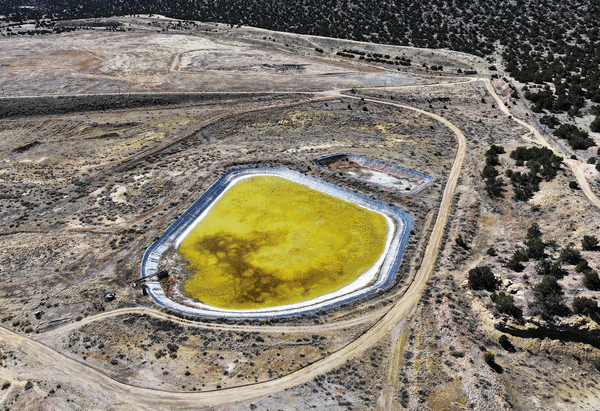
The Cotter Corp. — a Denver-based subsidiary of General Atomic — opened the Cañon City uranium mill in 1958. Along with the waste from its own production, the site was used to store radioactive waste from the Manhattan Project’s creation of the atomic bomb.
The waste leaked into the soil and water for decades. The company closed the mill permanently in 2011, but 5.8 million tons of radioactive waste remain at the site just south of town. For decades, bureaucracy and a series of corporate bankruptcies have stalled cleanup efforts.
Pettersen and Sen. Michael Bennet on Friday penned a letter to the head of the U.S. Environmental Protection Agency, urging transparency and progress on cleanup in Cañon City.
“Many community members have spent decades advocating for the remediation of this site, and they deserve clear information about when they can expect meaningful progress,” the lawmakers wrote.
In the void of government action, Fry and others with Colorado Citizens against Toxic Waste decided to pursue their own studies and tests. This summer, the group began providing free water testing so residents can see if their well water contains heavy metals and radionuclides. Testing for such materials is expensive — up to $500 per sample — and out of reach for many, Fry said.
“That’s the kind of help that the government should give us after they contaminated us,” Fry said. “But they’re not going to.”
The new bill, which is co-sponsored by Rep. Joe Neguse, would also extend the deadline to file for payment to 2042. If the bill does not pass, the application closes on Dec. 31, 2027.
Fry commended the extension but added that the law needs to be in place for as long as the United States continues to pursue nuclear development.
Nuclear contamination can last millions of years, she said.
“It’s in our environment, and because it lasts so long and gets resuspended, or carried, or dug up, it doesn’t mean it goes away,” Fry said. “It’s traveling in ways we don’t even know, deeper into our environment.”
©2026 MediaNews Group, Inc. Visit at denverpost.com. Distributed by Tribune Content Agency, LLC.






Comments