Gary Peters to direct USC politics center in post-Senate role
Published in News & Features
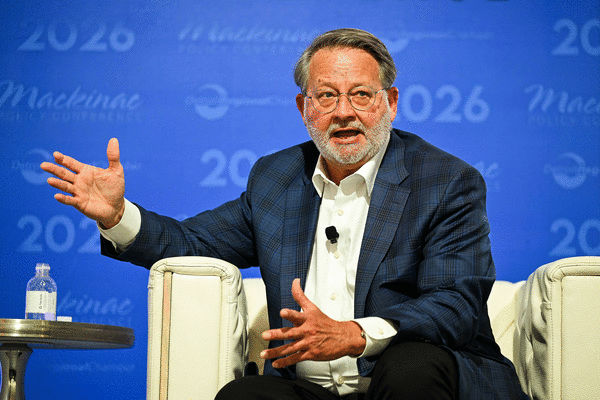
WASHINGTON ― Retiring Michigan U.S. Sen. Gary Peters said he has accepted a position as the new director of the Center for the Political Future at the University of Southern California, beginning after his term ends in January.
The Bloomfield Township Democrat will also be appointed the Carmen H. and Louis Warschaw Endowed Chair in Practical Politics; a professor of the practice of political science and international relations at the university; as well as the director of the Jesse M. Unruh Institute of Politics, he said.
Peters, 67, is leaving Congress in January after 18 years, having served two terms in the Senate and three in the U.S. House. He opted not to run for a third six-year term in the Senate, leaving his seat in battleground Michigan up for grabs this fall.
USC's Center for the Political Future has been jointly led by a Democrat and a Republican since its founding in 2018. Its mission is focused on bringing political leaders and strategists to USC "to engage students and foster civil dialogue."
Peters said the private university approached him and that he was drawn to the role in part because of its goal of reining in the polarized environment around U.S. politics.
"You've seen it. It's hyperpartisan. Even in the time that I've been there, I've been very successful working with folks across the aisle and getting things done. But every single year, it gets harder and harder," Peters said of Congress.
"The people who are interested in coming together and working in a bipartisan way and actually getting things done, when they leave Congress, they unfortunately tend to be replaced by people who are more polarizing, both on the left and the right. And so we've got to try to reverse that if we can."
Peters will take the place of the center's founding director, Robert Shrum, who is retiring. Peters will work in the new role with long-time Republican strategist and Detroit native Mike Murphy, the center's co-director.
"The mission of what the center is, how do we find common ground to solve the tough problems we face, and how do we do it in a bipartisan way?" Peters said. "So I'm looking forward to working with Mike, and the fact he has Michigan roots is great."
Peters insisted he isn't leaving Michigan, though his new teaching gig will require time at the USC campuses in both Los Angeles and Washington, D.C. "Colleen and I will continue to live and work in Michigan, too," he said, referring to his wife.
"I'll probably be flying from L.A. to D.C. and then swinging back through Michigan to see the family," he said. "I'll be here in Michigan a lot during the summer."
Peters said he aims to expand the Center for Political Future's presence in Washington using USC’s Capital Campus for courses and programs that link students with policymakers and the like. The university's D.C. building is near Dupont Circle.
“Gary Peters brings an extraordinary combination of public service, bipartisan leadership and real experience getting things done in Washington,” James Bullock, dean of the USC Dornsife College of Letters, Arts and Sciences, said in a statement.
“He has spent his career showing that you can hold strong political convictions and still work productively with people who see the world differently. I’m especially excited about what his leadership will make possible for our students, both in Los Angeles and in Washington.”
For Peters, a former state senator and lottery commissioner, his new job is a return to academia. Peters was working on his doctorate in political philosophy at Michigan State University when he put it on hold to run for Congress in 2007, he said.
At the time, he was a part-time professor of American government at Central Michigan University. He previously taught management and business policy at Oakland University and finance at Wayne State University, he said.
Peters holds advanced degrees from the University of Detroit Mercy, Wayne State University and MSU, where he earned a master of arts degree in philosophy.
"I enjoy working with students, and I think it's even more important now than ever — so many young people are completely turned off by politics. They see it as incredibly toxic," he said.
"But ultimately, we're going to rely on the next generation to pick up the torch and work on solving the tough problems that we face as a country and as a planet. And so, I want to be actively engaged in helping students acquire the tools that they need to be successful and understand how important political advocacy is, regardless of whether or not they're going to do it professionally."
_____
©2026 The Detroit News. Visit detroitnews.com. Distributed by Tribune Content Agency, LLC.





Comments